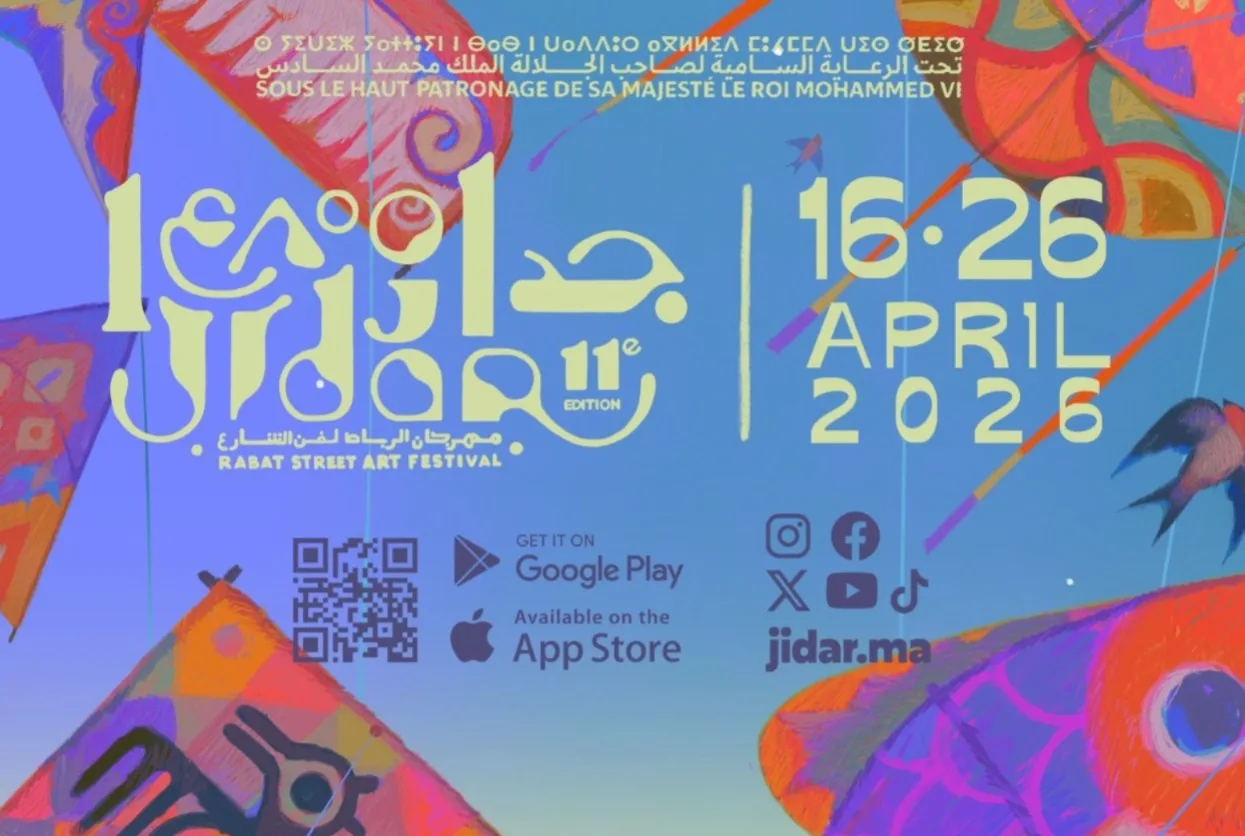
Lugano – The 11th edition of the Jidar Rabat Street Art Festival is set to take place from April 16-26, celebrating over a decade of artistic exchange in the heart of Morocco’s capital.
With a diverse program of murals and cultural activities, the festival offers a unique experience where art becomes part of everyday urban life, turning Rabat’s walls into powerful visual storytelling spaces.
Throughout the event, internationally renowned and emerging street artists will create large-scale murals across the city, blending contemporary techniques with cultural influences from around the world.
Among the featured artists is Keya Tama, a South African artist based in New York, displaying his minimalist visual language mural inspired by ancient iconographies and modern folklore.
His mural can be found at Avenue Al Mohit Al Hadi, Résidence Garde Royale in Yacoub El Mansour.
Spanish artist Guillem Font also joins the lineup, bringing a practice shaped by travel between Barcelona, Mexico City, and beyond.
His detailed work reflects humanity’s growing distance from nature and is located at the intersection of Avenue Tadla and rue Ouled Hassoune in El Youssoufia.
From Morocco, rising urban artist Rosh Roshdi marks a new milestone with his mural at the intersection of Avenue Al Ghazali and Avenue Hassan II in Agdal Riad.
He is joined by fellow Moroccan artist Rita Nosko, whose delicate and poetic scenes celebrate the beauty of everyday life.
Her work can be discovered at the intersection of Avenue Belhassan El Ouazzani and Avenue Ahmed Reda Gdira in El Youssoufia.
Also returning is Mizmiz, known for his distinctive graphic style and viral animations. This year, he will unveil a new mural at Avenue Fatouaka and rue Ouzguita in El Youssoufia.
Joining the Moroccan lineup, Reda RDS returns with a fresh creation that blends graffiti with architectural influences.
His mural is located at Maternité Souissi on Avenue Ibn Rochd in Agdal Riad.
These artistic interventions transform public spaces into open-air exhibitions, accessible to all, and invite residents and visitors to rediscover the city through a creative lens.
Side activities set to enrich the experience
A curated program of activities will be held in conjunction with the festival that promises to deepen engagement with urban art and its evolving practices.
Among the highlights is “JIDAR Talks,” a series of public discussions designed as spaces for dialogue and exchange.
Open to all, these sessions invite audiences to meet both emerging and established artists from Morocco and abroad.
Through conversations and interactive exchanges, participants gain insight into artistic careers, creative processes, and the inspirations behind urban art.
The talks also explore broader themes, including the relationship between street art, muralism, and institutional art, as well as the social and cultural dimensions of artistic expression in public spaces.
By fostering direct interaction between artists and audiences, “JIDAR Talks” contribute to a deeper understanding of contemporary urban art and its role in society.
Another key attraction is the “OUT/IN STREET ART,” a project that creates a dialogue between public space and gallery settings.
The program unfolds in three stages: a mural performance that experiments with unconventional surfaces, a gallery exhibition presenting smaller works connected to the outdoor intervention, and a public meeting that encourages discussion around artistic techniques and perspectives.
By bridging outdoor creation and indoor exhibition, the project highlights how street art can move beyond its traditional context while offering new ways to experience and interpret it.
The festival also includes “the Collective Wall,” a key initiative that serves as a platform for emerging mural artists in Morocco.
Running from April 20-26, the project brings together a group of pre-selected participants in a collaborative setting, where experienced artists guide them in co-creating a large mural while exchanging skills and creative perspectives.
Together, these initiatives reinforce Jidar’s mission to go beyond murals, creating a platform for reflection, learning, and exchange around the many dimensions of urban art.