Fez– As the final notes drifted into the night sky above Bab Al Makina, the 29th edition of the Fez Festival of World Sacred Music came to a close, ending four days that transformed Morocco’s spiritual capital into a crossroads of cultures, traditions and artistic expression.
Over the course of the festival, more than 160 artists from across Europe, Asia, Africa and the Middle East gathered in Fez, turning the city’s historic venues into spaces of encounter and exchange.
Through music, dance and poetry, performers invited audiences to travel across continents while exploring themes of spirituality, memory and shared humanity.
The journey began with “Anima Ex Materia: From Heaven to Earth”, an ambitious opening creation that celebrated the artisanal heritage of Fez.
Blending music, choreography and visual storytelling, the performance paid tribute to generations of craftsmen whose work has shaped the identity of the city.
It was a fitting introduction to a festival rooted in the idea that artistic creation can serve as a bridge between cultures and eras.
Throughout the following days, audiences were immersed in an extraordinary diversity of traditions.
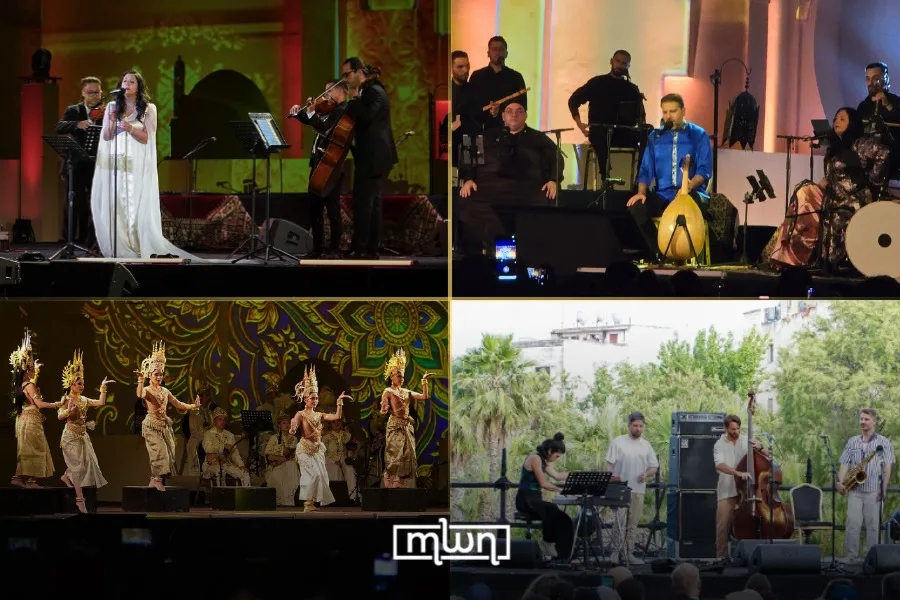
From the intimate folk melodies of Irish singer Niamh Bury to the sacred Khmer dances of Cambodia, each performance offered a distinct perspective on the relationship between art and spirituality.
The vast landscapes of Central Asia came alive through the Qulansaz Ensemble of Kazakhstan, whose music evoked the enduring traditions of nomadic peoples.
Elsewhere, L’Antidote brought together Iranian percussionist Bijan Chemirani, Lebanese pianist Rami Khalifé and Albanian cellist Redi Hasa in a remarkable dialogue between musical worlds, demonstrating the power of collaboration across cultural boundaries.
Among the festival’s most memorable evenings was “Hymns”: Voices of Women from East and West.
Bringing together Lebanese vocalist Ghada Shbeir, Moroccan singer Nabyla Maan, Indian classical star Kaushiki Chakraborty, Germany’s Kat Frankie and Bodies, and the women of Ahwach Isaffen from Morocco’s High Atlas, the performance celebrated the richness and diversity of female artistic expression.
Their voices moved effortlessly between sacred and traditional repertoires, creating one of the festival’s most powerful moments.
The festival also ventured into new musical territories.
Indian vocalist Pandit Shyam Sundar Goswami explored the poetic universe of ragas and Rabindranath Tagore, while French-Swiss saxophonist Léon Phal proposed a contemporary dialogue between ritual, spirituality and modern soundscapes.
Yet few performances generated as much anticipation as the return of Sami Yusuf.
Performing before a sold-out Bab Al Makina, the internationally acclaimed artist delivered one of the defining moments of this year’s festival.
Spectators travelled from across Morocco to attend the concert, filling the historic venue hours before the performance began.
The atmosphere was charged with excitement, and throughout the evening the audience responded with enthusiasm, transforming the concert into a collective celebration.
Blending spiritual reflection with musical virtuosity, Sami Yusuf once again demonstrated why his connection with the Fez Festival remains so enduring.
The standing ovations and emotional reactions from the crowd made the concert one of the highlights of the entire edition.
Later that night, Pakistani singer Sanam Marvi carried audiences deeper into the mystical traditions of Sufism.
Her powerful interpretations of devotional poetry provided a moment of contemplation and transcendence, extending a journey that had begun earlier in the evening.
The final day of the festival turned toward the great cultural routes that have linked civilizations for centuries. Tunisian musician Jasser Haj Youssef and Tanzanian singer Yahya Hussein Abdallah Bihaqi explored the poetic dimensions of the Sufi tradition, while “Songs of the Mountains and the Steppes” brought together artists from Mongolia, Uzbekistan and Kyrgyzstan in a celebration of the musical heritage of Central Asia.
The closing night offered a fitting conclusion.
“Sami Yusuf and the Night of Samaa” united the celebrated artist with Nabyla Maan, the Konya Metropolitan Sufi Music Ensemble and renowned Moroccan voices in a performance that embodied the festival’s spirit of dialogue and spiritual communion.
As music, devotion and tradition converged beneath the walls of Bab Al Makina, the festival concluded on a note of both celebration and reflection.
More than a succession of concerts, this year’s edition reaffirmed the unique place of the Fez Festival of World Sacred Music on the international cultural calendar.
The festival offered a rare space where artists and audiences could meet through beauty, listening and shared experience.
For four days, Fez became a stage for the world. And as the city returns to its familiar rhythm, the echoes of those encounters will continue to resonate long after the final applause.