Safi – Walk through any souk and “Moroccan necklaces” quickly stops being one thing.
The north works in gold, the south in silver. Some pieces are made to announce a bride, others to protect a newborn, and the same word can mean a different treasure two valleys away.
The material changes, the message changes, and both depend on where you are standing.
The lebba
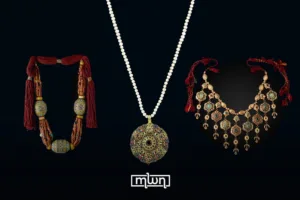
In the old imperial cities, the centerpiece is the lebba, a bib of gold openwork plaques set with emeralds, rubies, and pearls that spreads across the chest like a collar of light.
It serves as the centerpiece of the bridal set, traditionally paired with the taj, the matching diadem.
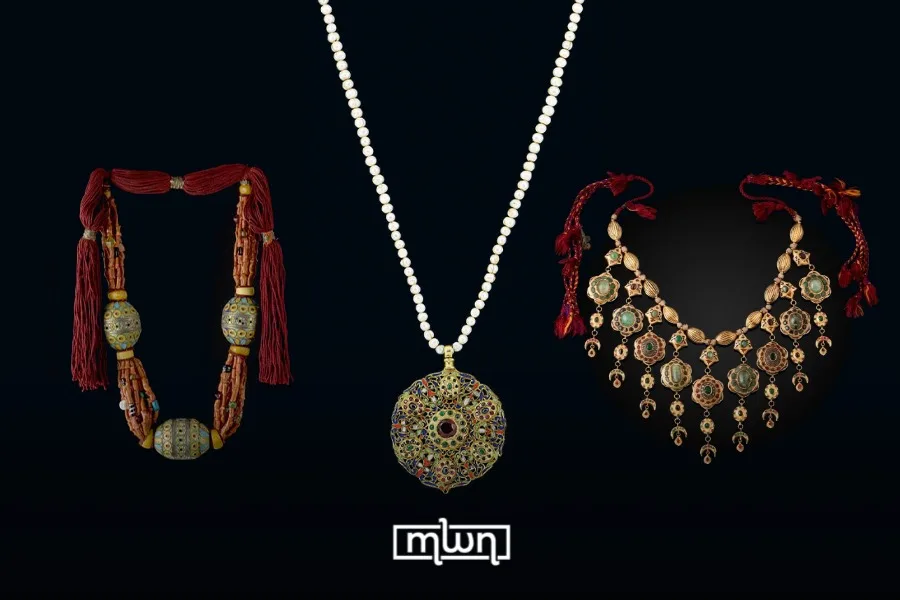
A classic early-20th-century Tetouan necklace reflects this design language: three rows of finely chiseled gold, threaded with filigree beads and seed pearls, and adorned with rubies and emeralds.
The jouhar
The city pearl necklace, known as “jouhar,” takes its name from the ancient word for pearls themselves.
Typically composed of rows of delicate seed pearls, sometimes woven into multi-strand ropes, it has adorned urban brides for generations.
Its name still carries meaning in the souk today: ask for el-jouhar el-horr, meaning “genuine pearl,” and any jeweler will immediately understand.
Fez gold at full scale: the tazra
The “tazra” is a gold chest ornament traditionally crafted for young women in Fez and set with colored precious stones.
Its classic form is a wide oval, tapering to points at both ends, decorated with small rosettes surrounding a central motif, and topped with a row of solid gold beads.
It is jewelry in its most architectural expression, designed to carry the weight of a wedding.
Ttagmout
At the center of many southern necklaces sits the tagmout, a hollow silver globe, engraved and enameled in green, yellow, and blue.
It is a fertility talisman as much as an ornament, and its home is Tiznit, the silver capital of the south, where the bead is still made by hand.
Atlas amber: The heirloom strand
In the mountains, amber is wealth you can wear. Strands of large, graduated amber beads, spaced with silver, were prized for protection and good health, and they pass from mother to daughter like property.
They come out for weddings and naming celebrations, growing glossier with every generation that wears them.
The marjan
Coral threads through necklaces across Morocco’s south and coasts, as branches or polished beads mixed with silver.
Generations have worn it for protection and well-being, a small guarantee of health carried close to the skin. A few beads are enough; the color does the work.
Abroad, all of this tends to be sold under one label, “Moroccan jewelry.” Inside Morocco, a necklace places you.
It can tell you the city a woman comes from, the occasion she is dressed for, and what she carries it for.