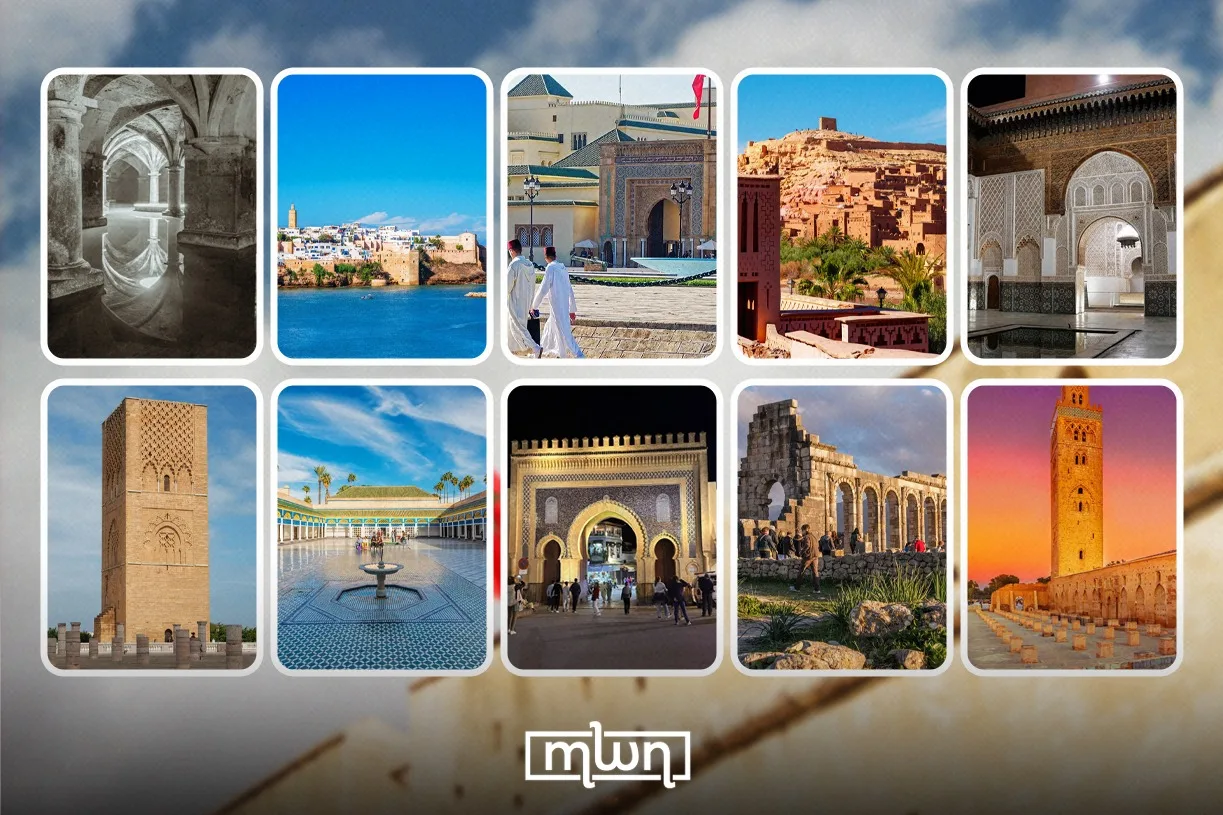
Rabat – Moroccan architecture is not defined by one visual language. Across the country, centuries of Islamic, Amazigh, Andalusian, Saadian, Alaouite, and European influences have shaped everything from royal palaces and religious monuments to fortified kasbahs and modernist buildings.
What makes the country particularly interesting for architecture lovers is the contrast between its regions.
In the south, rammed earth and adobe create monumental kasbahs that seem to emerge from the landscape.
In the imperial cities, carved stucco, zellige, cedar wood, and geometric patterns dominate historic buildings.
In Casablanca, meanwhile, Moroccan craftsmanship meets modern architectural ideas.
For architects, students and anyone interested in the built environment, these are some of the Moroccan sites worth putting on the list.
Hassan Tower – Rabat
In Rabat, an unfinished medieval project has become one of Morocco’s most recognizable monuments.
The Hassan Tower was intended to serve as the minaret of a vast mosque commissioned by Almohad ruler Yaqub al-Mansur in the late 12th century.
Construction stopped after his death, leaving the tower surrounded by the remains of the original mosque.
Its monumental proportions and geometric design reflect the architectural ambitions of the Almohad period. The complex is now part of Rabat’s UNESCO-listed historic heritage.
Bahia Palace – Marrakech
Rather than relying on monumental height, Bahia Palace makes an impression through its sequence of courtyards, gardens, and richly decorated interiors.
The palace began taking shape in the 1860s under Si Moussa and was substantially expanded by his son, Ba Ahmed, toward the end of the 19th century.
The rooms are arranged around courtyards and gardens, creating a layered transition between private rooms and open spaces.
Painted cedar ceilings, carved stucco and zellige provide much of the palace’s visual identity.
Bou Inania Madrasa – Fez
Built between 1350 and 1355 under Marinid Sultan Abu Inan Faris, Bou Inania is one of Fez’s most important examples of Marinid architecture.
It is also unusual among Moroccan madrasas because it functioned as both a school and a congregational mosque.
Its decoration brings together zellige, carved stucco, cedar wood, and brickwork in a highly detailed composition.
Bab Boujloud – Fez
One of Fez’s most photographed entrances, Bab Boujloud provides a striking introduction to the city’s historic medina.
The current gate dates to the early 20th century, when the French administration created a new entrance through the city’s walls.
Its blue-and-green zellige decoration has since become closely associated with the gateway.
It is also a useful example of how newer architecture can become visually intertwined with an older historic city.
Read Also: Bahia Palace in Marrakech: A Masterpiece of Moroccan Architecture and History
Dar al-Makhzen – Rabat
Rabat’s Royal Palace, known as Dar al-Makhzen, is more than a single monumental building, comprising courtyards, gardens, ceremonial spaces, and administrative buildings.
The palace was developed as a royal complex over successive periods and has been an Alaouite royal residence.
Its layout combines formal public areas with more private spaces, following the long-established organization of Moroccan palace architecture.
Because the complex remains an active royal residence, much of it is not open to the public.
Nevertheless, its scale and organization offer an example of how traditional Moroccan palace architecture continues to function within the country’s modern capital.
Madrasa Ben Youssef – Marrakech
The Madrasa Ben Youssef is one of Marrakech’s clearest examples of how architecture can organize an entire institution around a central space.
The historic madrasa is arranged around a large courtyard with a reflecting pool, with student rooms distributed across its upper and lower levels.
Small secondary courtyards create additional pockets of space throughout the complex.
Its architecture combines carved stucco, zellige, cedar wood, and carefully controlled natural light, creating a dramatic contrast between the relatively restrained entrance and the expansive central courtyard.
Volubilis – Near Meknes
Long before the architecture of Morocco’s imperial cities took shape, Volubilis reflected the country’s Roman past.
The archaeological site contains the remains of a Roman-era city, including temples, basilicas, monumental arches, and residential buildings decorated with mosaics.
The site later became associated with the early Idrissid state, adding another layer to its history.
Today, Volubilis offers something very different from Morocco’s Islamic monuments: an opportunity to see Roman urban planning and architecture within the Moroccan landscape.
Koutoubia Mosque – Marrakech
The Koutoubia Mosque is one of Marrakech’s defining landmarks and one of the best-known examples of Almohad architecture in Morocco.
Built during the Almohad period in the 12th century, its square minaret rises about 77 meters above the city and is distinguished by its restrained geometric decoration and proportions.
The minaret became an important reference for later architecture in the western Islamic world.
Its design also belongs to the same broader Almohad architectural tradition as Rabat’s Hassan Tower and Seville’s Giralda, reflecting the connections between cities that came under Almohad rule.
Kasbah of the Udayas – Rabat
Perched above the Bou Regreg River, the Kasbah of the Udayas combines defensive architecture with the intimate scale of a historic residential quarter.
Founded during the Almohad period and expanded over subsequent centuries, the kasbah is enclosed by massive defensive walls and entered through the monumental Bab Oudaia.
Inside, narrow streets and white-and-blue houses create a distinct urban environment shaped by successive periods of settlement.
The site also contains an Andalusian-style garden, a later addition rather than a medieval feature.
Together, the fortified walls, residential streets, and garden illustrate the different layers that have shaped the kasbah over time.
Aït Ben Haddou – Ouarzazate
Aït Ben Haddou is one of Morocco’s best-known examples of pre-Saharan earthen architecture.
The UNESCO-listed ksar consists of clustered earthen buildings, defensive walls, corner towers, and narrow passageways, forming a dense fortified settlement rather than a single monumental structure.
Located along a historic commercial route linking the Sahara with Marrakech and beyond, the ksar reflects traditional building techniques adapted to the region’s environment.
While the settlement has much older roots, UNESCO notes that the oldest surviving structures do not appear to date earlier than the 17th century.
Aït Ben Haddou has also gained international recognition through its appearances in numerous films and television productions.
The Medina of Meknes
Rather than focusing on one building, Meknes itself can be approached as an architectural project.
The imperial city developed substantially under Sultan Moulay Ismail in the 17th and early 18th centuries, with monumental gates, defensive walls, palaces, granaries, and religious buildings forming part of a larger urban vision.
Bab Mansour, in particular, is known for its monumental proportions and elaborate tile and carved decoration.
The Portuguese Cistern – El Jadida
The Portuguese Cistern in El Jadida is one of the most distinctive surviving structures from the city’s Portuguese past.
Built as part of the fortified Portuguese settlement of Mazagan, the cistern dates to the 16th century and consists of a large vaulted underground chamber supported by stone columns and arches.
Its shallow layer of water reflects light across the vaulted interior, creating the dramatic visual effect for which the site is known.
The cistern forms part of the historic Portuguese City of Mazagan, a UNESCO World Heritage site that reflects the military and architectural influence of Portuguese expansion along Morocco’s Atlantic coast.
Read Also: Zagora’s Architecture: A Window into the ‘Ksor’ of Southern Morocco