Morocco Adds 20th Century Casablanca Buildings to National Heritage List
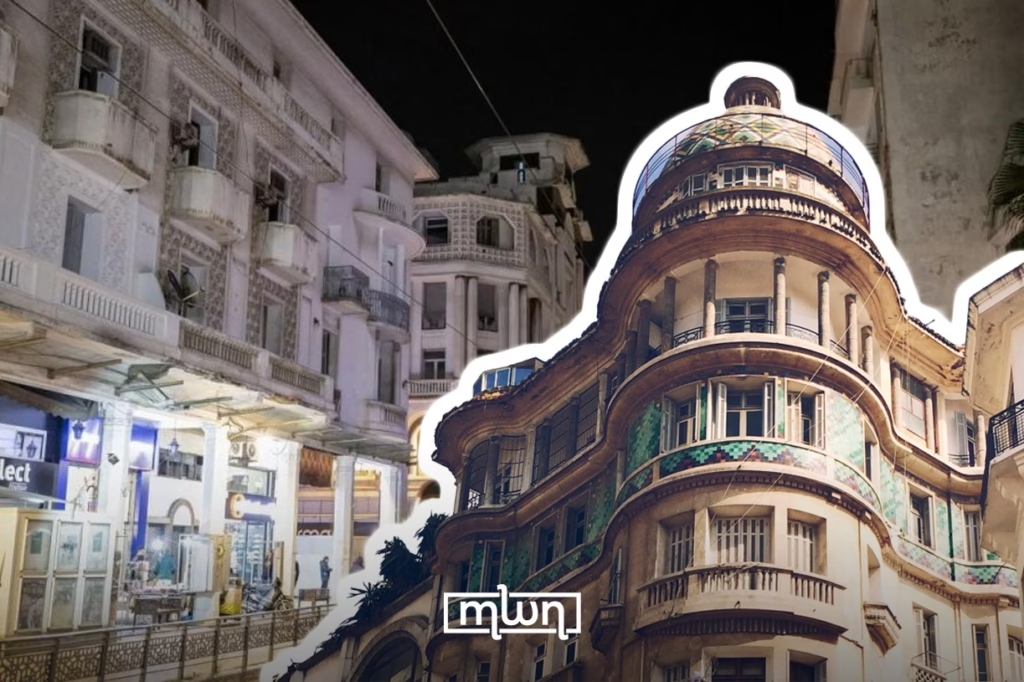
A wave of the city’s 20th-century buildings has been granted protected status by Morocco’s Ministry of Culture. Fez – Casablanca is finally recognizing the value of its modern architectural heritage. In a long-awaited move, Morocco’s Ministry of Culture and Sports has officially added several 20th-century buildings in the city to its list of historical monuments, signaling a major shift in how the nation preserves its urban legacy. More than just concrete and design, these structures are living markers of a century defined by colonial influence, post-independence ambition, and rapid economic evolution. They tell the layered story of a city in constant transformation; complex, bold, and unapologetically modern. For too long, these structures stood in the shadow of more “classical” heritage sites; medinas and imperial palaces. But this new classification pushes back against that selective memory, affirming that modern history, too, has its place in the national narrative. Under Moroccan heritage law, any building officially classified as historic comes under strict protection. Owners must now seek approval from the Ministry of Culture at least six months before starting any modification work. This isn’t just red tape; it’s a mechanism designed to safeguard the architectural integrity of spaces that are often at risk of demolition or reckless renovation. It’s a message to developers: progress doesn’t mean wiping the slate clean. This shift matters for more than just preservation, it reframes how Casablanca presents itself to the world. Known primarily as Morocco’s business hub, the city is now making room for another identity: that of a cultural destination with a rich and layered urban fabric. From Art Deco façades to modernist experiments, these buildings add a new chapter to the Moroccan story, one that moves beyond the clichés of exotic souks and ancient kasbahs. It’s also a smart move in terms of cultural tourism. By expanding its heritage offerings beyond the usual suspects, Morocco is opening the door to niche audiences, urbanists, architects, design lovers, who are eager to explore the lesser-known corners of its cities. For Casablanca, this could mean renewed interest in neighborhoods that have been overlooked, or even forgotten. With the right investment and vision, these architectural relics could help revive parts of the city center, turning them into vibrant cultural hotspots. But above all, this recognition is a form of respect for the people who lived, built, and dreamed within these walls. It signals that memory doesn’t only belong to the distant past. Sometimes, it’s the concrete, glass, and steel of the recent century that carries the heaviest weight. And now, finally, Casablanca’s modern legacy is getting its due.
Casablanca for Architecture Lovers: A City of Layers, Lines, and Surprises
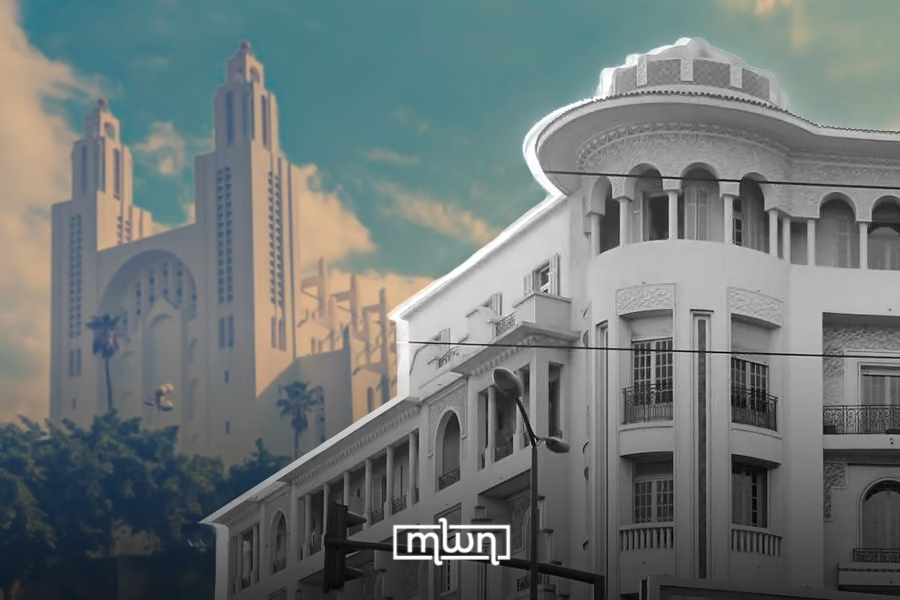
Casablanca is what happens when centuries of style collide and somehow make it work, and we’re going to dive into its origins. Fez – Casablanca isn’t the kind of city that unveils itself all at once. It’s not a postcard, it’s a blueprint, drawn and redrawn over centuries. And if you’re into architecture, it’s a dream with cracked edges and unexpected brilliance. Think soaring minarets, faded art deco, 1950s cinemas, space-age skateparks, and a mosque that juts out into the Atlantic like it owns the sea. It all started with Anfa, the Amazigh town the Portuguese wiped out in 1468. They returned to rebuild it as “Casa Branca”. Then the 1755 Lisbon earthquake brought everything crashing down again, and the sultan decided to start fresh with a medina of whitewashed walls. The Spanish began calling it “Casablanca”, and the French later turned it into a full-blown business hub. Cue the art nouveau facades, neo-Moorish arches, and eventually the sleek concrete experiments of Jean-François Zevaco, the architect who helped define post-independence Morocco. Today, the city’s layers are still alive and well. Start with Boulevard Rachidi, where Islamic motifs wrap around colonial symmetry. The post office, the Palais de Justice, and the ghostly-white Sacré Coeur cathedral feel frozen in time; elegant, if a little haunted. Then head to Quartier Habbous for a different mood: low-slung buildings, hand-carved doors, and pastry shops like Pâtisserie Bennis Habous, where “Kaab Ghazal” (gazelle horn cookies) come stacked like edible sculptures. Down by the ocean, the Hassan II Mosque dominates the skyline : emerald tiles, 210-meter minaret, and waves crashing just below your feet. For a deeper dive into Casablanca’s architectural timeline, Casamémoire offers excellent guided tours through the city’s 20th-century landmarks. Casablanca’s not just old bones, though. In the Petit Paris district, retro gems like Cinema Rialto and the Lutetia Ciné-Théâtre are back in action, hosting events that echo the city’s cinematic golden age. Nearby, the revamped Royal Mansour Casablanca hotel nods to its 1950s heritage with style. As for the city’s young heartbeat? You’ll find it in Anfa Park or the Arab League Gardens, where teenagers gather between music festivals like Jazzablanca and L’Boulevard. Around Villa des Arts, breakdancers spin beneath palm trees, while murals along the Corniche promenade go full sci-fi. Nevada Skatepark, one of Africa’s biggest, adds its own visual punch, with bold street art layered across ramps. When hunger strikes, head to the medina for fresh fish sandwiches or date-stuffed sweets. For something more refined, Dar DaDa and Saveurs du Palais serve the kind of Moroccan comfort food that lingers in your memory. Want to learn the recipes? Book a market tour and cooking class with “Taste of Casablanca” tours. Casablanca isn’t for everyone. But for architecture lovers? It’s a playground that is chaotic, evolving, and absolutely worth exploring. Read also: Abdel Halim Hafez’s Family Denies Hologram Concert at Mawazine
China’s Most Famous Replicas
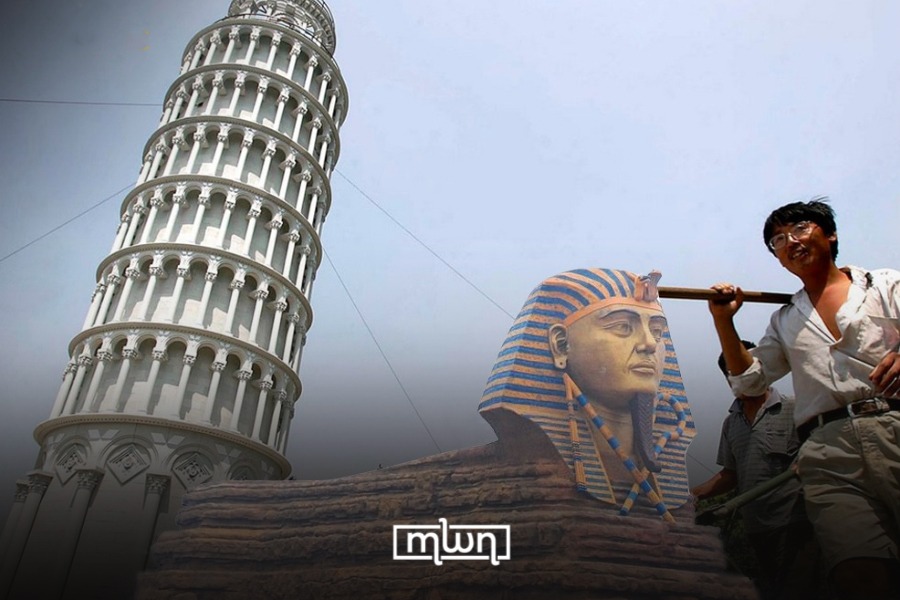
If imitation is the sincerest form of flattery, then one country might just be the biggest fan of world architecture. Fez – China has become known for replicating famous landmarks from around the world. These copies range from architectural marvels like the Sydney Opera House to historical monuments like the Colosseum. Some of these replicas serve as entertainment attractions, while others function as government buildings or residential areas. While some criticize these replicas as inauthentic imitations, architecture has always borrowed elements from different cultures. For example, the White House in Washington, DC shares similarities with the Irish Parliament in Dublin, which was influenced by Roman architecture. Here are eight of the most famous replicas found across China: ‘The White House’ – Hangzhou In Hangzhou, businessman Huang Qiaoling built an exact copy of the US White House, complete with an Oval Office and a gallery of American presidents. His estate also features mini versions of Mount Rushmore and the Washington Monument. This replica has become a tourist attraction, even drawing a visit from former US President George W. Bush in 2002. ‘The Great Sphinx of Giza’ – Chuzhou, Anhui Province For thousands of years, Egypt’s Great Sphinx stood alone. That changed when a full-scale replica appeared in an entertainment park in Chuzhou, China. This modern version of the iconic monument has drawn both admiration and controversy. Austria’s ‘Hallstatt’ – Huizhou, Guangdong Province The town of Hallstatt in Austria, a UNESCO World Heritage site, is known for its stunning lakeside scenery. In 2012, a Chinese corporation spent $1 billion to create a near-exact replica in Huizhou, complete with European-style houses, cobblestone streets, and a church modeled after the original. ‘The Kremlin’ – Beijing, Mentougou District Beijing’s Mentougou district is home to a building that closely resembles Moscow’s Kremlin. The Chinese version serves as a government office, and houses departments like the local weather bureau. The project had a price tag of approximately 9.34 million yuan (USD 1.54 million). ‘The Colosseum’ – Macau Macau, China’s only city where gambling is legal, features a replica of Rome’s renowned Colosseum. Located in the Fisherman’s Wharf amusement park, the structure is not a full-scale copy but still captures the essence of the ancient Roman arena. ‘Chateau Maisons-Laffitte’ – Beijing Originally designed by French architect François Mansart in the 17th century, the Chateau Maisons-Laffitte now has a Chinese twin. The Beijing version, known as the Chateau Laffitte Hotel, blends European elegance with modern luxury. ‘Karnak Temple’ – Wuhan, Hubei Province Egypt’s Karnak Temple, one of the world’s most famous ancient sites, has an unexpected twin in Wuhan. This replica stands inside Wanguo Park, an abandoned theme park intended to showcase global architecture. Various English towns – Songjiang, Shanghai China hasn’t only copied individual landmarks; it has recreated entire towns. Thames Town, just 40 minutes from downtown Shanghai, was designed to resemble a classic English village. While many homes were bought by wealthy investors, the town remains largely unoccupied, earning it the nickname of a “ghost town.” China’s fascination with replicas reflects both admiration and ambition. These structures allow locals and tourists to experience world-famous landmarks without traveling abroad. While opinions on these copies vary, they exhibit the country’s unique approach to blending global culture with Chinese development. Read also: A Girl’s Guide to Relationships