Silicon Valley’s New Frontier: Designing Babies Before Birth
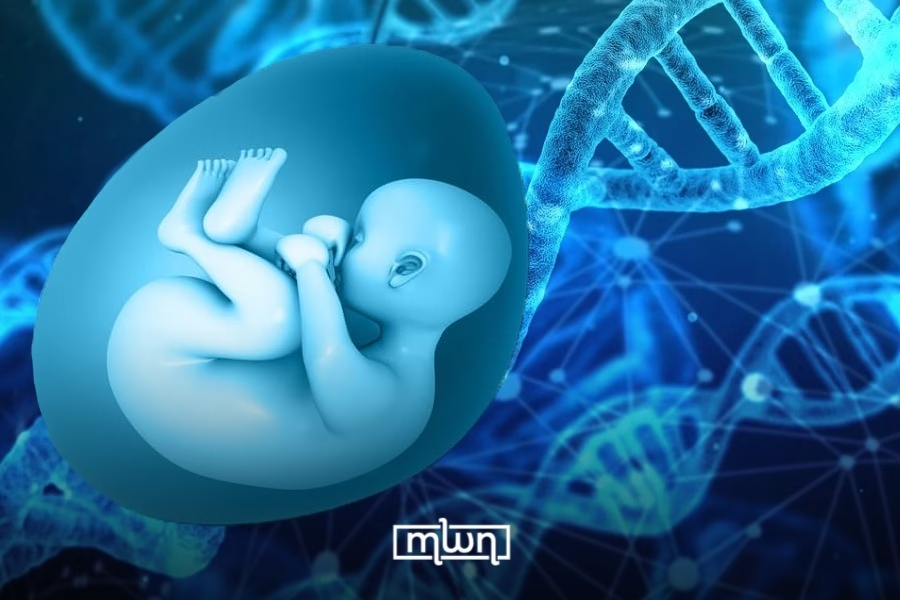
What if having a child became less about biology and more about data? Fez – A quiet revolution is unfolding in the polished dining rooms of San Francisco, where tech ambition often meets personal aspiration. It’s not about apps or algorithms, but embryos. A new wave of fertility startups is changing how a certain class of people approaches reproduction. For some of the world’s wealthiest and most tech-savvy parents-to-be, having a child is no longer just a biological event, it’s becoming a project. One company in particular, Orchid, is leading this shift, offering genetic screening for embryos that promises to assess risks for thousands of potential diseases before pregnancy even begins. This isn’t science fiction. It’s science with a business model. According to The Washington Post , the technology behind Orchid allows for a full genetic report using just five embryonic cells. In theory, this lets prospective parents weigh the likelihood of future conditions like cancer, schizophrenia, or Alzheimer’s, long before a child is born. The company’s founder, Noor Siddiqui, sees this as a natural next step: making reproductive decisions based on data, not just hope. But the service isn’t for everyone, literally. A single embryo screening costs $2,500, and IVF cycles can run upwards of $20,000. In practice, this technology isn’t reshaping reproduction for the masses. It’s tailoring it for the elite. Critics call it a slippery slope toward designer babies. Supporters argue it’s just responsible parenting. Siddiqui herself is a vocal advocate, openly planning to have multiple children using embryos screened by her company. For her, it’s not theoretical, it’s personal. While the science sounds impressive, the debate around it is far from settled. Some geneticists are wary of drawing sweeping conclusions from such a small number of cells. The technology relies on amplifying genetic material, a process that can introduce errors. One Stanford expert even compared it to a game of Russian roulette: high-stakes and uncertain. Still, not everyone is hesitant. Orchid’s backers include some of the most influential names in tech and biotech, who see the company’s work not just as a medical service but as a step toward a new cultural norm: intentional, optimized parenthood. The trend fits within a broader movement known as pronatalism, a growing push to encourage higher birth rates in wealthy societies. For some, it’s about preserving civilization. For others, it’s about building better humans. Either way, the future of family planning is no longer just about when to have kids, but how to have them. And the market is already responding. Investors are betting that more people will want control over what was once left to nature. In March, the first baby screened with Orchid’s technology was born. Her name is Astra Meridian, a name that sounds like it belongs to the future.
Ancient Egyptian Pyramids Were Burial Sites for Laborers Also, Study Finds

Turns out that ancient Egyptian pyramids weren’t just VIP lounges for the afterlife; some hard working laborers crashed the party too. Fez – For centuries, historians assumed that pyramids were the final resting places of Egypt’s elite, powerful rulers, influential scribes, and the ultra-wealthy. But fresh research from Sudan’s Tombos site suggests we may have been picturing the wrong guest list. According to a study in the Journal of Anthropological Archaeology, it turns out that ancient pyramid burials weren’t just for VIPs; hardworking laborers may have secured a spot alongside them. Tombos: The colonial outpost that kept on giving Located on the Nile’s third cataract in modern Sudan, Tombos was originally an Egyptian colony. Established around 1400 B.C. after Egypt’s conquest of Nubia, it functioned as an administrative hub, one where both elites and workers left their mark. And, as it turns out, their bones. When archaeologists examined 110 skeletons from the site, they weren’t just looking at burial styles. They focused on entheseal changes: tiny bone modifications that reveal how much physical labor a person endured in life. Essentially, the more grueling your day job, the more pronounced these skeletal markers become. The muscle mystery: who’s who in the pyramid? What did the bones tell us? Some individuals had smooth, unmarked attachment points, suggesting a life of bureaucratic comfort, scribes, officials, or maybe an ancient version of a desk job. Others, however, displayed significant wear and tear, evidence of years of back-breaking labor. Both groups were buried under pyramid tombs. Pyramids weren’t exclusively for the rich. Some of the hardest-working members of society were laid to rest in grand monuments once thought to be off-limits to commoners. Why were laborers buried like the elites? Theories abound. Some researchers suggest that wealthy individuals allowed lower-status workers to be buried nearby to reinforce the social hierarchy, even in death. Others believe the laborers may have chosen to rest near their employers, hoping for some posthumous status boost, kind of like an eternal networking strategy. Stuart Tyson Smith, an anthropology professor at UC Santa Barbara, suggests that elites surrounded themselves with the very workers who had served them in life. This wasn’t just about proximity; it was about power, prestige, and possibly even religious beliefs about the afterlife. The debate isn’t over Not everyone is sold on this groundbreaking revelation. Some scholars argue that physical labor wasn’t exclusive to lower classes; elites may have been physically active too, meaning their skeletal wear doesn’t necessarily indicate a working-class background. Still, the study has sparked major conversations in Egyptology. If further research supports these findings, our understanding of social divisions in ancient burial practices could change dramatically. And who knows, maybe history’s been underestimating the ambitions of ancient laborers all along. Read also: Vast Underground Structures Beneath Giza Pyramids