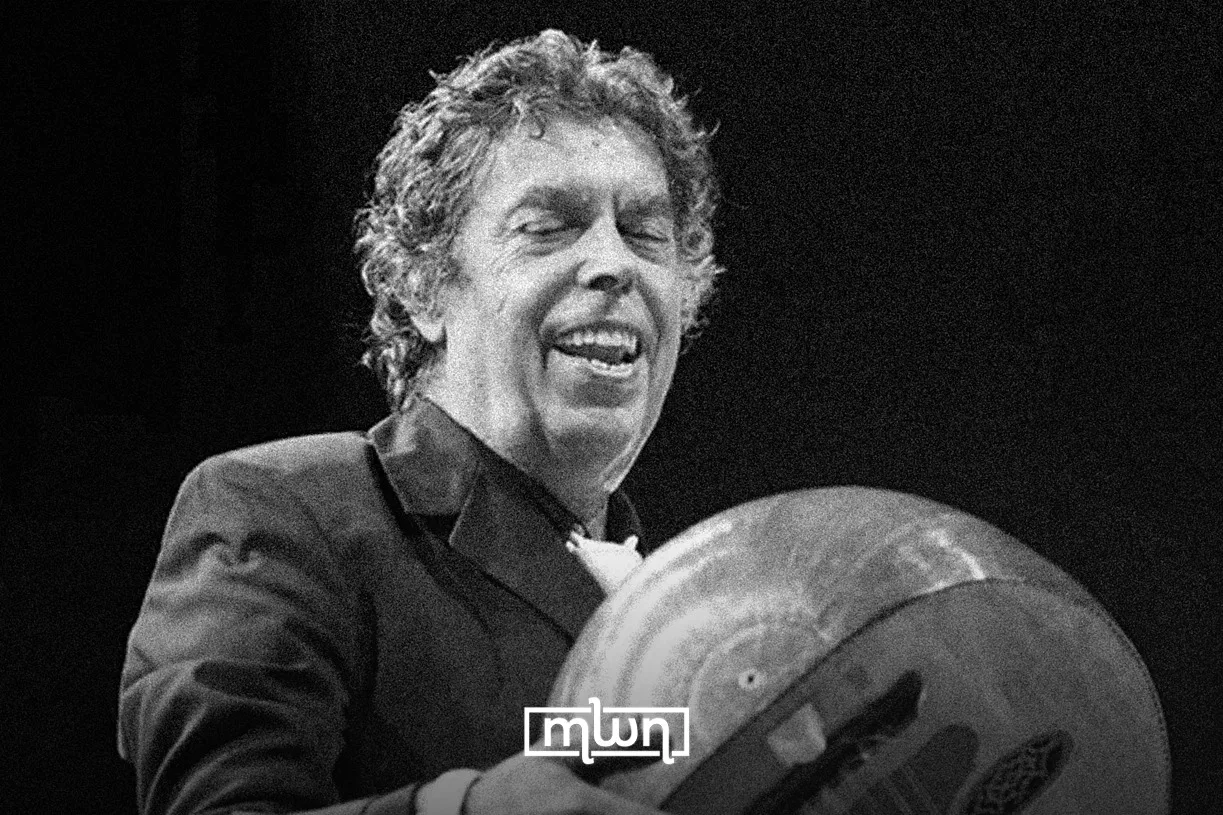
Fez — Morocco is mourning Abdelwahab Doukkali, the legendary singer, composer, actor, and visual artist whose voice shaped modern Moroccan music for more than six decades.
Doukkali died on Friday, May 8, in Casablanca at the age of 85, according to his family and the Ministry of Youth, Culture, and Communication. The ministry described him as one of the pillars of Moroccan song and recalled works including “Kan Ya Ma Kan” (once upon a time), “Marsoul El Hob” (the messenger of love), and “Souk El Bacharia” (the market of humanity) as part of a lasting national repertoire.
His passing marks the loss of an artist whose songs helped generations of Moroccans understand love, longing, dignity, exile, and memory through a voice that was unmistakably his.
A child of Fez
Abdelwahab Doukkali was born in Fez on January 2, 1941, into a large and conservative family. The city, with its Andalusian musical heritage, spiritual atmosphere, and dense medina life, formed the first landscape of his imagination.
His story has often been told as that of a young man who felt the pressure of tradition but refused to let it silence him. He drew, sang, acted, and absorbed the voices around him. Fez gave him discipline, but it also gave him restlessness.
That tension would stay with him throughout his career. Doukkali’s music often sounded polished and classical, yet emotionally urgent. He belonged to tradition, but he never stood still inside it.
He left for Rabat at 18, going on to briefly work with Moroccan radio and television. But that job in the capital did not retain him for long. He was drawn toward performance, toward Casablanca, and toward a wider artistic life that would eventually place him among the most important Moroccan voices of the 20th century.
A young artist who disturbed convention
Doukkali emerged at a time when Moroccan music was still defining its post-independence modern identity. Radio, theater, television, and cinema were becoming national spaces where artists could help shape how Morocco saw and heard itself.
He did not arrive quietly. His stage presence, style, gestures, and emotional delivery challenged older expectations of how a singer should behave. He did not simply perform songs; he inhabited them.
Early audiences saw an artist who could be theatrical without losing musical seriousness. He sang with his eyes, hands, and body, turning the stage into a dramatic space. Critics sometimes mocked his style, but the public listened. More importantly, they remembered.
Songs such as “Ya Lghadi Ftoumobil” (you, going in the car), “Habibati” (my lover), and “La Tatroukini” (don’t leave me) helped build his early reputation, while his public image became part of the story. He was elegant, expressive, sometimes controversial, and visibly modern.
For Moroccan music, this mattered. Doukkali helped move the singer from the position of interpreter to that of full artistic personality. He was not just a voice attached to a melody. He was a presence.
The Cairo chapter
In 1962, Doukkali left Morocco for Cairo, then one of the great capitals of Arab culture. For any North African artist of his generation, Cairo represented a severe test. It was the world of Oum Kalthoum, Abdel Halim Hafez, major orchestras, demanding audiences, and a music industry that set standards across the Arab world.
Doukkali spent several years there and gained recognition beyond Morocco before returning home with greater confidence and a broader musical vocabulary.
The Cairo chapter is essential to understanding his impact.
He absorbed the grandeur of Arab orchestral music, but he did not return as an imitation of Egyptian stars. He brought back scale, discipline, and ambition, then filtered them through Moroccan language, rhythm, and feeling.
That synthesis became one of his great contributions. Doukkali showed that Moroccan songs could carry local intimacy and pan-Arab sophistication at the same time.
The messenger of love
If one song defines Doukkali’s public memory, it is “Marsoul El Hob.” The title, often translated as “Messenger of Love,” became more than just a hit. It became a second name.
The song endures because it feels direct without being simple. Like much of Doukkali’s work, it treats love as a serious emotional force. It is not only romance; it is devotion, distance, pain, and communication across silence.
That is why “Marsoul El Hob” still moves across generations. Older listeners hear the era in which it was first sung. Younger listeners hear a standard, a song that has already passed into cultural inheritance.
But Doukkali’s legacy cannot be reduced to one work. His repertoire includes “Kan Ya Ma Kan,” “Ma Ana Illa Bashar” (I’m only human), “Souk El Bacharia,” “Montparnasse,” “Lil O Njoum” (night and stars), and “El Leil We Ana We Enta” (the night and me and you). Each title reveals a different part of his artistic range.
“Kan Ya Ma Kan” carries the spirit of storytelling. It opens like a memory and moves like a tale told after loss. “Ma Ana Illa Bashar,” meaning “I am only human,” gave vulnerability a grand musical form and traveled widely across Arab repertoires.
“Montparnasse” revealed another side of him: the artist of travel, exile, and distance. It connected Moroccan songs to the emotional geography of migration, cafés, stations, and the loneliness of foreign cities.
A complete artist
Doukkali was not only a singer. He composed, acted, painted, and lived with the curiosity of someone who saw art as one continuous language.
He appeared in Moroccan cinema, including “Vaincre pour Vivre,” also known as “Life Is a Struggle,” a 1968 film associated with the early development of Moroccan feature filmmaking. His screen work placed him within a generation of artists building national culture through more than one medium.
He also composed for films and remained attached to visual art. In later years, accounts of his Casablanca apartment described a private world filled with paintings, objects, and memories. The image fits the artist: Doukkali was not simply a performer who visited art. He lived artistically.
This breadth helps explain why his death feels so large. He belonged to several histories at once: Moroccan music, radio, cinema, theater, visual art, and the Arab song tradition.
A Moroccan sound with Arab reach
Doukkali’s importance lies in how he gave Moroccan song prestige without stripping it of its Moroccan soul.
He sang in Moroccan Arabic and literary Arabic. He could address local listeners in their emotional language, then reach wider Arab audiences through classical phrasing and orchestral depth.
His music came from a Morocco negotiating several inheritances: Andalusian refinement, urban popular song, Arab tarab, radio modernity, and the new cultural confidence of independence. Doukkali did not resolve those currents through theory. He resolved them by singing.
This is why his voice remained relevant even as Moroccan music changed. Later generations moved through chaabi, Nass El Ghiwane, Jil Jilala, raï, rap, and pop, but Doukkali stayed in the background as a reference.
For young artists, he represented craft. For older audiences, he represented memory. For the diaspora, he represented the sound of home.
Honors and a lasting public place
Over his long career, Doukkali received major recognitions in Morocco and abroad. Accounts of his career cite awards including major Moroccan song prizes, recognition as a dean of Moroccan song, honors connected to Fez, and international distinctions.
But his real honor was always public memory. Few artistic achievements are deeper than becoming part of how people remember their own lives.
A Doukkali song could belong to a wedding, a late-night radio program, a family living room, a taxi ride, or a Moroccan home abroad. His work traveled through official concerts, but also through cassettes, television archives, and private longing.
That is the difference between celebrity and cultural permanence. Celebrity depends on the moment. Doukkali became part of the emotional structure of Moroccan life.
The voice after the silence
The death of Abdelwahab Doukkali leaves Morocco with a quieter cultural landscape. It also invites a necessary return to his work beyond merely nostalgia, but also as heritage.
His music reminds listeners that Moroccan art was never minor, provincial, or secondary. It carried complexity, elegance, drama, humor, and philosophical depth. It could speak in the language of the street and still reach the scale of Arab classical music.
Doukkali’s life was the story of a boy from Fez who refused the limits placed around him, entered the great cultural cities of his time, and returned to give Morocco some of its most enduring songs.
He is gone, but “Marsoul El Hob” still has a message to deliver. In the cafes of Fez, the homes of Casablanca, the memories of Rabat, and the apartments of Moroccans abroad, Abdelwahab Doukkali’s voice will continue to do what it always did: turn feeling into heritage, and heritage into song.