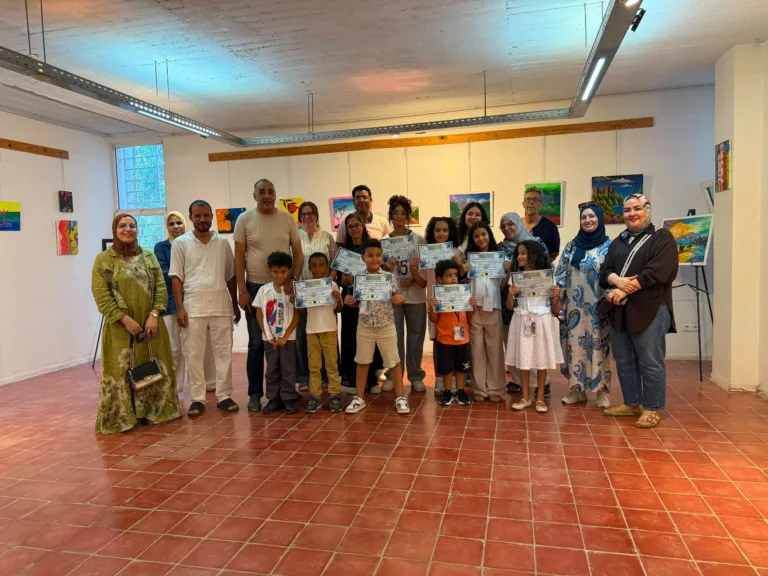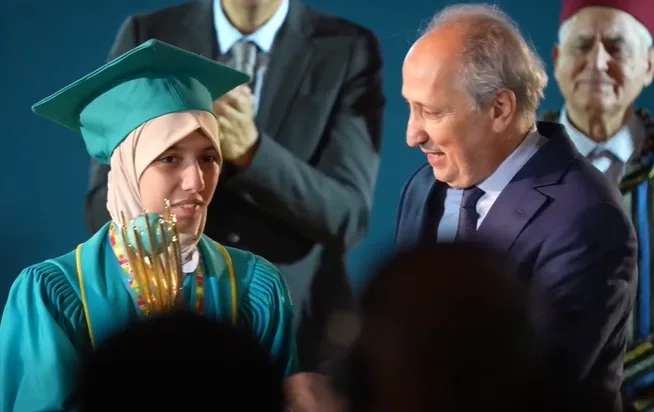
Fez — Moroccan student Riham Aouragh has won first place at the second edition of the “National Reading Project,” held on May 13 in Rabat.
Aouragh, a student at Kassita middle school in the Oriental region, also ranked first in the lower secondary school category. The project is organized by Morocco’s Ministry of National Education, Preschool, and Sports in partnership with the “Scientific Research Foundation for Investment of the United Arab Emirates.”
A national competition across school levels
The competition recognized students from several educational levels, from primary school to university, as well as teachers.
In the lower secondary category, Meryem Bellouch from Souss-Massa took second place, followed by Ines Ait Bamzi from Casablanca-Settat. Hasnae Oujja from Laayoune-Sakia El Hamra and Malak Amrani from Rabat-Sale-Kenitra ranked fourth and fifth.
For the first primary school category, covering grades one to three, the top places went to Mouad Izzane from Marrakech-Safi, Sara Bellouch from Souss-Massa, Tasnim Eddoukh from Fez-Meknes, and Baraa El Khadroni from Tangier-Tetouan-Al Hoceima.
In the second primary school category, covering grades four to six, Zaid Labhih from the Oriental region ranked first. Meryem Hakkouni from Fez-Meknes, Ihssane Ait Hammad from Casablanca-Settat, and Mohamed Reda El Kachoum from Dakhla-Oued Eddahab followed.
Reading as a school reform priority
The qualifying secondary school category also highlighted strong regional participation, with Hind Driassi from Casablanca-Settat taking first place, followed by Houria Semlali from Drâa-Tafilalet, Hajar Fahmi from Rabat-Sale-Kenitra, and Malak Louh from Tangier-Tetouan-Al Hoceima.
The project also awarded university students in the “educated student” category and teachers in the “educated teacher” category, expanding the competition beyond school-age pupils.
Speaking at the ceremony, Education Minister Mohamed Saad Berrada said the National Reading Project aligns with the ministry’s 2022-2026 roadmap. He linked the initiative to improving basic learning, language mastery, cultural openness, and school life.
Berrada also noted a sharp rise in participation. The number of student participants grew from more than 272,000 in the first edition to more than 1.3 million in the second edition. Berrada presented this figure as evidence of growing interest in reading across Moroccan schools.
The ceremony also saw the signing of cooperation agreements between the UAE foundation and several Moroccan institutions, including the education ministry, the State Secretariat for Social Integration, and the Ministry of Higher Education, Scientific Research, and Innovation.
A declaration of intent was also signed between the Mohammed VI Foundation for the Promotion of Social Works in Education and Training and the UAE foundation.