Rabat – In Casablanca in the late 1970s, music did not come cleanly. It hissed through cassette decks that were passed hand to hand in cafes, taxis, and student apartments.
What emerged from that noise was not a new “genre” in the Western sense, but something difficult to name: a Moroccan counterculture built on poetry, distortion, and collective voice.
To call it a “punk revolution” is inaccurate even if that is the only way to vaguely describe it.
There was no unified punk movement in Morocco like London’s snarling three-chord rebellion or New York’s downtown nihilism.
But there was a loud, poetic, spiritual, and deeply urban rebellion. It did not look like western punk, it sounded like Morocco trying to modernize itself at a critical post-independence period without losing its memory.
In this period, Morocco was changing rapidly. Cities like Casablanca, Rabat, and Marrakech were expanding and new generations were living between traditional structures and urban modern influence.
Imported vinyl, French radio, and the spread of cassette culture introduced the youth to electric guitars and new forms of rock and punk. But instead of copying them, Moroccan artists bent these new sounds into something entirely different.
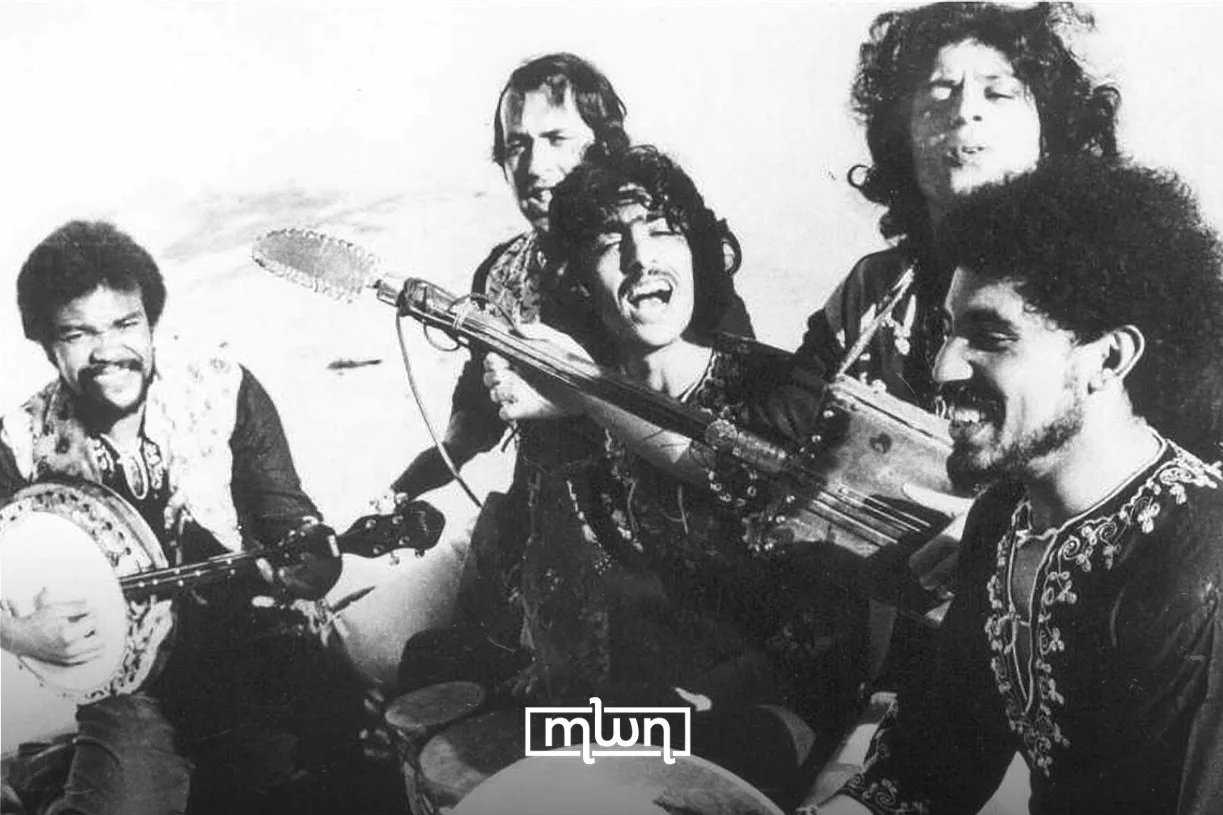
Nass El Ghiwane stood at the heart of this underground movement. They became the sound of the streets with their poetic choruses and lyrics that mirror society that stemmed from their theatre background.
Their lyrics drew from Sufi thought, Malhoun poetry, and everyday struggle. Their songs turned from an existential reflection into mass culture, the Moroccan Zeitgeist at the time.
Songs like “Fine Ghadi Bya Khouya” and “Siniya” became a shared emotional language for an entire generation. Played at both weddings and protests, they crossed the boundary between art and life.
Jil Jilala were important players as well. They represented the streets’ spiritual pulse. The band is deeply rooted in sufi traditions and ritual brotherhoods, which made their songs carry a meditative quality in a time where loud urban sounds were at their peak.
Then there was Lemchaheb, definitely the most experimental of the trio. Their work focused more on theatricality and political expression.
They blended funk rhythms, rock structures, and dramatic stage presence. Lemchaheb were the edge that was always restless and less concerned with accessibility than with pushing their sound itself.
Their music suggested that Moroccan identity was and still is never fixed but constantly under construction.
Alongside these musical giants existed more underground figures, such as Fadoul. A musician whose raw garage rock/funk placed him slightly outside the dominant narrative. His sound was rough, groove-heavy, and unpolished.
He did not become a mainstream symbol in his time. It was only decades later that he would resurface after Jannis Stürtz of the Berlin-based record label Habibi Funk Records was crate-digging in Casablanca and discovered a rare 7-inch vinyl record by Fadoul.
Despite their differences, all of these artists shared a common impulse: to translate a society in transition.
They build a hybrid language; not quite similar to Western rock nor does it abide by traditional forms of music. They managed to merge electric instrumentation with poetic heritage, and Sufi metaphysics with the everyday realities of working-class life.
What makes this movement remarkable is the reach these artists had in their time. Their songs circulated through cafés, taxis, family gatherings, and student dorms. And anyone who could afford cassette tapes owned their entire discography.
Yet, its “revolution” was not expressed through confrontation like in the west. There was no uniform rejection of society and no chaos for its own sake.
Instead, the rupture was poetic. It was a transformation of language, sound, and collective feeling. Rebellion came through metaphor, rhythm, and spiritual questioning rather than speed or aggression.
In that sense, what Morocco experienced in the 1970s and 80s was not punk, but something more enduring. It was a cultural redefinition of what modern music could sound like.
Today, echoes of that era resurface from time to time in Moroccan music. In rap samples, indie reinterpretations, and in the way younger artists continue to blur genres.
Morocco’s forgotten punk revolution was never about punk at all. It was about a generation discovering that tradition and modernity were not opposites, but materials to be remixed.