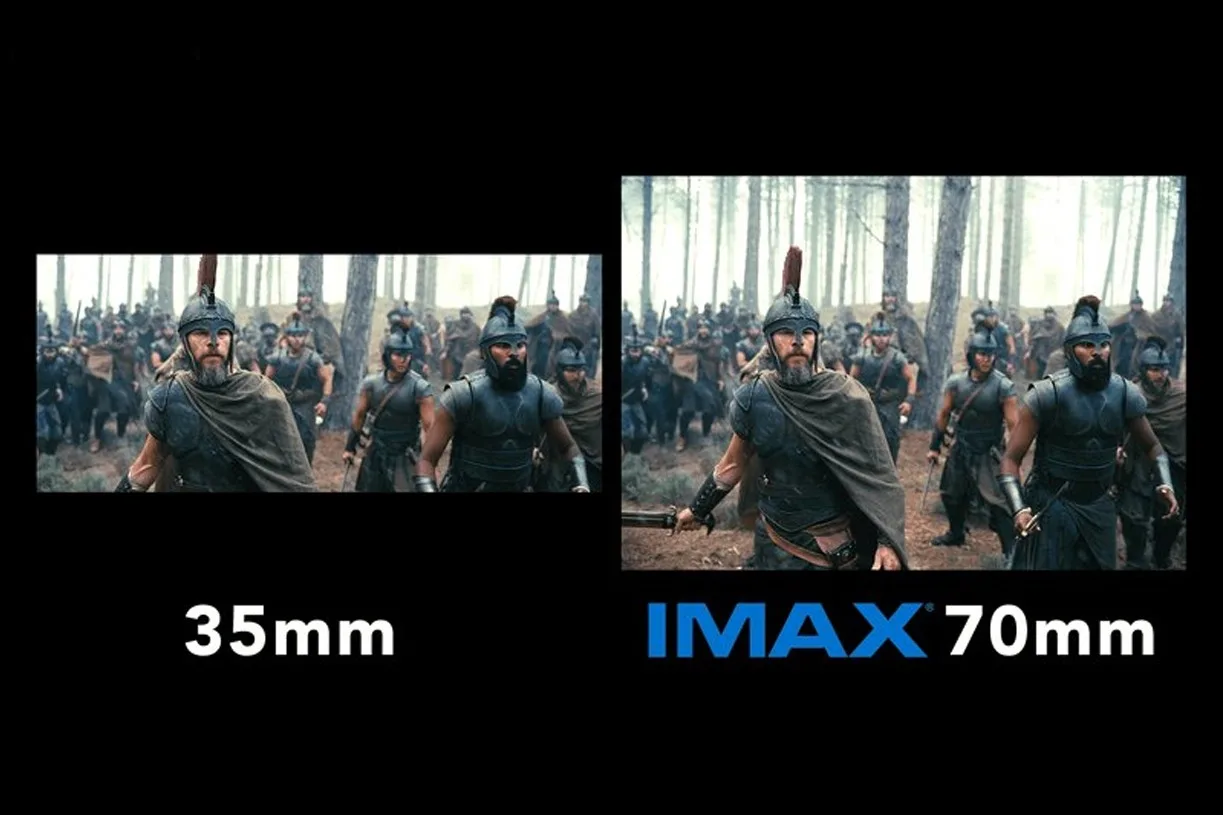
Rabat – If you’ve bought a ticket labeled “IMAX” and assumed you were getting the full, unfiltered Christopher Nolan experience, you’re not alone, and you’re probably wrong.
The word “IMAX” gets stamped on hundreds of screens around the world, but only a tiny fraction of them can actually show a movie the way Nolan built it to be seen, which is the IMAX 70mm.
The gap between those two is a real, measurable difference in image size, resolution, and shape, and it means most audiences are watching a cropped, lower-fidelity version of the film without realizing it.
Two IMAX tickets, different formats
The confusion starts with the fact that “IMAX” doesn’t mean one format.
It means at least two very different ones, and theaters aren’t always eager to clarify which one you’re getting.
“IMAX 70mm film” is the original, analog format. A physical strip of film, more than twice the width of standard 35mm stock, threaded through a massive projector at high speed.
Resolution estimates for “70mm film” run as high as the equivalent of 18K, far beyond what any digital cinema projector currently outputs.
The format also fills the screen differently. Its native aspect ratio is “1.43:1,” close to square, designed to cover a screen from floor to ceiling with no black bars.
Digital IMAX, on the other hand, is what’s actually installed in the overwhelming majority of “IMAX” auditoriums worldwide.
It’s a laser or xenon digital projection system, typically capped around 4K resolution, displayed in a wider “1.9:1” ratio that shows noticeably less vertical information than true 70mm.
Both theaters carry the IMAX name, but only one presents Christopher Nolan’s films in the format he actually shoots and finishes them for.
Why is Nolan using such a rare format?
This isn’t a minor technical preference. Nolan has used IMAX cameras since “The Dark Knight,” while “Dunkirk,” “Tenet,” and “Oppenheimer” were all shot on a mix of large-format film stock.
His latest film, “The Odyssey,” takes that commitment further than any major studio release before it, becoming the first feature ever shot entirely on IMAX film cameras from start to finish, rather than combining multiple formats.
Nolan’s reasoning for going through all this trouble comes down to information density.
He explained that shooting on IMAX captures such a large amount of visual detail that a film can be reframed to fit almost any screen shape without losing quality, but the reverse isn’t true.
Watch it in the format it was designed for, and you’ll see the full IMAX frame, with maximum image area and no cropping.
Watch it in other formats, and some of that image may be cropped or adjusted to fit the screen, though you’ll still experience the same film and storytelling in high quality.
So does it actually matter for the average viewer?
IMAX film captures far more visual information than standard formats, while ensuring the key elements of every frame remain intact when the image is cropped for conventional digital screens.
For most audiences without access to IMAX film theaters, that’s an encouraging takeaway.
Most viewers who see “The Odyssey” in a standard multiplex will still experience the full story without losing its core elements.
However, a difference remains between the way the film was shot and the way it is ultimately displayed in many theaters.