Fez — Ahwach does not need to be frozen in time to remain Amazigh.
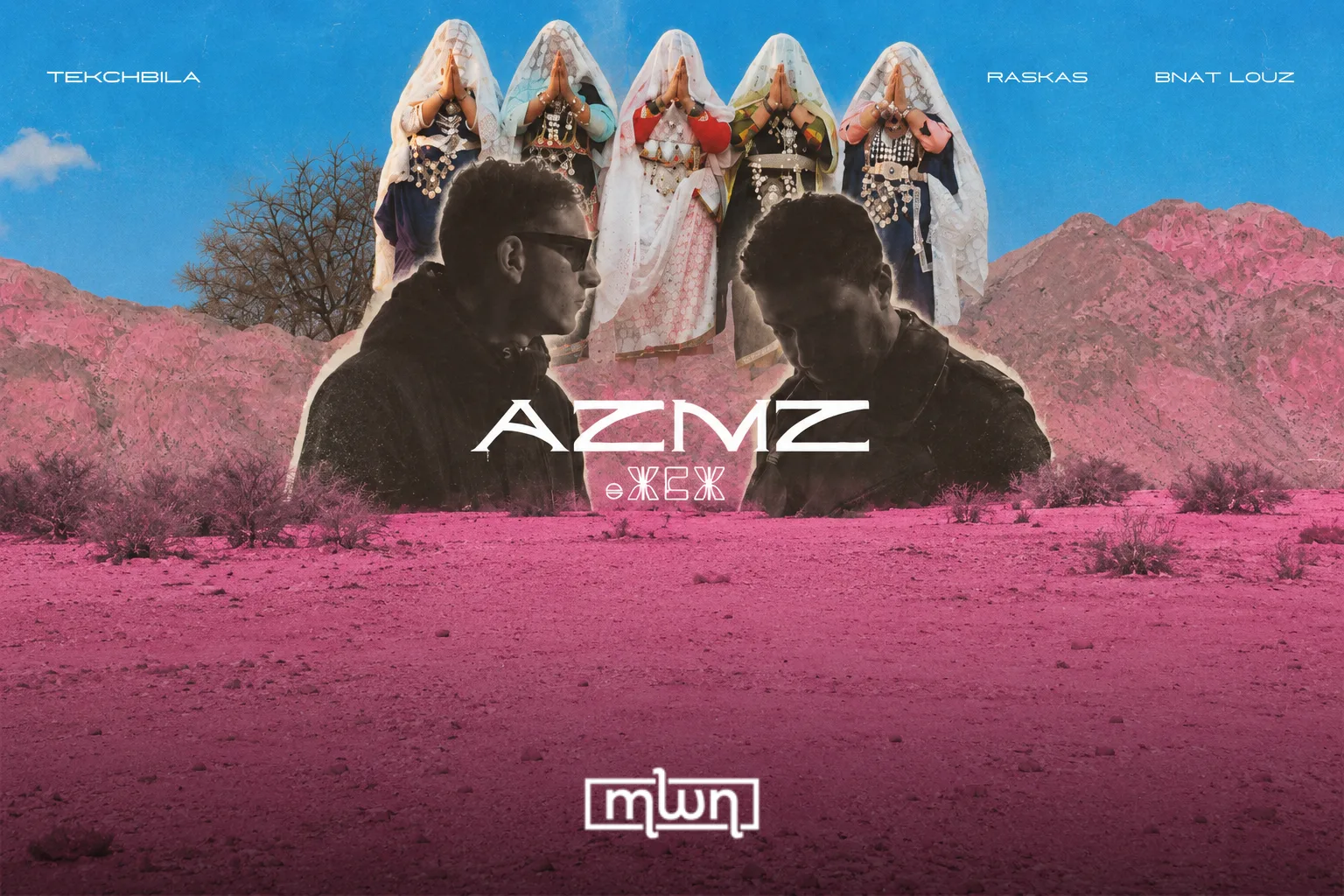
That idea sits at the center of “AZMZ,” the new release bringing together Tafraout’s all-female Ahwach troupe Bnat Louz and Casablanca experimental duo Raskas.
Casablanca label HSS·HSS released the project in September, following several years in which the collaboration developed through performances and Tekchbila residencies.
The title “AZMZ” translates roughly as “air of the times” in Amazigh. The music places traditional female choruses and Souss rhythms beside synthesizers, basslines, post-rock textures, and experimental electronics.
It is less about putting a beat beneath an old musical form than allowing two distinct traditions to alter one another.
Ahwach without the museum glass
Bnat Louz is based in Tafraout and was founded by the late Amina Haddadi. The troupe is now led by her sister Zahra Haddadi.
The Moroccan Electronic Music Association describes Bnat Louz as a pioneering group, widely regarded as the first women’s troupe to perform Ahwach professionally.
Raskas comes from a very different musical environment.
Formed in Casablanca in 2013, the duo works across post-rock, electronica, and experimental sound. Its music often favors atmosphere, repetition, and gradual transformation over conventional song structures.
Their meeting through “Tekchbila” created a space where neither side had to imitate the other.
The resulting performance has already traveled through Moroccan cultural events, including the Gnaoua and World Music Festival in Essaouira. The festival presented “AZMZ” as a combination of polyphonic Ahwach singing, Souss rhythms, Amazigh poetry, electronic textures, and post-rock experimentation.
Visual artist Kevin Le Dortz has also contributed imagery drawn from Tafraout and the wider Souss landscape.
A third sound
The project fits into the wider direction of “HSS·HSS,” a Casablanca label working between electronic experimentation and Amazigh musical traditions.
The label explicitly positions itself around creating what it calls a “third voice,” rather than simply placing heritage music beside contemporary production.
That distinction matters for “AZMZ.”
Ahwach is not treated as raw material waiting to be modernized. Electronic music is not presented as the force bringing it into the present.
Instead, Bnat Louz and Raskas meet as artists working in two living musical languages.
“AZMZ” therefore feels less like a fusion experiment and more like an argument about what Moroccan tradition can become when musicians are allowed to move forward with it.
The project suggests that preserving cultural memory does not always mean protecting it from change. Sometimes survival depends on giving it enough space to change on its own terms.