Casablanca – Hamza Atifi grew up with cinema almost within arm’s reach. Born in Casablanca in 1992, he spent his childhood around his father, an actor and assistant director, and entered the world of filmmaking early. He acted as a child in “Casablanca by Nights” and witnessed Tony Gatlif making “Exils,” an experience that sparked his passion for film.
He later studied at the Marrakech School of Visual Arts (ESAV) and Brussels National Institute of Performing Arts and Broadcasting Techniques (INSAS) before returning to Morocco and building a career behind the camera. At 23, he gained recognition as director of photography on “Nouhe, ne sait pas nager.”
Since then, Atifi has worked as a director of photography on five feature films and more than 100 commercials, several of which he also directed. He made his television debut with “Souhlifa,” which reached more than 140 million views in 2021.
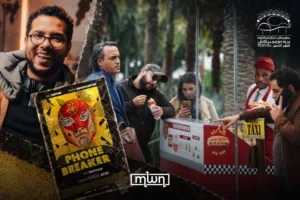
His five short films, including “Candidats au suicide” and “Phone Breaker,” have also picked up awards in Morocco and internationally.
Now “Phone Breaker” is coming home in a way. The film joins the national competition at the sixth Marrakech Short Film Festival, which runs from September 25 to 30.
The festival received more than 400 submissions from five continents and more than 90 countries, with its 2026 program bringing Moroccan and international short films to venues including El Badii Palace, Cyber Park, Le Folk and the Institut Français de Marrakech.
For Atifi, Marrakech means more than another festival stop. It is the city where much of his filmmaking education began.
It all started with a phone problem
The idea for Phone Breaker began in 2015, when Atifi studied at INSAS in Brussels. He found a short story by Stéphane Blanchet on a writing forum and immediately connected with its strange, exaggerated take on an everyday problem.
“I immediately loved the approach,” Atifi told MWN Lifestyle magazine. “It takes something completely ordinary, a frustration we all recognise, and pushes it much too far. Naturally, that got my attention.”
He contacted Blanchet, who gave him the adaptation rights. Atifi then rebuilt the story around a Moroccan setting, changing the characters and situations to reflect the society he wanted to explore.
“I wanted to see how this idea could come alive in our own society, with our behaviours and contradictions,” he said.
The adaptation itself became part of the filmmaking challenge. Atifi was interested in what happens when prose turns into images, actors and movement.
“A page of prose can become a glance lasting just a few seconds,” he explained. “Conversely, an actor can bring something to a line that you never imagined when reading it. You lose certain things and gain others.”
That process led to Jalil, the film’s central character. “He desperately needs silence, a little space to reconnect with himself,” Atifi said.
“Phones have made us more reachable, but being reachable does not mean being available,” he further explained.
But Jalil’s anger has a deeper source. He also believes that mobile phone masts clouded his mother’s mind and caused her cancer.
“Beneath his everyday frustration, there is something much more personal,” Atifi said. “For him, smashing a phone is not simply a bad-tempered outburst. He is attacking what he believes is responsible for his mother’s illness.”
And then comes the contradiction that drives the film. “I love working with chaos,” he said. “Events unfold, connect and send a character much further than they ever intended to go. Jalil wants to silence the world and ends up making a great deal of noise.”
That is where the comedy starts.
The cast, the chaos and the production room
Atifi did not build the cast through conventional auditions. He already knew Aziz Hattab from their work on a sitcom and had noticed something that made him right for Jalil.
“In life, he is quite reserved, but on screen, he has an explosive presence,” Atifi said. “I could already see Jalil in him.”
Sandia Tajdine joined the project under much more sudden circumstances. The actress originally cast for Sophia developed a severe case of COVID-19 one week before filming and had to leave the production. Atifi already knew Tajdine from his work as a cinematographer and had wanted to direct her.
“I worked up the courage, explained the situation, and she said, ‘Khouya (bro), we’re making cinema. Send me the script,’” he recalled.
She read the script and joined the film. Her arrival changed the character too.
“Her arrival made Sophia younger, gave her a more connected, Gen Z quality, and strengthened the contrast with Jalil,” Atifi said. “That change became one of the best things that happened to the film.”
Samia Akkariou and Adil Abatourab also joined the cast. Atifi wanted them because he does not see supporting parts as small ones. “I do not believe in small roles. I believe in great actors,” he said.
Abatourab plays a kind but intrusive man who becomes Jalil’s “victim zero,” while Akkariou brings Jalil’s personal vendetta into the public sphere.
Behind the camera, Atifi drew on his experience as a cinematographer but handed the cinematography to Sylvain Rodriguez. Rodriguez understood the visual direction quickly, and the production company Caestus Production also played a role in shaping the film’s visual approach.
“Caestus Production’s thoughtful input, support and artistic commitment helped shape the film,” Atifi said. “I felt I had partners who were willing to explore ideas with me and fully commit to the creative choices we were making.”
The production also gave Atifi room to work in the way he likes. He prepares meticulously, creating a detailed shooting plan that covers framing, camera movements and shot breakdowns.
“Generally, around 90% of what I prepare makes it into the shoot,” he said. “I like chaos in my films, considerably less in my shooting schedule!”
But even the most detailed plan has to leave room for what happens on set.
“When the structure is solid, I can welcome an actor’s suggestion or an idea that emerges on set,” he said. “For me, preparation creates freedom.”
One scene proved that point. Atifi wanted a handheld sequence to follow Jalil as he discovered through a television report that his story had grown beyond his control. When he struggled to explain the camera movement he imagined, he picked up the camera himself.
“The distances, camera heights and movements came instinctively,” he said. “That was a moment when my experience as a camera operator allowed me to express physically what I was looking for.”
Marrakech brings the story home
Atifi initially saw short films as a practical step toward his first feature. He had already started writing a feature and did not imagine that short films would become such an important part of his filmmaking identity.
“My original ambition was to go straight into making a feature,” he said. “I had already started writing one, and I could not imagine telling a story in a short film. A lovely youthful mistake!”
He started making shorts to qualify for his director’s card and eventually discovered that the format gave him much more creative freedom than he expected.
“You sometimes hear people say, ‘It’s only a short film,’” Atifi said. “But telling a story, establishing characters and taking an audience on an emotional journey in fifteen or twenty minutes is a considerable challenge. The film is short. The work is not.”
“Phone Breaker” has since traveled with MAD Solutions handling its distribution, reaching audiences in Morocco and abroad, including Tangier, Rotterdam and Ibiza. Those screenings have also connected the film with the professional side of filmmaking.
“With a comedy, you can actually hear that encounter happening in the room,” Atifi said about seeing audiences react to the film.
He also sees festivals as part of the road toward his first feature.
“When you are developing a first feature, co-producers, distributors and development labs take an interest in the journey of your shorts,” he said. “Festival selections open up conversations and get your work seen by future collaborators.”
Marrakech, however, carries its own history. “It is the city where I grew up as a filmmaker, particularly during my years at ESAV,” Atifi said. “Returning with a film inevitably feels different.”
“In a city already so strongly associated with international cinema, I am delighted that a festival gives short films a space of their own,” he said. “The Marrakech Short Film Festival showcases Moroccan shorts and brings them to the attention of professionals from abroad.”
The festival also gives selected films a chance to travel further through its Best Of program, which can take them to audiences in Morocco and internationally after their Marrakech screenings.