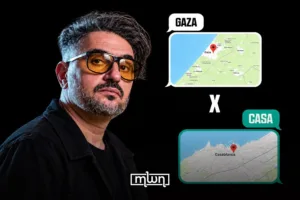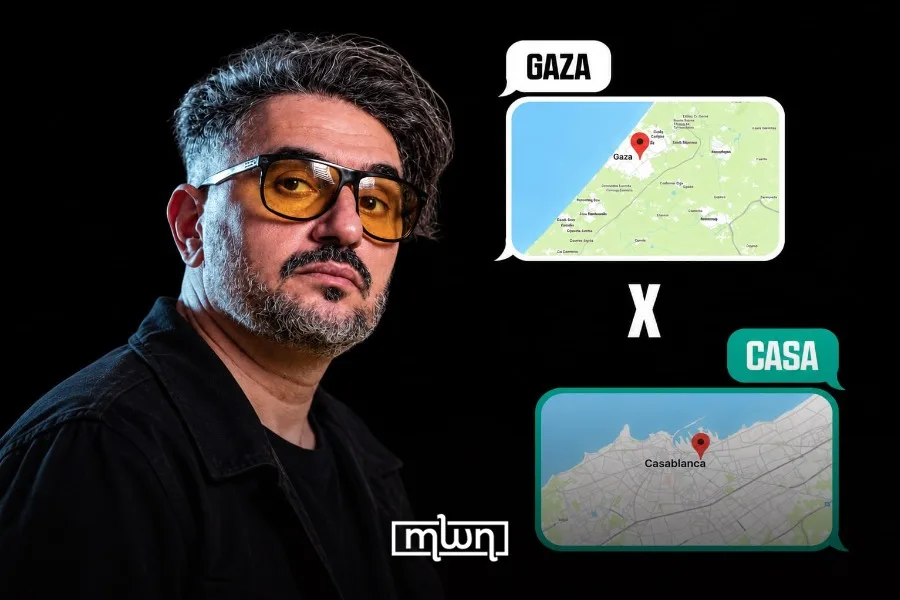
Fez — In Hicham Lasri’s “GAZA X CASA,” reaching Morocco does not mean leaving Gaza behind.
The Moroccan filmmaker’s latest short follows a Palestinian woman trying to reassure her mother that she is safe in Morocco. Yet across the film’s 20 minutes and 33 seconds, her words increasingly clash with the images surrounding her.
She describes security, work, a car, kind people, and a luxurious apartment in a quiet neighborhood. Lasri, meanwhile, places her among traffic, damaged vehicles, deteriorating spaces, fire, and stretches of isolation.
The contradiction becomes the film’s central device. Her messages can be read as an attempt to protect her mother from further worry. They can also suggest a woman trying to persuade herself that surviving elsewhere should feel like happiness.
Lasri said that contradiction was deliberate.
“I tried to tell a story through double language, where what we see and what is expressed are not the same thing,” he told Morocco World News. “That is the Orwellian dimension of the film.”
“GAZA X CASA” never fully resolves that tension.
For Lasri, that ambiguity also reflects the form of the work itself. He does not see the short as a conventional narrative built around straightforward events.
“For me, it is more a poem than a narrative film,” he said. “It is a mental, inner, personal journey that comes from a wound.”
Safety without peace
The film opens with images of an aircraft, an explosion, smoke, and fire before settling into the woman’s life in Morocco.
Violence therefore precedes the audience’s encounter with her new surroundings. Even when the geography changes, its visual traces remain.
Lasri described the film as painful to make, particularly because the images had not originally been shot for this exact project. At the same time, he called the process liberating.
“It allowed me to create a form of irony within something that is ultimately quite dramatic, quite tragic,” he said, adding that he also wanted to create something capable of returning to hope.
For Lasri, the premise rests precisely on the distance between the protagonist’s situation and the version of it she presents to her family.
“The film tells the story of this young woman who finds herself in Morocco and has to lie to her family, who are still under the bombs,” he said. “She tells them everything is fine, everything is fine, everything is fine.”
He compared that repeated reassurance to the famous refrain in Mathieu Kassovitz’s “La Haine”: “So far, so good.”
Lasri repeatedly uses fragmented compositions, reflections, obstructed views, and tilted frames. At times, the woman appears doubled or partly concealed. In wider landscapes, she becomes a small figure against mountains, stone, snow, and open sky.
The effect is one of physical arrival without emotional settlement.
Lasri described her movement through the film as a form of wandering. He compared her to a wanderer moving through an emotional pilgrimage and said the imagery contains an explicit homage to Jack Kerouac and “On the Road.”
That visual instability fits naturally within Lasri’s wider filmmaking practice. The Casablanca-born director has long worked across cinema, literature, drawing, and graphic art, with his work frequently returning to fractured identities and the contradictions of contemporary Moroccan life.
Lasri said the situation in Gaza has affected him personally in recent months and pushed him toward several forms of artistic expression.
“I try to repair that in my own way,” he said. “And my way is always painting, cinema, and writing.”
He described “GAZA X CASA” in part as a testimony, saying cinema offered him a way to reach an audience while recording his response to the moment.
One of the film’s clearest intellectual references, Lasri said, was Omar El Akkad’s 2025 nonfiction book “One Day, Everyone Will Have Always Been Against This.” Lasri said the book inspired him less through its specific content than through what he described as its lucidity.
The title originated in a 2023 statement by El Akkad about the tendency to recognize and condemn an injustice only when doing so no longer carries a personal cost. The idea later became the title of his book, which won the 2025 National Book Award for Nonfiction.
For Lasri, that premise recalls the way historical periods such as McCarthyism are often condemned retrospectively, once the risks associated with opposing them have disappeared.
“I find this title incredible,” Lasri said. He described the book as “one of the inspirations or references” used while making “GAZA X CASA.”
His concern, he explained, is with the difference between condemning something years later and speaking while it is still unfolding.
“The real courage is to say it at the moment when it is happening,” Lasri said, “to stand up and defend your fellow human being.”
Love, memory, and the heart balloon
One of the film’s most persistent images is a heart-shaped balloon.
It appears with the protagonist in public spaces and also behind her digital exchanges with “MAMA.” Its meaning shifts throughout the film.
Among traffic, the balloons can appear connected to earning a living. Against damaged surroundings, the bright heart becomes almost painfully delicate. In the vast mountain sequences, its color only emphasizes how alone she appears.
The image becomes more complicated when the film introduces her deceased fiancé.
Around the middle of the short, she tells her mother that she dreams about him. A sequence involving a man, an instant camera, and a photograph can therefore be read as memory, dream, or imagined reunion rather than a straightforward encounter in Morocco.
The photograph gives temporary form to something she cannot recover.
Her messages soon expose a deeper guilt. She wishes she could have taken her fiancé’s place, before recognizing that her own death would only have transferred the pain to him.
The heart balloon consequently connects different forms of attachment. It accompanies romantic memory, maternal communication, and the protagonist’s fragile effort to continue living.
Its brightness never fully becomes optimism. Like the connection she is trying to preserve, it looks vulnerable, temporary, and easily lost.
When survival becomes an accusation
Later, the questions become harsher.
The woman asks herself why she left her homeland, whether leaving amounted to betrayal, and whether fear made her a coward.
These are her accusations against herself, rather than conclusions the film asks viewers to accept.
The distinction matters. “GAZA X CASA” is less interested in judging escape than in showing the psychological burden carried by someone who has survived when people she loves remain exposed to violence.
Lasri described this tension as part of a larger structure within the film.
He sees the protagonist wandering through Morocco while simultaneously trying to reassure her mother and family. Beyond the frame, meanwhile, lies the violence she knows they continue to experience.
“The real violence, the blood and the explosions, are off-screen,” Lasri said. Yet that unseen violence remains devastating because of the mental world it creates around the protagonist.
Her repeated appeals to her mother gradually go unanswered. Because earlier exchanges establish a reciprocal relationship, the silence creates dread. Lasri does not, however, provide enough information to turn that silence into certainty about what has happened.
The filmmaker said his emotional response to Gaza also shaped his decision to make the short.
He framed the project less as conventional political filmmaking than as an attempt to preserve a basic human response.
“For me, it was important to make it into a poem,” he said, describing the short as his own small contribution to a broader form of resistance against indifference.
From private messages to the endless scroll
The short’s sharpest shift arrives near its conclusion.
A social-media reaction suddenly intrudes over the landscape. A rapid succession of images follows: food, animation, football, performance, politics, police, a Palestine march, and crowds.
The phone has served throughout the film as the woman’s fragile connection to her mother. Now another kind of screen appears: one built for constant movement.
Suffering can be watched, acknowledged, and immediately displaced by the next image.
For Lasri, this ending is the most important part of the film.
“In the end, nobody cares,” he said. “The world scrolls toward something else, toward things that become less and less important and increasingly stupid.”
The intense emotion generated by Gaza today, he argued, can eventually be replaced by another object of public attention.
Lasri described social media as a space where profoundly different events are flattened into the same stream. Political violence, entertainment, football, solidarity, jokes, and daily distractions appear one after another and compete for the same few seconds of attention.
“By investing our emotions and suffering with these people, eventually we stop feeling anything,” he said. “It becomes another recreational or amusing Instagram story, and then we doomscroll and move on.”
That final sequence expands “GAZA X CASA” beyond one woman’s experience. Lasri turns the viewer’s attention toward the act of viewing itself, asking what happens when war, grief, solidarity, entertainment, and distraction occupy the same endlessly refreshed space.
It also changes the meaning of the screens that came before it.
The messaging interface holds the protagonist’s urgent attempt to remain connected with her mother. The scrolling interface shows how easily another viewer can disconnect.
The film’s most unsettling idea is therefore not that its protagonist has failed to escape Gaza. It is that geographical escape may be possible while memory, guilt, love, and fear continue to travel with her.
Lasri ultimately describes the project as a record of a particular historical and emotional moment rather than an attempt to provide answers.
“For me, it was simply a testimony,” he said, “and a reminder that our humanity is also found in our actions as human beings.”
In bringing Gaza and Casablanca together, Lasri presents displacement not simply as movement between two places, but as the difficult experience of inhabiting one place while emotionally remaining somewhere else.