Rabat – Between cultural expectations and economic constraints, the value of dowry, or sdaq, in the absence of agreed-upon amounts, has long sparked controversy in Morocco.
Before the wedding party, dresses, music, and the other arrangements, there is always a heated conversation that takes place behind closed doors: How much will the dowry cost?
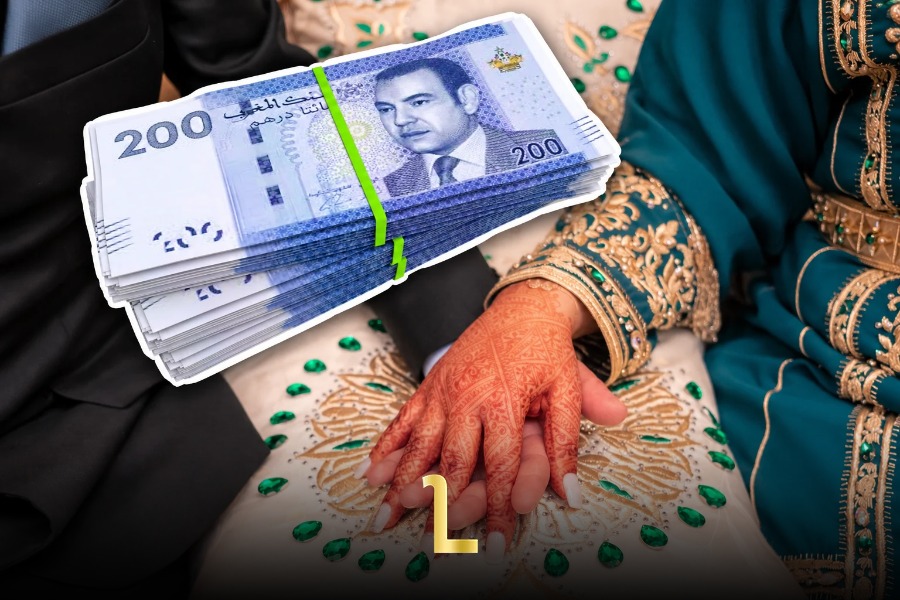
Traditionally, the dowry, anything of value the groom can offer to his future spouse, was perceived as a symbolic, meaningful gift signaling the groom’s commitment and readiness to get married.
The form and amount, however, used to be negotiated between the couple’s families, taking into account the groom’s financial capabilities.
What is dowry? A religious perspective
Dowry is a long-held religious and cultural practice deeply rooted in Islamic teachings; dowry is anything of material value that the groom can offer to his bride to honor her and to guarantee her financial independence.
In Islam, the dowry is a religious obligation stated clearly in the Holy Qur’an. Surat An-Nisa (Chapter 4), Verse 4 (4:4) says, “And give the women [you wed] their due dowries graciously…”
The exact value of the dowry, however, was not stated in any religious text; therefore, it is usually determined by a mutual agreement, with the bride having the ultimate right to determine and approve the value. The dowry is usually used to cover the bride’s pre-marital expenses and her contribution to her new household.
What does dowry have to do with drastic marriage decline among Moroccans?
For Moroccan families, marriage is a sacred social occasion, and the financial expectations associated with it are usually high; however, they vary widely depending on several factors.
In any pre-marriage discussion, sdaq has a good share of the discussion; questions like what can you offer, and how much, are recurrent themes.
Generally, discussions about the amount or form of the dowry are considered controversial that they sometimes take a financial turn, leading to misunderstandings or even conflicts.
The dowry is only the initial part of a series of financial commitments, like the actual wedding arrangements that add up to the overall budget.
In Morocco, some couples prefer modest, simple arrangements and symbolic dowries, while others face more financially demanding standards shaped by social expectations.
Morocco has witnessed a remarkable decrease in marriage rates; a decline of 3.9% was recorded in 2024 compared to 2023, according to the High Commission for Planning (HCP).
According to the 2025 National Family Survey (ENF), 59.8 % of Moroccan men aged above 18 are not considering marriage, and those aged between 25 and 39 cited economic constraints as primary reasons for this reluctance.
Morocco’s new government addressed this issue in its 2026-2031 program, pledging financial support of up to MAD 5,000 (approximately $500) for young people preparing to marry.
But the question remains: what is the optimal value of dowry amidst global economic crises?