

Fez — The Comptoir des Mines Galerie is hosting “Sarabande,” the latest exhibition by Yasmina Alaoui, on view until March 8. The exhibition extends the research initiated in her previous project, “Binatna.”
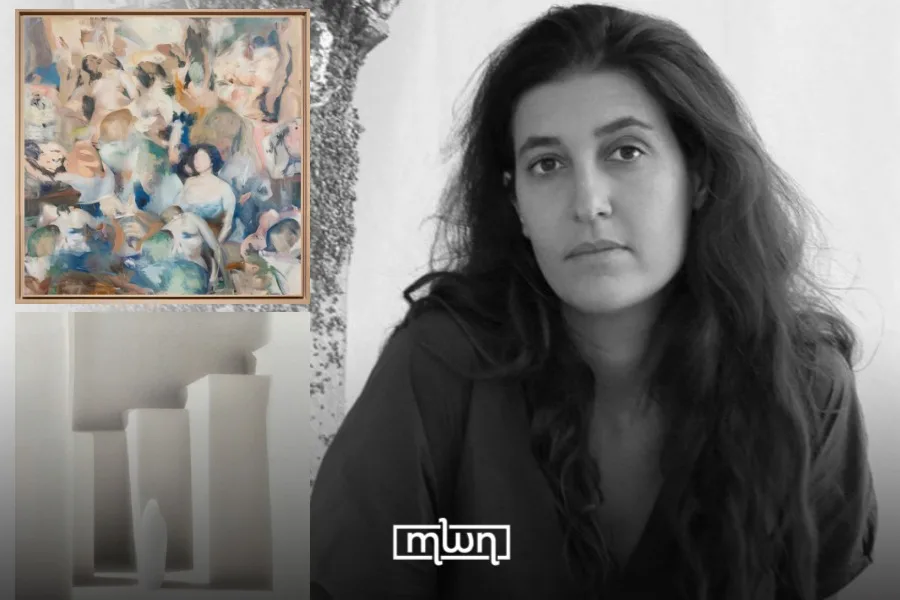
In “Sarabande,” Alaoui embraces the tactile weight of paint. The exhibition unfolds as a choreography of intertwined bodies, where movement overtakes figure and hierarchy dissolves.
Rather than offering fixed focal points, the canvases draw the eye into a restless circulation. Bodies twist and merge in dense clusters, refusing clear boundaries between foreground and background.
The suggested body
Drawing from the history of Western painting, from neoclassicism to early twentieth-century expressionism, Alaoui reactivates inherited postures and compositional structures associated with Eugène Delacroix, Édouard Manet, Henri Matisse, and Max Beckmann. These references are not quotations. They are shifts. The artist appropriates visual codes in order to displace their meaning.

Her figures are anonymous and intertwined. They are never individualized or eroticized. Instead, they are placed in tension within unstable compositions that at times evoke a mass grave, and at others suggest circular, almost choreographic movement. Hierarchies dissolve and no single figure dominates the scene.
Alaoui’s gaze remains distant and vigilant. Her painting does not narrate and does not moralize. It reveals. The body becomes the visible symptom of a world in deregulation, subjected to contradictory forces and oscillating between collapse and renewal. The canvas functions as a sensitive register of contemporary excess, excess of destruction as well as excess of sensation, without spectacle or indulgence.
At the threshold of truth
In counterpoint, the photographic series introduces a suspended temporality. Isolated figures stand within architectures defined by thresholds and passages. The compositions are geometric and restrained. Where painting accumulates and entangles, photography condenses.

Between appearance and disappearance, these solitary presences extend the reflection on transition, or perhaps on its disappearance in a world that shifts abruptly from one extreme to another. The body stands at the edge of visibility, caught between exposure and erasure.
“Sarabande” does not celebrate decadence and does not glorify transgression. It questions what our era struggles to produce, a form of transcendence. By mobilizing the codes of a grand pictorial tradition that once confronted the excesses of its own time, Alaoui turns the body into both archive and signal, a site where the tensions of the present remain inscribed.
