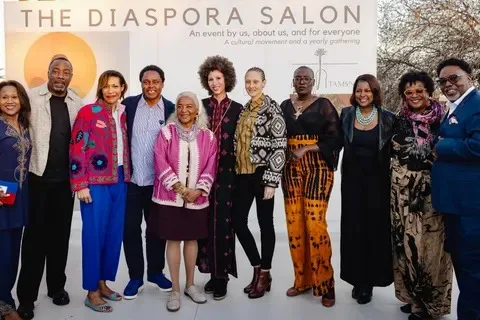
Lugano – Forbes has spotlighted The Diaspora Salon in a recent feature, highlighting its evolution into a growing global platform for cultural exchange and collaboration.
Founded by Meryanne Loum-Martin, a Senegalese-born, Parisian lawyer and owner of the boutique hotel Jnane Tamsna, the Diaspora Salon reflects her vision of creating a space where culture, identity and global exchange intersect.
Speaking to Forbes, Loum-Martin said the Salon was established to create “a transformative experience for active change and connecting people,” emphasizing its role as a space for unexpected connections and dialogue.
The concept for the Salon grew out of her observations during years of international travel, where she noticed that while Black communities worldwide share deep cultural connections, opportunities for cross-cultural gatherings remain limited.
She pointed out that these communities often engage within their own circles, with few spaces that bring together voices from across regions and backgrounds.
Highlighting this gap, Loum-Martin emphasised, “We don’t meet across the Diaspora as much as we should.”
Drawing on her background in law, hospitality and advocacy for African and diasporic voices, Loum-Martin has positioned the Salon as both an intellectual and cultural hub, connecting creatives, entrepreneurs and thought leaders from across the global Black community.
A gathering of culture & dialogue
Hosted annually at the Jnane Tamsna in Marrakech, the occasion welcomes artists, authors, academics and cultural figures for a multi-day exchange.
The most recent edition of the Diaspora Salon, held in Marrakech in February, brought together a diverse group of creatives, entrepreneurs and thinkers from across Africa and its diaspora.
The program featured notable voices including fintech entrepreneur Bryan Lattimore, co-founder of Utility, and New York Times bestselling author Heather McGhee, whose work has shaped global conversations on inequality.
The event also explored topics related to technology, featuring design director and AI practitioner Ovetta Sampson as a guest speaker.
Her work focuses on human-centered design and artificial intelligence, and she has held roles at IDEO, Microsoft and Google, contributing to more inclusive and responsible approaches to technology.
Designed as more than a traditional conference, the event offered an immersive environment where dialogue, collaboration and shared experiences take center stage.
From Intimate Salon to Global Platform
Originally conceived as a curated, salon-style gathering, the initiative draws inspiration from traditional intellectual salons, where ideas and creative expression are shared in an intimate setting.
Loum-Martin told Forbes, “People come expecting a conference. What they find is something much more human.”
Over time, the Salon has evolved into a broader platform connecting participants from dozens of countries and disciplines.
By hosting the event in Morocco, Loum-Martin underscores her hopes that people from the community know that there is “a space on the continent where they can come together, build, and think freely.”
The initiative places a strong emphasis on long-term engagement, encouraging participants to develop projects, partnerships and networks that extend beyond the event itself.
As the platform continues to grow, Loum-Martin is expanding its reach through podcasts, a book club and digital storytelling, with a documentary in development to bring the experience to a wider global audience.