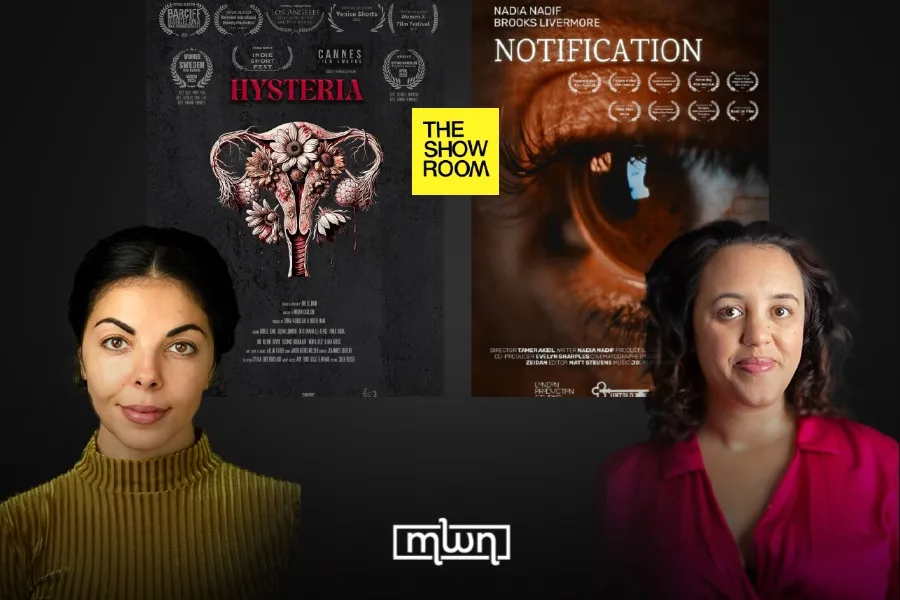
Fez — Two short films by Moroccan diasporic artists, “Hysteria” and “Notification,” will screen in London on May 26 as part of “Church St Arab Film Nights: Community Shorts,” a program presented at The Cockpit Theater.
The screening is part of a spring series presented by The Showroom and curated by The Arab Film Club and Ifriqiya Cinema. Founded by actress and curator Sarah Agha, the program brings together short films by Arab artists and filmmakers working across geographies and diasporas.
After the four-film screening, actress and writer Ibbi El Hani of “Hysteria” and actress and writer Nadia Nadif of “Notification” will join the on-stage Q&A, alongside writer Khalil Hefaf of “Aksil” and actress Sofia Asir of “Hind Under Siege.”
Moroccan voices in a wider Arab program
While the event includes four shorts, “Hysteria” and “Notification” stand out for their Moroccan and diasporic perspectives.
Written by Danish-Moroccan actress, writer, producer, and midwife Ibbi El Hani and directed by Miriam Carlsen, the short film follows Houda, a woman whose chronic pelvic pain is dismissed by doctors in a healthcare system shaped by gender bias and structural racism. Ekko’s listing describes the film as a drama about illness, power, racism, and isolation.
El Hani told Morocco World News (MWN) that she submitted the film because “structural racism in healthcare is also a very big problem in the UK — in fact in Europe and the US in general.”
“People end up getting very sick or even die because of prejudice from doctors and nurses,” she said.
For El Hani, the London screening matters because it places the film inside a community-led Arab film space. “What makes this event special is that this event is for Arab filmmakers, and I feel honoured for being selected,” she told MWN.
“I hope my short film can inspire and empower women and men to stand up for themselves,” she added. “We are not just stereotypes or a homogenous group. We are diverse humans.”
‘Notification’ and the politics of looking away
“Notification,” written by Nadia Nadif and directed by Tamer Akeil, takes a different route into the present moment. The short psychological drama follows a couple whose relationship is strained by clashing approaches to social media, news, and global crisis.
Nadif, who is English, Irish, and Moroccan, grew up in Colchester, Casablanca, and Hull; she has worked across stage, screen, and audio.
Nadif described “Notification” to MWN as a “Black Mirror style short” exploring “UK complicity in genocide, the Moroccan earthquake, social media use, being in a Mixed Heritage marriage and trying to conceive.”
The screenplay won the Screen South / Screen Ashford 2024 prize, with Greenlit describing the film as Nadif’s debut as a screenwriter.
Nadif said the project was made on a tight budget of £6,699 and employed 20 people during a two-day shoot. “In the UK a lot of short films are shot with ten times that budget,” she told MWN.
Her vision came from the emotional whiplash of 2023, when the Morocco earthquake and the war in Gaza forced different kinds of distance and proximity into daily life.
“There was the disconnect between me contacting my Moroccan family to check they were safe and being far away,” Nadif said. “Then when the genocide began suddenly censorship happened and I did feel like I was living in a parallel universe.”
She said the film explores how people in close relationships can live “on the same planet” while remaining “in different worlds” because of how they consume, avoid, or process the news.
A community screening with wider stakes
The Arab Film Club describes itself as a community-led platform showcasing cinema from the Arab world, with screenings and discussions that have covered films from Morocco, Palestine, Algeria, Tunisia, Lebanon, Syria, Sudan, and beyond.
Nadif said The Showroom’s location around Edgware Road gives the event a local community dimension, adding that Sarah Agha, who runs The Arab Film Club, is “a superb curator.”
The May 26 screening places “Hysteria” and “Notification” in a shared conversation about how private life absorbs public violence, whether through medical neglect, social media overload, or the emotional burden of watching distant crises unfold in real time.