Safi – Singer and musician CHAAMA has spent years turning old classics into electronic remakes, and she has done it all without a name or a face attached. The privacy is deliberate, and so is what sits beneath it.
“That feeling was never about who was listening,” CHAAMA told MWN Lifestyle magazine in an exclusive interview. “It was for me.”
‘It just happened’
There was never a master plan or defining moment. Singing was simply an interest and a hobby during her teenage years.
It was not until her mid-to-late twenties that she began making music, starting with cover songs she recorded on Smule for the joy of it.
“It wasn’t really one moment,” CHAAMA recalled. “It started with just doing covers on Smule for fun, no plan behind it. And then one day, I just posted one on Instagram. That was it. No big decision, no push. It just happened.”
What kept her going was never the crowd but the singing itself, which she likens to therapy.
“It’s soothing, almost therapy-like,” she explained. “The sound of music pulls me into this timeless, borderless bubble.”
From that bubble, she quietly built a career, sharing faceless covers and letting her voice speak for itself. Before long, her music had found listeners across North Africa and beyond.
Her YouTube channel counts more than half a million subscribers and 3.32M monthly listeners, with several remakes past a million views apiece. On Spotify, she draws more than 200,000 monthly listeners.
The bubble she lost
Everything shifted when one of her covers unexpectedly took off.
While the recognition opened new doors, CHAAMA said she still longs for the days when music was just for herself.
“Sadly, the moment it went viral, that’s when it stopped being just a hobby,” she said. “I miss sharing music without expectations, without pressure, without anyone watching. I miss my bubble.”
Staying unseen is how she protects what is left of that space. She does not perform live, and she stays out of the spotlight.
“The industry is hard,” she emphasized, “and staying true to yourself within it is even harder.”
Seen this way, hiding her face is less about mystery than preserving the place where her music began: within herself.
On her Instagram bio, she sums up that philosophy in two words: “Faceless Sound.”
She produces her own music videos too, so even the visuals stay on her terms.
For listeners, the missing face changes very little; the voice is the entire experience.
For CHAAMA, however, it changes everything, shielding her music from the distractions that often come with fame.
Chosen by nostalgia
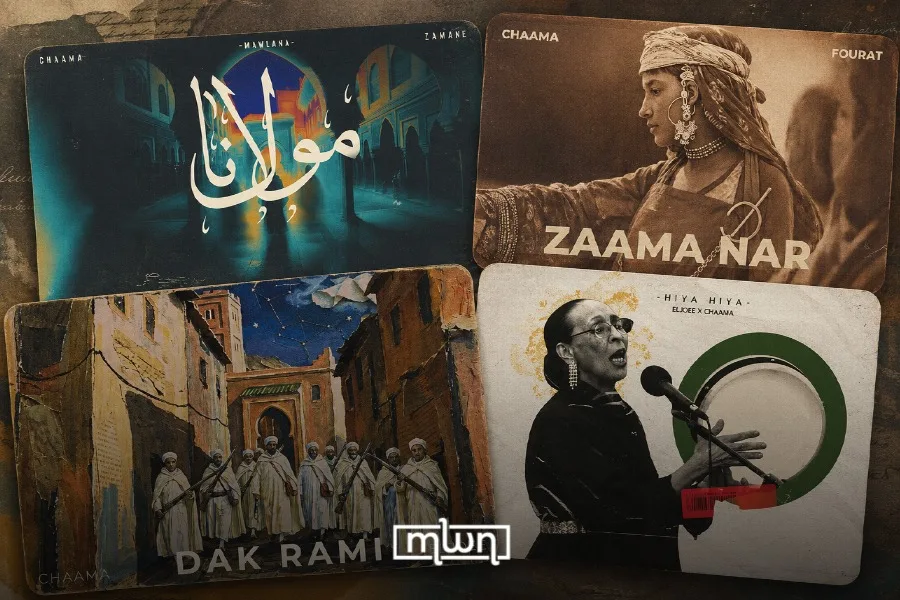
CHAAMA breathes new life into classic Arabic and Moroccan songs like “Hiya Hiya,” “Lala Mama” and “Moulat Lkhala,” layering them with electronic production while preserving their original melodies and lyrics.
The traditional maqam scales that define Arabic melodies remain untouched, serving as the foundation for electronic arrangements she creates with producers from across North Africa.
What she won’t do, however, is choose songs according to a formula.
Sometimes the inspiration comes from producers, other times from fans, but the final decision always comes down to one thing: the feeling a song evokes in her.
When asked what inspires most of her work, she immediately replied,“Nostalgia, always. That’s the root of most of it.”
That instinct is reflected throughout her catalog. One standout example is “Burakia,” an electronic reinterpretation of a Moroccan religious song created with Algerian producer Eljoee.
The track earned the duo a spot on the 2022 All Africa Music Awards shortlist for Best Female Artist in Inspirational Music.
Her approach has remained remarkably consistent,starting with an old song, building alongside a producer, and rediscovering the emotions that have always lived within it.
How her songs take shape
Some songs are stripped back to just her voice and a guitar, while others evolve into full-scale productions with collaborators like Eljoee, Zamane, and Faylsauf.
For CHAAMA, there is no need to choose between the two. According to her, producers give the songs “more levels and more depth.”
“It’s less about choosing,” she highlighted, “and more about what the song is allowed to become.”
Of all the songs she’s working on, one unreleased remake with Tunisian producer Fourat stands out. As soon as the production was finished, she knew it was special.
“We finished the production so quickly, and I fell in love with it immediately,” she stated. “I can’t say much more yet, but this one has a different kind of closeness to it.”
What remains and what matters
Despite the millions of streams and growing audience, what matters most to CHAAMA is something far quieter, which is “Inner peace over fame, over anything, anyone, everyone.”
For CHAAMA, music and memory are deeply intertwined. “Art is the transformation of a feeling into something lifeless and timeless at once,” she reflected.
“Facts fade. Time might not even really exist. But art is the proof. It’s the memory that remains. “That is why she looks backward instead of chasing new sounds.
“It wasn’t built for algorithms or social media,” she said. “It was built to be felt in that moment, and to last beyond it.”
Her greatest hope is that younger listeners hear one of her remakes and discover a piece of their heritage they didn’t even know they had inherited.
What’s next for CHAAMA,
She exclusively shared with MWN Lifestyle what listeners can expect next.
On July 24, she will release a blend of two Tunisian songs made with Fourat, and a new patriotic song will follow by the end of the month, after the success of “Huna Watan” and “Masiratna.”She also teased future collaborations with Eljoee, Fourat, Zamane, and artists from across North Africa. But for CHAAMA, the journey is still driven less by strategy than by the same passion that inspired her first Smule covers.
CHAAMA knows her music asks something different of listeners in 2026.
“I think the world is getting too hard to understand already,” she said. “I hope my songs aren’t a burden on top of that.They are not meant to be analyzed or explained, only felt.”