Fez — At 2.11 meters tall, Serge Ibaka has the kind of presence that changes the proportions of almost anything he wears.
For Paris-based stylist and image director Mickael Carpin, that scale is something to build around.
The former NBA champion’s recent appearances across Milan and Paris show the idea in motion. Over several major fashion events, Carpin moved Ibaka through sharply different visual identities, from structured Italian tailoring to monochrome eveningwear and raw denim.
The sequence also reflects Ibaka’s increasingly visible place in fashion after a career spent largely on basketball courts. In July, he spoke about the relationship between sport and creativity in a shoot styled by Carpin, describing fashion as another space for personal expression.
Starting in Milan
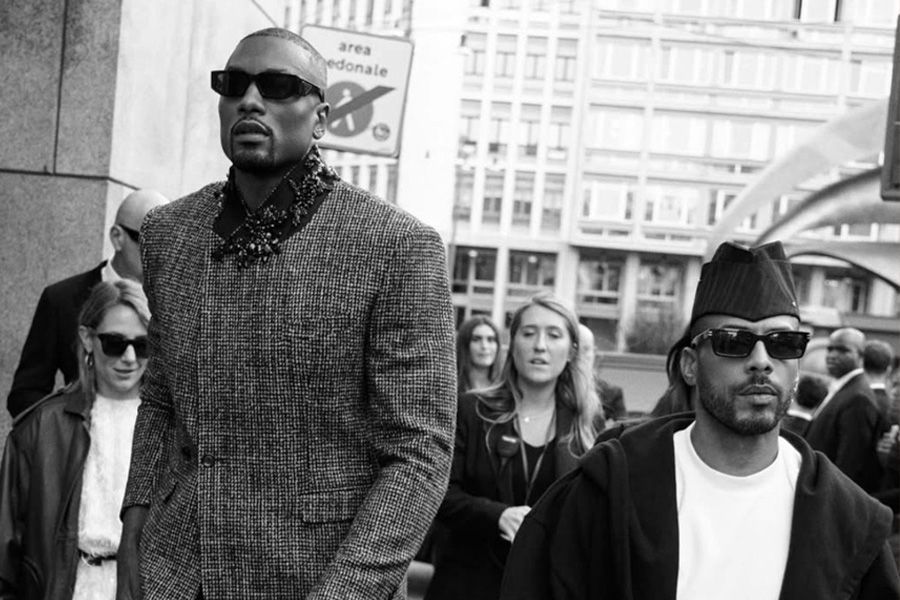
At “Vogue World: Milano,” Ibaka wore a black-and-white Dolce & Gabbana tweed blazer with pronounced shoulders and crystal embroidery.
Wide pleated trousers extended the line of the look, while black sunglasses kept the styling controlled despite the jacket’s sparkle.
The setting suited the approach. “Vogue World: Milano” took over the Galleria Vittorio Emanuele II on September 22, opening Milan Fashion Week with a celebration of Italian craftsmanship and fashion history. Vogue covered Ibaka among the guests arriving for the night.
The look was less about dressing an athlete formally than using tailoring to amplify a silhouette already difficult to ignore.
That distinction runs through Carpin’s work.
Based in Paris, the stylist has built a career across editorials, red carpets, and celebrity image-making. His work has appeared in titles including “Vogue,” “Harper’s Bazaar,” “Elle,” “L’Officiel,” and “Glamour,” while his collaborators have included Cindy Bruna, Precious Lee, Achraf Hakimi, and other figures across fashion and entertainment.
Carpin has also worked with Bruna for years. She has previously described their red-carpet process as one built around risk, experimentation, and trying unexpected ideas.
Paris changes the mood
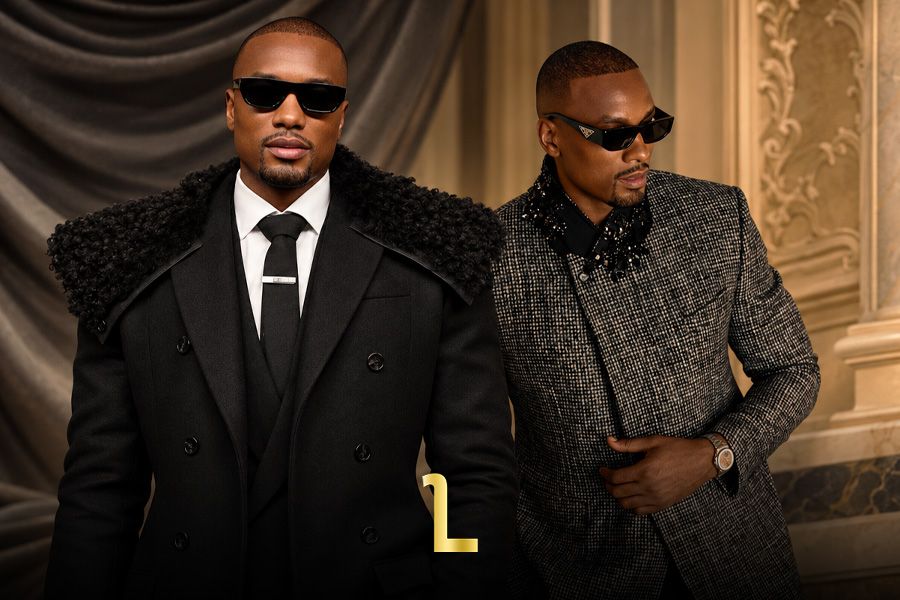
For the “BoF 500 Gala,” Ibaka’s wardrobe shifted into a darker and more formal register.
He wore a long black Louis Gabriel Nouchi coat with a shearling collar over a three-piece suit, finished with a white shirt, black tie, and silver tie clip.
The result relied almost entirely on black, letting proportion and texture do the work.
The annual gala takes place during Paris Fashion Week and brings together designers, models, executives, creative figures, and other names shaping the international fashion industry. The 2026 edition gathered the latest members of the wider “BoF 500” community.
Carpin then pushed Ibaka in almost the opposite direction for A$AP Rocky’s AWGE presentation.
The suit disappeared.
In its place came a raw denim jacket with contrast stitching, a white ribbed tank top, red cap, thick black glasses, silver jewelry, an engraved belt buckle, and a wallet chain.
A$AP Rocky staged the Spring/Summer 2027 AWGE show at Paris’ Accor Arena on September 30, shortly before performing there on his “Don’t Be Dumb” tour.
For Ibaka, the setting allowed Carpin to trade red-carpet polish for something more relaxed and street-led without losing the strong visual presence connecting the earlier looks.
Styling beyond the clothes
Carpin describes his work in broader terms than selecting outfits.
His approach is built around image direction, considering how clothing, proportions, accessories, photography, and public appearances contribute to the way a person is perceived.
That becomes particularly relevant with Ibaka, whose identity was established long before fashion became such a visible part of his public life.
He spent more than a decade in the NBA and won the 2019 championship with the Toronto Raptors. Fashion now gives him another visual language, one that does not require abandoning the physicality associated with his basketball career.
Carpin instead appears to be using it as the starting point.
Across Milan and Paris, Ibaka moved from crystal tweed to severe black tailoring and then into denim and streetwear. None of the looks attempted to make his stature less noticeable.
They did the opposite.
The result shows how athlete styling is moving beyond the predictable suit-and-red-carpet formula. In Carpin’s hands, Ibaka’s height, frame, and confidence become part of the design itself, giving the former NBA champion a fashion identity that can shift dramatically without losing its center.