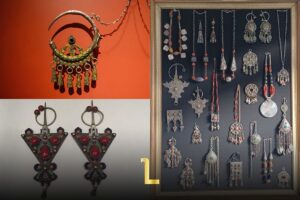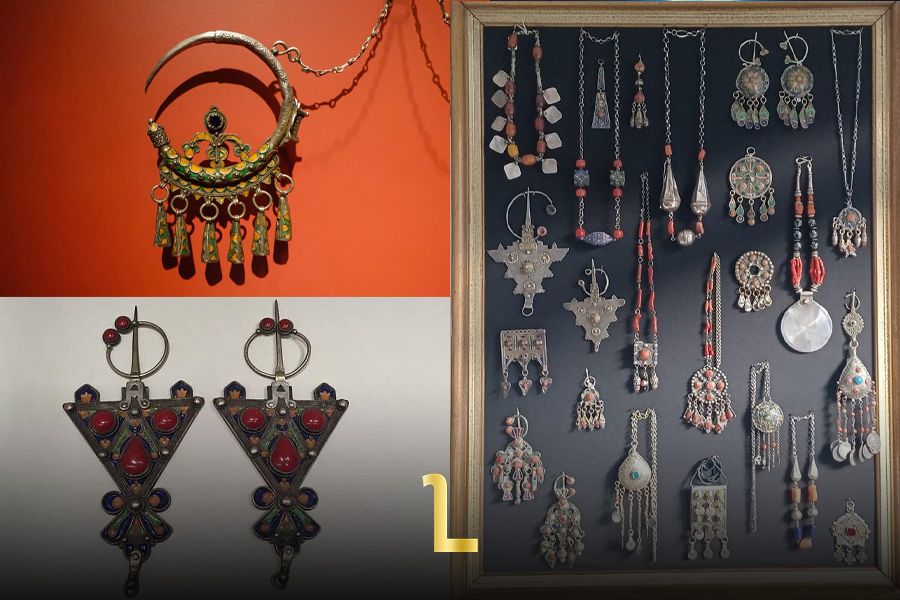
Rabat – For Amazigh women, jewelry was a form of protection against misfortune. It was also a way of showing who they were, since a silver necklace or brooch alone was often enough for someone to tell which tribe its owner belonged to.
That identity was carried largely by the designs. Amazigh jewelry is typically built from geometric shapes such as triangles, circles and squares, and open hands and crossed lines are among the most common motifs, whether engraved, hammered or enamelled onto different types of pieces. Each shape had its own meaning, usually tied to protection, fertility or stability.
The same shapes appear in other Amazigh art forms, including weaving, pottery, architecture and tattoos, which shows that the jewelry belongs to a wider, shared visual tradition.
History
Amazigh jewelry is older than both Islam and Arabic culture in Morocco. Archaeological evidence indicates that metalworking dates back to ancient times in the region. At a later time, trade routes through the Sahara Desert and the Mediterranean Sea brought gold, silver, amber, coral, and glass beads to the Amazigh population, which then created new additions to jewelry.
With time, jewelry acquired significance in tribal identity. The regions, starting with the Rif up to the Anti-Atlas, developed their unique styles that were a signal of status, motherhood, and protection.
Jewish silversmiths also played their role. In places like Fes, Tiznit, Sefrou, and Essaouira, they have worked side by side with the Amazigh for centuries, sharing techniques and traditions. The skill of the Jewish in ornamentation and finery made it possible for this activity to survive through shocks of political and cultural changes. Meanwhile, Amazigh silver remained for centuries the first choice while gold ruled in the Arabized urban centers.
In the Souss Valley, women are often seen wearing bulky fibulas combined with silver chains, signifying power and binding togetherness.
In mountain areas, the ornaments are more primitive and bulkier; they usually bear geometric marks and are worn during harvest celebrations, marriage ceremonies, and transitions.
In Northern Morocco, the weather has played its role in shaping jewelry pieces thanks to the influence of Andalusian immigrants and trade with the Mediterranean basin.
Each of the shapes has a meaning of its own. The triangle symbolizes femininity, procreation, and divine protection. The circle represents infinity. The square symbolizes stability and the existence of the world. Khmissa is the open palm designed to keep away evil eyes.
The crossed lines often refer to older traditions rooted in Amazigh culture. The jewelry worn by brides is usually passed on from a mother to a daughter and signifies procreation and connections. Silver is also believed to repel darkness due to its ability to reflect light.
How it is made
The blacksmiths operating in Tiznit, Taroudant, and Marrakech still use bellows, anvils, and hand hammers. The production process starts with melting the pure silver and shaping it into plates or wires. After that, different techniques are employed.
The first one is filigree, which means twisting fine silver wires into delicate patterns. The second technique is called repoussé, which means hammering the metal from the reverse side. Then comes chasing, which is the process of engraving surfaces. After that comes granulation, when the tiny silver beads are fused onto the metal. Enamelling is adding color by fusing glass powder into the metal.
Each process is done by hand following the skills passed down from generations. Many artisans consider their work sacred and recite prayers and verses in the course of hammering and engraving.
Modern changes
In the latter half of the 20th century, the migration from rural areas to urban centers occurred among the community; thus, the traditional lifestyle season in rural Morocco was fundamentally compromised.
Jewelry retained very little value, while the volume of production decreased significantly together with demand. Cynthia Becker, a renowned art historian, conducted her field research in Southern Morocco, where she found that only a few Amazigh women were wearing silver any longer, and old clothing patterns and accessories were only presented on marriage occasions.
The majority of researchers confirmed that many women preferred wearing modern-type jewelry in gold. Old jewelry was usually sold to mobile traders, who would then sell it in retail antique and souvenir shops. Conditions of mass manufacturing and cheap imports became an additional pressure factor for silversmith manufacturers.
In contemporary realities, the market is dominated by tourists and foreign collectors. The jewelry is often used in modern art as a way of expressing a nostalgic vision of past events.
A revival has taken place since the end of the 20th century. Women’s cooperatives in Tiznit and in the Souss-Massa region have received support from government programs and NGOs. Through the sale of their genuine products to visitors and markets, these women were able to provide income for themselves and preserve their culture.