

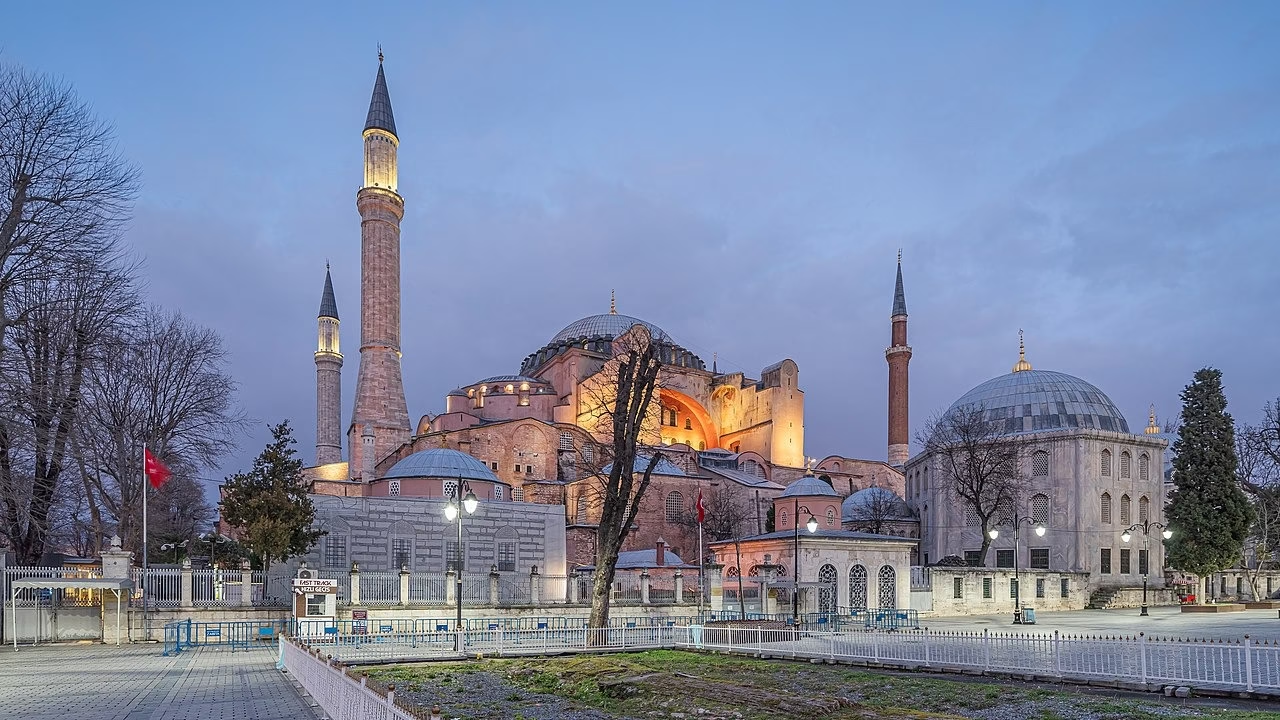
It’s seen empires fall, religions shift, and time stretch, yet it still stands.
Fez– There’s something otherworldly about stepping into Hagia Sophia. Regardless of faith, you feel it: a quiet grandeur that stretches and expands around you.
Originally built as a church in 537 AD, later converted into a mosque in 1453, this architectural marvel has survived conquests, earthquakes, political storms, and still stands tall at the heart of Istanbul.
The current structure isn’t even the first on the site. Before Hagia Sophia came two earlier churches, and even before those, a pagan temple.
The version we know today was commissioned by Emperor Justinian I, who was determined to outdo the Temple of Solomon in Jerusalem.
He summoned relics and columns from across the empire, effectively building a monument with the bones of ancient civilizations.
Legend has it that when Justinian first entered the completed structure, he looked up, overwhelmed, and exclaimed: “Solomon, I have outdone you!” A powerful moment, though, historically, a little shaky. The tale didn’t appear until centuries later.
But regardless of lore, the ambition was real. The project was finished in just five years, an astonishing feat given its size and complexity.
Estimates of the cost vary wildly, from 20,000 pounds of gold (according to one historian) to the modern equivalent of $1.3 billion, making it even pricier than the restoration of Notre Dame.
Inside, Christian mosaics share space with grand Islamic calligraphy, Jesus and Mary beside Quranic verses.
That coexistence isn’t accidental. When the Ottomans took Constantinople in 1453, Sultan Mehmed II converted the church into a mosque but preserved much of its iconography.
He saw it not just as a place of worship, but as a symbol of legitimacy. Later, in the 16th century, some mosaics were plastered over, but not destroyed.
Fast forward to 1935, and under Atatürk’s secular reforms, Hagia Sophia became a museum. The covered mosaics were unveiled, restored, and reintroduced to the world.
That lasted until 2020, when Turkey reclassified it as a mosque once again. Still, it remains open to visitors, with an entrance fee introduced in 2024.
In April 2025, a major three-year restoration project began, focusing on preserving its iconic dome and seismic stability.
Hagia Sophia is a palimpsest of power, faith, and identity, a building that has never belonged to one era or one people.
Instead, it continues to evolve, adapting to whoever holds the keys, while somehow staying the same.
Not many structures can say they’ve lasted 1,600 years. Hagia Sophia can. And it’s not done yet.
Read more: How a Babylonian Princess Invented the World’s First Museum 2,500 Years Ago