Fez — Morocco can now add 16 newly described spiders to its biodiversity records, and at least one comes with a name sports fans will recognize immediately.
Scientists studying spiders collected across Morocco between 2021 and 2025 have formally described 16 species that were previously unknown to science.
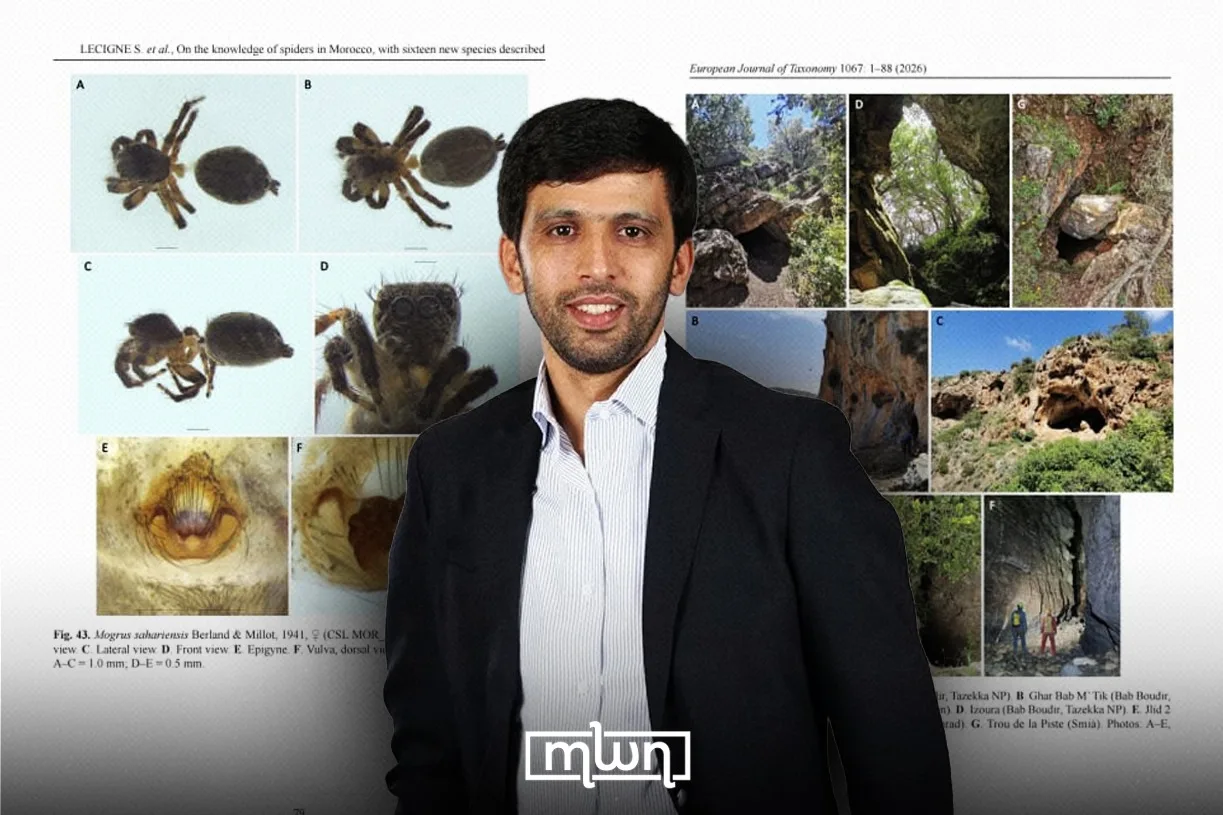
Their 88-page study, published in June in the “European Journal of Taxonomy,” records 40 spider species belonging to 10 families. Researchers explored everything from beaches and rocky grasslands to forests and eight caves in Tazekka National Park and the Beni Snassen massif.
A spider fit for a Moroccan running legend
One of the discoveries is “Gorbiscape hichamelguerrouji,” a species found in Berkane in Morocco’s Oriental region.
The study explains that the species was named as a tribute to the Moroccan middle-distance running legend, praising his achievements, dedication, and influence on generations of young athletes.
El Guerrouj still holds the world records for the 1,500 meters and mile, meaning he can now add something considerably stranger to his legacy: having a Moroccan spider carry his name.
The species belongs to the genus “Gorbiscape,” and the “World Spider Catalog” now formally lists it among the genus’ recognized species.
Not every name requires an Olympic résumé, though.
There is also a spider named after Moroccan hospitality
Researchers discovered another new species in Sefrou and called it “Oecobius diafa.”
“Diafa” comes from the Arabic ضيافة, meaning hospitality.
The scientists write that the name honors locals who welcomed them during their fieldwork, as well as the hospitality they experienced across Morocco during their expeditions.
The spider itself is tiny. The male specimen described in the study measured just 2.27 millimeters in total length, making its very Moroccan name considerably larger than its body.
Other names read almost like a map of the country.
“Oecobius tiznit” takes its name from Tiznit, while “Nomisia tazekka” references Tazekka. “Gorbiscape dayetchiker” points to Dayet Chiker, and “Dysdera sidimaafa” recalls Sidi Maafa.
Another species, “Gorbiscape littoralis,” was found near the mouth of the Oued Souss River outside Agadir, in coastal dunes and thorny vegetation.
Morocco’s caves may be hiding even stranger residents
Two of the newly described spiders stood out because of their relationship with underground habitats.
Researchers said “Lycosoides jlida” may be a cave-loving species, while “Lepthyphantes ntafaghi” could be even more specialized for life underground.
Together, the discoveries show how much of Morocco’s biodiversity remains easy to walk past, crawl over, or apparently leave hiding inside a cave.
Sixteen spiders may not change everyday life in Morocco, but they add 16 new entries to science’s understanding of the natural world. And somewhere in Berkane, a tiny eight-legged tribute to one of Morocco’s greatest athletes is now officially part of it.