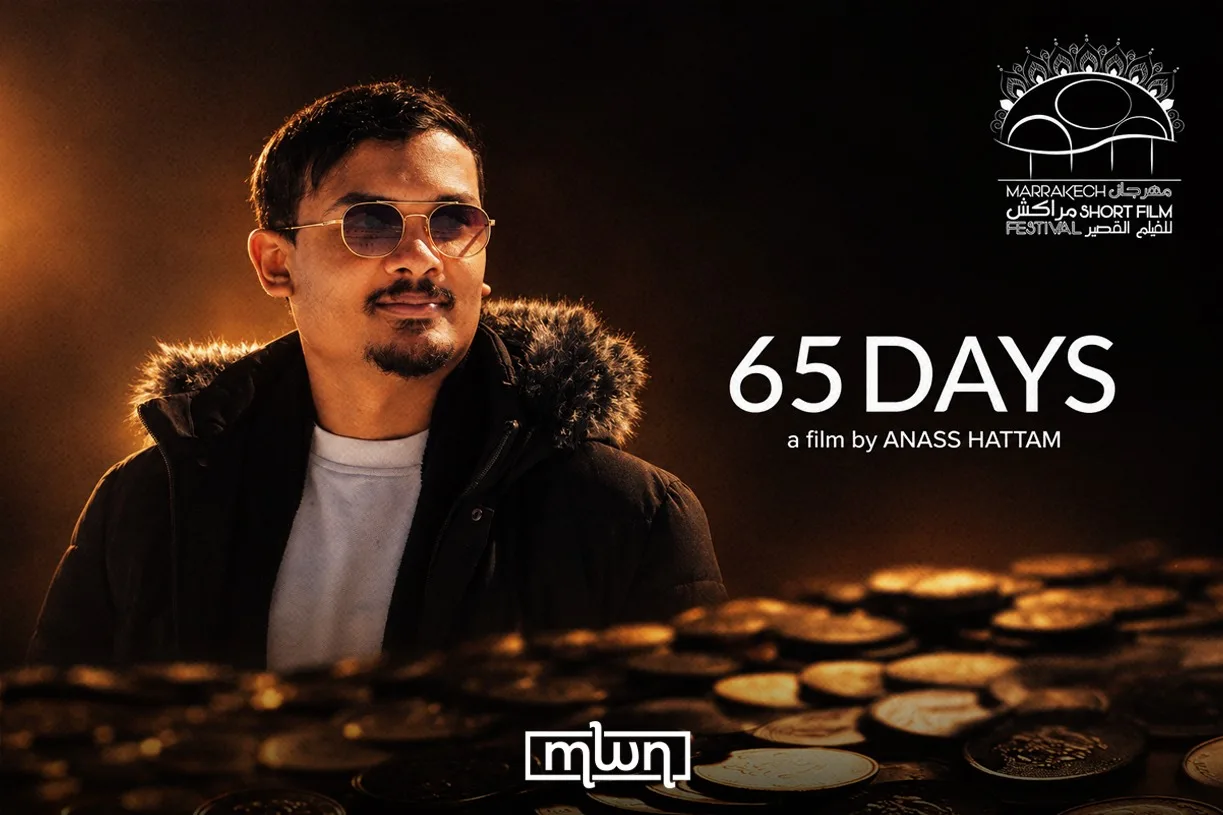
Rabat — In “65 Days,” a conversation over a cafe waiter’s salary gradually becomes something far more unsettling, exposing how power can operate through changed numbers, broken promises, and the slow erosion of someone’s confidence in what they are owed.
There is a particular kind of tension in a room where nobody raises their voice.
No slammed doors. No dramatic confrontation. No music telling you when to feel afraid. Just two people sitting across a table, discussing a salary, and, somewhere beneath the arithmetic, a question of dignity.
That is the territory explored by Moroccan filmmaker Anass Hattam in “65 Days,” a short film centered on the relationship between a café waiter and his employer. What initially appears to be an ordinary conversation about wages gradually becomes something more unsettling: a struggle over power, memory, and the value of a person’s time.
For Hattam, however, calling the film a story with a specific “message” feels a little too definitive, and definitely limiting.
“I’m always a little afraid of the word message,” he explained in an interview to MWN Lifestyle magazine. “I believe a message arrives already sealed. Cinema for me should arrive with the envelope torn open.”
That openness is central to the way Hattam approaches “65 Days.” Rather than telling audiences what to think, the film places them inside an uncomfortable space and allows them to recognize it for themselves, perhaps as a worker, perhaps as an employer, or, more uneasily, as both.
The moment when someone begins “bargaining with his own dignity” simply because he needs to survive is what stayed with Hattam throughout the making of the film. Yet violence is rarely visible in “65 Days.” Instead, it takes the form of altered numbers, broken promises, changed agreements, and the subtle manipulation of reality.
“Someone simply moves a number on a piece of paper. Changes an agreement. Makes you doubt your own memory,” the director said.
The room remains calm. Life continues outside. Yet something inside the person sitting at that table is slowly being diminished.
A café as a stage for power
Hattam’s choice of a café as the film’s setting is far from incidental.
For him, the café represents a “beautiful contradiction”: a place associated with leisure that depends on somebody else’s constant movement.
“You sit. Someone stands. You linger. Someone watches the clock,” Hattam explained.
The hierarchy is almost physically written into the space. The owner can remain seated while the waiter crosses the room again and again. One body accumulates fatigue; the other accumulates authority.
It is also a setting rich with cinematic details: glass, steam, metal spoons, fluorescent light, daylight, chairs scraping across the floor and faces briefly caught in reflections.
But beyond its visual possibilities, the café keeps the film’s central conflict close to everyday life.
“This is not a factory behind a wall,” Hattam maintained. “It is a place we enter every day. We order something. We leave. And somebody stays.”
That final distinction, between those who leave and those who remain, captures much of the quiet unease at the heart of “65 Days”.
When time becomes a burden
The title itself carries that weight.
At first, Hattam said, 65 was simply a measure of time. Then it became something heavier.
Someone waiting for recognition, payment, or a promise to be honored does not experience time as a number on a calendar. They relate to it as something physical, visceral, be it in the form of tired feet, an aching back, a shirt washed at night because it must be worn the next morning again.
“Sixty-five days means sixty-five mornings of believing that endurance is leading somewhere,” the Moroccan filmmaker added.
That idea of hope is particularly important to Hattam. Hope, he suggests, can sometimes become a form of confinement. Tomorrow things will improve. At the end of the month, things will be different. After the trial period, a promise will finally become real.
The cruelty lies not only in the time taken from the worker, but in the meaning he has given those days.
“Sixty-five days are not very long,” Hattam stated. “Unless they are yours.”
The violence of speaking softly
The film’s central confrontation is therefore not built around explosive conflict. Hattam was more interested in what happens when power speaks quietly.
He spoke of how this faked, artificial softness is a weapon: a day disappears, an amount changes, an accusation is made. Suddenly, the person with less power is forced to defend not only his wages, but his version of reality.
For Hattam, that dynamic extends far beyond the workplace.
“It happens between people all the time,” he added. “Not only employers and workers. In families. In relationships. In institutions.”
As the Moroccan director sees it, the deeper fear is the loneliness of having to prove your own experience.
For that reason, the confrontation in “65 Days” is ultimately less about money than about whether the days someone gave- their labour, time, and endurance- can simply be declared to have meant less.
Refusing to create a villain
Hattam also resisted turning the café owner into a conventional antagonist.
“I never wanted him to enter the frame carrying evil with him,” he further explained. “That would let us off too easily.”
Instead, he wanted to preserve the character’s humanity. People capable of hurting others are not necessarily monstrous at every moment. They laugh, have families, worry about bills and develop explanations that allow them to live comfortably with their own choices.
For Hattam, that is precisely what makes the character more disturbing.
“Maybe exploitation, when practiced long enough, becomes administration,” he said. “A figure on a page. A shrug. This is how things are.”
The question, then, is not simply whether a villain would exploit someone. It is what ordinary people allow themselves to do when the circumstances happen to favour them.
From a Moroccan café to a wider conversation
That question now travels with “65 Days” to the Marrakech Short Film Festival, where the film has been selected for the Behja Prize category through the performance of Mohamed Ben Seltana, recognized in the Best Actor category.
For Hattam, there is something particularly fitting about that recognition.
The film began with a worker whose presence could easily be overlooked. Now, the performance of the café owner is itself being placed in the spotlight.
“There is something very fitting about that for this film,” he proposed.
The selection also places “65 Days” within a festival bringing together filmmakers from more than 90 countries, reinforcing the idea that a very local story can enter a much larger conversation.
Hattam does not believe that making a film “universal” requires stripping it of its identity.
“It is Moroccan because I am Moroccan,” he said. “The air is Moroccan. The pauses are Moroccan. The way people negotiate pride without naming it is Moroccan.”
He is wary of universality when it comes at the expense of those fingerprints.
Yet exploitation, he argues, travels easily.
A café may look different from one country to another, but the feeling of discovering that another person has greater control over your future is immediately recognisable.
“I hope it contributes to a silence people recognize,” Hattam added.
For him, that is where cinema can cross borders. The local detail can remain entirely local while the emotion underneath it belongs to no particular country.
“The wound beneath it has no passport.”
Learning to say less
Perhaps the most revealing part of Hattam’s reflection on 65 Days is what the film taught him about directing.
“I learned to arrive later,” he said.
He means this both literally and creatively. Rather than entering a scene determined to explain why someone is hurt or what the audience should notice, he has become more interested in allowing the audience to encounter the wound before being told where it came from.
The lesson has been one of subtraction.
Take away the explanatory line. Move the camera less. Stay on a face longer. Allow silence to become uncomfortable. Trust an actor when, on the surface, nothing appears to be happening.
For Hattam, directing is increasingly about removing rather than adding, allowing a scene to breathe without the filmmaker’s fingerprints all over it.
“There is a moment on set when everybody becomes nervous about stillness,” he said. “The harder thing is to recognize when the emptiness is the thing.”
That instinct is perhaps what makes “65 Days” particularly suited to a short-film festival built around cinematic voices from different places. The film does not rely on spectacle. Its tension comes from what remains unsaid, from expressions that barely change and from the space between two people who are not experiencing the same reality.
What comes after ‘65 Days’?
For now, Hattam is resisting the pressure to immediately move on to the next project.
“There isn’t an upcoming project,” he declared.
Instead, he is allowing himself to experience the success of “65 Days” while watching another part of his creative journey unfold through “SWEAT”, his first animation film.
He describes learning animation as “learning to see in the dark one frame at a time,” an experience that has encouraged him to remain open, listen more carefully, and continue learning.
There is something quietly appropriate about that philosophy coming from the filmmaker behind “65 Days”.
His film is concerned with the value of time, the days we give to work, to hope and to promises. His own creative process appears to be moving in the opposite direction: slowing down enough to notice what might otherwise disappear.
“Every film leaves something behind in you,” Hattam maintained, “the way light remains in your eyes after the screen goes black.”
He is for now staying with that afterimage, letting his eyes adjust.