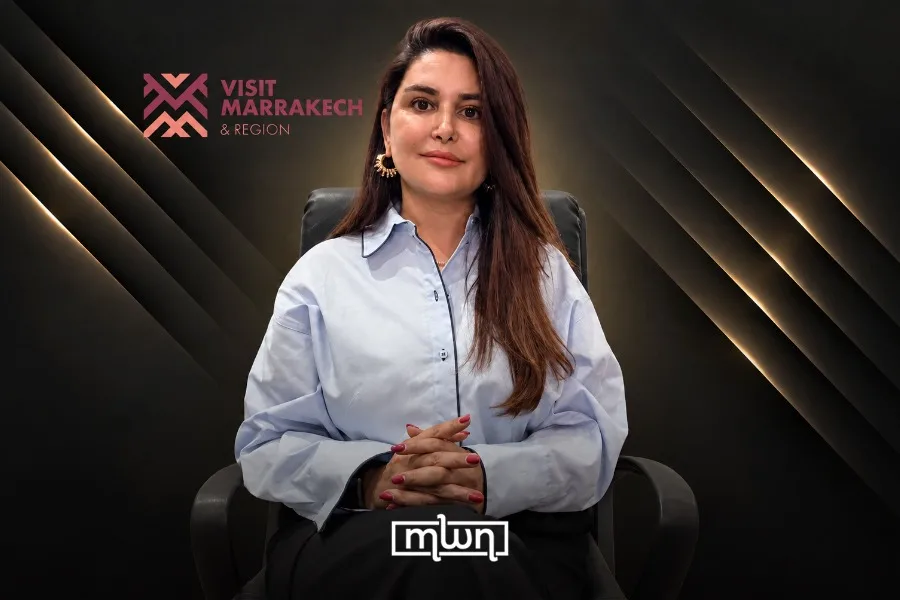
Fez — Imane Rmili has announced her candidacy for the presidency of the Marrakech-Safi Regional Tourism Council (CRT), putting forward a platform focused on bringing tourism professionals closer together, widening representation across the region, and strengthening dialogue with public institutions.
The council is due to elect its president on September 29. The vote comes at a potentially significant moment for the organization, which has been led by Hamid Bentahar since 2008. He has also played a prominent role in Morocco’s wider tourism industry.
Rmili is presenting her candidacy not as a rejection of that period, but as an attempt to open a new phase in how the council works with professionals.
“I am not running against anyone. I am running to put forward a project and a way of working,” she said in a press release shared with MWN Lifestyle magazine.
“After many years of commitment to our industry, I believe the time has come for me to put my experience at the service of a new collective dynamic.”
Bringing more professions into the conversation
Rmili’s proposal places particular emphasis on representation. She wants hoteliers, restaurateurs, tour guides, tourism transport operators, travel agencies, guesthouses, golf operators, and leisure and experience providers to see the CRT as a practical space for dialogue rather than simply a promotional institution.
“We are all part of the same ecosystem,” she said. “Our professions are different and our challenges may sometimes differ, but we all have one destination to defend and develop.”
The approach builds on Rmili’s existing work within tourism representative bodies.
She currently heads the National Federation of Tourist Restaurants (FNRT). In 2025, she publicly announced her re-election for a second mandate at the federation, saying at the time that the organization had worked to strengthen the formal recognition of tourist restaurants within Morocco’s tourism sector.
According to her candidacy announcement, Rmili also serves as president of the Association of Restaurateurs of the Marrakech Wilaya (ARWM), vice president of the Marrakech-Safi CRT, and vice president of the CNT.
She comes from a Marrakech family with a long history in the restaurant sector and has more than three decades of professional experience.
Looking beyond Marrakech
One of the clearest themes in Rmili’s candidacy is the argument that a regional tourism council cannot focus on Marrakech alone.
Her platform calls for closer cooperation with tourism professionals and provincial councils in Essaouira, Safi, Al Haouz, Rehamna, Chichaoua, El Kelâa des Sraghna, and Youssoufia.
“Marrakech is an extraordinary driving force, but our responsibility is to think about Marrakech-Safi as a whole,” she said.
That regional question has become increasingly visible in the CRT’s own work. This week, the council joined the Essaouira Provincial Tourism Council at IFTM Top Resa in Paris, where the two organizations promoted a broader Marrakech-Safi offer to the French market rather than Marrakech as a standalone destination.
Rmili said she wants that logic to extend beyond promotion and into decision-making. Her proposal includes closer work with provincial tourism councils so that professionals outside Marrakech have a clearer role in shaping regional priorities.
A growing industry faces new pressures
The leadership vote also comes during a period of rapid growth for Moroccan tourism.
The Ministry of Tourism reported that Morocco welcomed 19.8 million tourists in 2025, an increase of 14% from the previous year. Tourism receipts later reached MAD 138 billion ($ 14,49 billion) for the full year.
The ministry also said that arrivals continued to rise in 2026, growing by nearly 7% during the first quarter, more than three times the global average recorded over the same period.
For Marrakech-Safi, that expansion brings opportunities but also pressure on infrastructure, staffing, transport, service standards, regulation, and the distribution of tourism activity beyond the region’s best-known destinations.
Rmili argues that the CRT should play a stronger role in connecting those concerns with the institutions responsible for addressing them.
“The CRT must be a genuine bridge,” she said. “Our role is to listen to the challenges faced by professionals, bring them to the appropriate decision-makers and work together to find concrete solutions.”
Her platform calls for regular coordination with local and regional authorities, municipalities, the Regional Investment Centre, and national tourism institutions on issues ranging from mobility and infrastructure to investment and training.
Quality, training, and the informal sector
Professionalization is another major element of Rmili’s program.
With Morocco preparing for major international events, including the 2030 FIFA World Cup, she argues that tourism growth needs to be accompanied by improved service quality, stronger professional training, and clearer enforcement against informal operators.
“Those who invest, create jobs, meet their obligations and comply with regulations must be supported and protected,” she said.
The issue reaches beyond enforcement. Rmili also wants the council to help businesses develop the skills needed to respond to changing visitor habits and increasingly competitive international markets.
The CRT has already been moving into areas such as digital training. In June, it organized a workshop for tour operators, destination management companies, and experience providers focused on online distribution, booking technology, and digital payments.
For Rmili, the next step would be to make that kind of support part of a wider model built around what she describes as three commitments: “Listen. Unite. Act.”
“I do not claim to have all the answers,” she said. “What I do commit to is meeting professionals, listening to every profession and every territory, bringing people together and working collectively.”
After nearly 18 years of continuity under Bentahar, the September 29 vote will determine whether the Marrakech-Safi tourism council enters its next phase under new leadership.
Whatever the outcome, Rmili’s candidacy is already placing questions of regional representation, professional coordination, and the management of tourism growth at the center of the conversation.