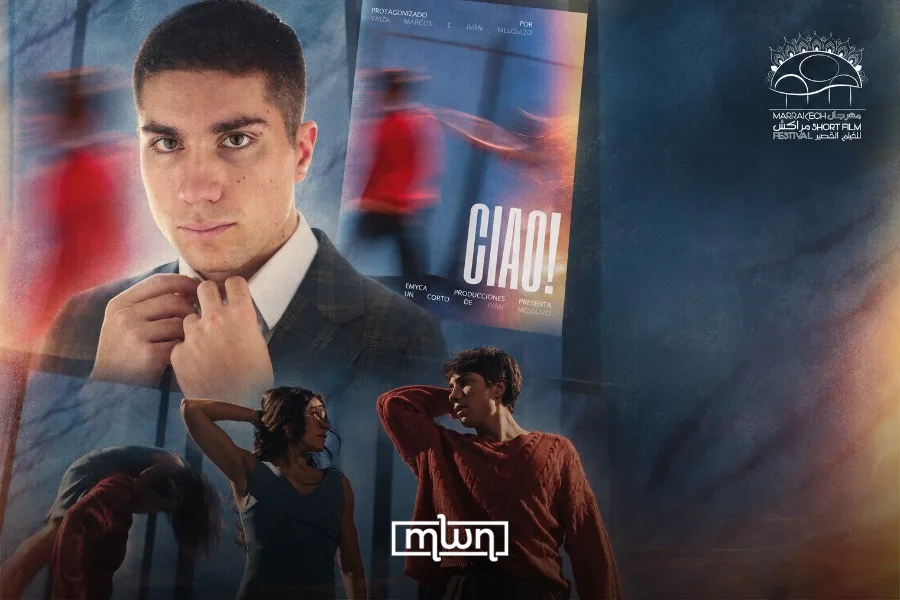
Casablanca – What does a breakup look like when words are not enough to explain it? For Iván Melguizo Martín, it looks like a door between two people who share the same space but know they will never see each other again.
That image sits at the heart of “Ciao!”, the Spanish filmmaker’s seven-minute short about heartbreak, fantasy and the sudden return to reality that comes when love ends. Melguizo directs the film and takes on an acting role, blending fiction with choreography and video art.
Now, “Ciao!” is heading to Marrakech. The film forms part of the international competition at the sixth Marrakech Short Film Festival, which will bring more than 400 submissions from over 90 countries into the city from September 25 to 30, 2026.
A seven-minute story about heartbreak
“The starting point for the film was the image of a door between two people who are never going to see each other again,” Melguizo said in an interview with MWN Lifestyle Magazine.
For him, that physical distance became a way to express the emotional distance created by a breakup. He also wanted the film to capture the strange way love can change how people see the world.
“Ciao! is a story about heartbreak, about what it feels like when something comes to an end and you don’t want it to,” he said.
The filmmaker describes the world of the short as a reality touched by fairy tale. Love makes everything appear brighter, almost unreal, before that fantasy eventually meets reality.
“And it is precisely at that point that this fantasy collides with reality,” Melguizo further explained. “That is where Ciao! begins.”
The film’s seven-minute running time also shapes the way the story unfolds. Rather than explaining everything, Melguizo leaves space for viewers to bring their own experiences into the film.
“I believe in a dialogue between the author and the audience,” he said.
The approach gives the audience enough information to understand the central idea while leaving certain gaps open. Melguizo said the team wanted viewers to read something specific as a universal experience without making the story feel generic.
That balance also reflects the filmmaker’s relationship with short films, a format he has explored for years.
From childhood stories to Ciao!
Melguizo has been making short films since he was 14. His interest in filmmaking, however, goes back even further.
“When I was a child, I used to record my toys and make up stories with them,” he said.
He joked that he might one day go back through that old material and discover a “cult body of work” hidden in the footage.
His professional work now covers several areas of audiovisual production. According to his professional profile, Melguizo works as a director, screenwriter, actor, and audiovisual producer. He is also a founding member of the theatre company emyca.
His recent audiovisual credits include “Ciao!”, which he directs and performs in, as well as De tanto usarlo, María and Postureo. His profile also lists his work as a producer on Epifanía, directed by Chiqui Carabante.
In 2024, Melguizo appeared in Dance of the bound men, directed by María Pizarro and Eva Banegas, and worked on De tanto usarlo as director and screenwriter. In 2025, he acted in Las Bizarrías, directed by Álvaro de Juan, and worked as assistant director on Los Hermanos, directed by Chiqui Carabante.
His theatre work has also continued alongside cinema. This year, he worked on Espinos y Martirio as an assistant director and performed as a dancer in Fedra, en los infiernos, directed by Jose María del Castillo. He also directed and wrote El Príncipe de Carabanchel, un Hamlet Castizo, which the profile says received the Second Prize at the ClassicOff Festival.
Melguizo’s training includes Estudio Juan Codina, Escuela de Cine y TV Séptima Ars and Escuela Primera Toma. He also studied theatre at Mountview Academy of Theatre Arts and completed a master’s degree in theatre direction.
For him, short filmmaking remains a useful space for experimentation.
“I think short films are a format that allows you to experiment and take risks in different ways,” he said. “They also force you to be precise.”
That last part suits him for another reason. Melguizo admitted that he tends to go off on tangents, so the limitations of the short-film format can help keep the work focused.
“Ciao!” itself went through a changing creative process. The team shot most of the film before making a first cut. Then Melguizo and the actress began talking about love and their own experiences, almost like they were making a documentary.
That conversation eventually became the testimony heard at the beginning of the film. It also changed the edit.
Although the filmmakers had a clear internal structure from the start, and carefully planned and rehearsed the choreography and other elements, Melguizo said the film “really found itself during the editing process.”
‘Ciao!’ finds a place in Marrakech
The film now arrives in Marrakech as part of the international competition at the sixth edition of the Marrakech Short Film Festival, running from September 25 to 30.
The festival received more than 400 short-film submissions from more than 90 countries across five continents. Its international competition includes films from countries including Italy, Iraq, China, Portugal, Australia, Albania, Lebanon, Kazakhstan, Egypt, Spain, the United Kingdom, South Korea and Japan. Ciao! appears in the official international selection alongside works such as “The Bridge,” “Where The Balloon Led Me,” “The Wind in Ash,” “Dog Alone,” “Trading Cards” and “Majonézé.”
The festival will screen films across several Marrakech locations, including El Badii Palace, Cyber Park, The Folk, the Institut français de Marrakech and the World Storytelling Café. The festival describes its program as an international platform connecting filmmakers, artists, audiences and industry professionals.
For Melguizo, the international festival journey of “Ciao!” was not something he could take for granted. The subject and the film’s experimental form both made the reception difficult to predict.
“The film’s festival journey was something of an unknown,” the filmmaker said, pointing to its focus on romantic love and its form, which sits close to video dance.
The response has nevertheless been a pleasant surprise for the filmmaker, particularly because of how personal the project became during its production.
“It is now reaching other countries and cultures,” he said, adding that the experience becomes more interesting when different audiences connect with the story from their own perspectives.
That is also what he hopes will happen when Moroccan audiences watch “Ciao!.’
Melguizo does not expect viewers to have one fixed interpretation of the film. Instead, he hopes the seven-minute story will bring back something personal for each person watching.
“When people finish watching the film, they remember someone special, a story, or a love they once had,” he said.
For the filmmaker, that personal memory matters more than a single explanation of what the film means.
“And that is what I would like to happen in Morocco too,” Melguizo said. “For each viewer to remember something that belongs to their own story during those seven minutes.”
“And remembering a love is always beautiful,” he concluded, referring to the feeling he hopes Ciao! leaves behind.