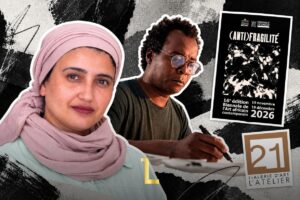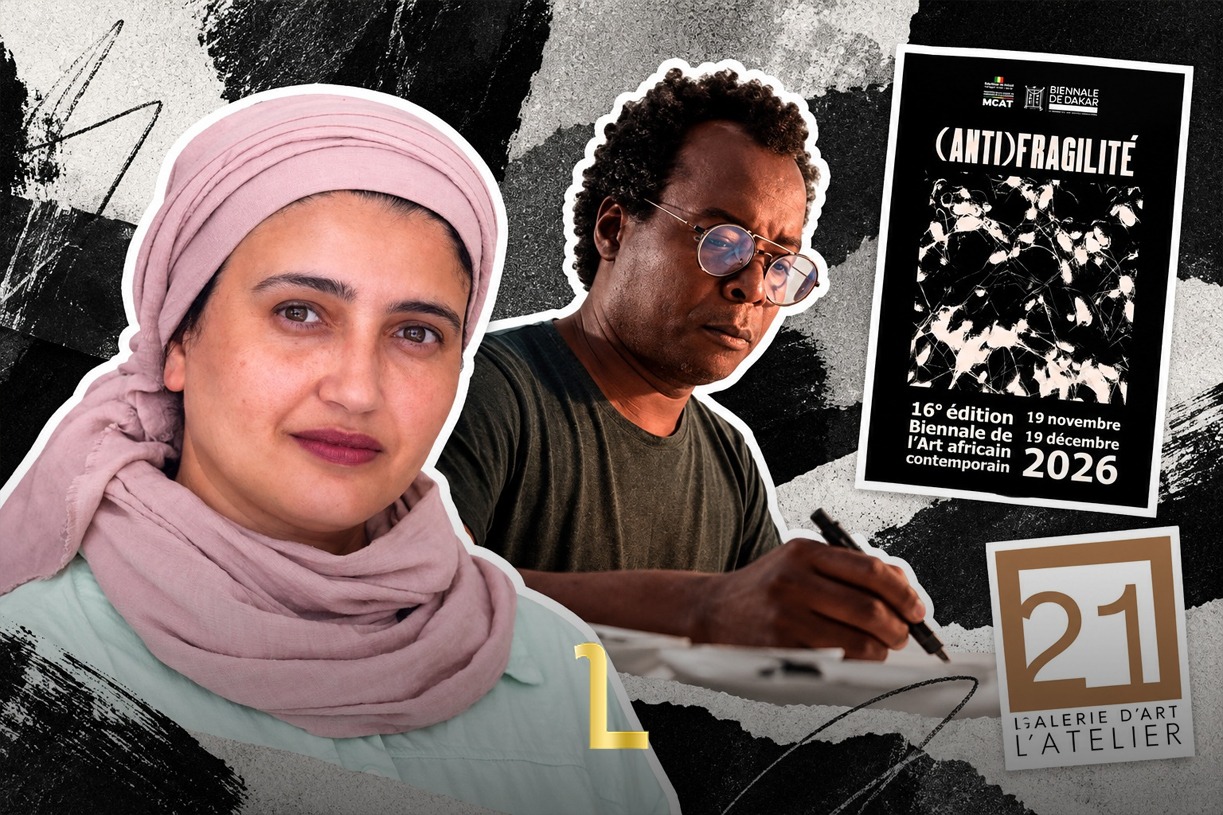
Fez — Moroccan artists Safaa Erruas and M’barek Bouhchichi will participate in the official international exhibition of the 2026 Dakar Biennale of Contemporary African Art, according to Casablanca-based gallery L’Atelier 21.
The 16th edition of the biennale, known as “Dak’Art,” will run from November 19 to December 19 in Senegal’s capital under the artistic direction of art historian and curator Morad Montazami.
This year’s theme, “(Anti)Fragility: Arts of Repair and Counter-Shock Strategies,” will explore how artists transform vulnerability into creative strength while addressing questions of resilience, cultural memory, and collective healing.
The official selection includes 54 artistic proposals for the international exhibition and 21 for the design section, bringing together creative practices from across Africa and beyond.
Safaa Erruas explores fragility through material
Born in Tetouan in 1976, Safaa Erruas graduated from the city’s National Institute of Fine Arts in 1998.
Her practice revolves around the color white and the physical properties of materials, combining delicate surfaces with objects that suggest danger, pain, or vulnerability.
Through installations and works on paper, Erruas incorporates cotton paper, Japanese paper, needles, pins, razor blades, metallic threads, cotton gauze, and fiberglass.
These contrasting materials create a visual language in which fragility and sharpness coexist. Her restrained compositions often conceal an underlying physical and emotional tension.
The artist currently lives and works in Tetouan, where she continues to examine the relationship between material, space, and perception.
Her ongoing exhibition, “Habiter l’interstice” (Inhabiting the Interstice), at L’Atelier 21 in Casablanca further examines the concepts of borders, passage, and the spaces between geographical and personal experiences.
The exhibition runs until November 7, shortly before her participation in Dakar.
M’barek Bouhchichi examines identity and the Black body
M’barek Bouhchichi, born in Akka in southern Morocco in 1975, approaches questions of identity and representation through sculpture, drawing, painting, and installation.
His practice explores the visibility and perception of the Black body within Moroccan society, drawing attention to the relationships between physical presence, cultural heritage, and collective memory.
Hands, faces, imprints, and bodily fragments frequently appear throughout his work, forming a recurring vocabulary through which he investigates belonging and historical representation.
Bouhchichi also examines how cultural narratives shape perceptions of identity and how artistic materials can preserve experiences that conventional historical accounts often overlook.
His interest in craftsmanship and material processes connects individual stories with broader questions about heritage, social visibility, and transmission.
The artist currently lives and works in Tahannaout, Morocco.
Dakar Biennale examines art as a form of repair
The 2026 edition of Dak’Art will focus on the possibilities of artistic creation in societies facing political, cultural, and social upheaval.
Artistic director Morad Montazami, who also directs Zamân Books & Curating, approaches antifragility as the ability to transform vulnerability into a source of expression and collective strength.
The biennale will highlight artistic practices that encourage collaboration, preserve cultural knowledge, and develop new responses to historical and contemporary challenges.
The participation of Erruas and Bouhchichi brings two distinct perspectives from Morocco’s contemporary art scene into this conversation.
While Erruas explores vulnerability through the tension between delicate and potentially harmful materials, Bouhchichi investigates identity and historical memory through representations of the body.
Their inclusion in the international exhibition underscores the diversity of Moroccan contemporary art and its engagement with questions that extend across the African continent.
As Dakar prepares to welcome artists and audiences from around the world, both artists will contribute to a wider dialogue about how art can confront inherited histories, question established narratives, and imagine new forms of cultural resilience.