Fez — The “Mémoire de la matière” exhibition at the Marriott Hotel in Rabat puts Moroccan artist Wafaa Mezouar and her long-standing work with pigments and raw materials at the center of the story. The show gathers recent pieces where earth, dust, and natural color meet metal elements, opening a visual conversation between weight, texture, and light.
A Moroccan artist rooted in matter
Born in Meknes in 1955, Mezouar studied at the École supérieure des Beaux-Arts in Casablanca and in architectural drawing before building a career that moved from tapestry to painting and mixed media. For about fifteen years she focused on modern wall tapestry, combining wool, cotton, jute, leather, old jewelry, metal wire, and fishing nets to bring traditional techniques into contemporary art.
Her work later shifted toward abstract painting, but the link to matter stayed strong. She began using worn metals, pages from old poetry books, sea-eroded wood, and organic and mineral pigments collected during travels. This has given her canvases a layered, almost archaeological feel, where surfaces seem to carry time as much as color. Over the decades she has exhibited in Europe, Asia, Africa, and the United States, won prizes in Tunisia, Paris, and London, and entered major collections, including the National Museum of Beijing.
Matter and light as a shared language
Speaking to Morocco World News at the Marriott, Mezouar said the core of the exhibition is the tension and balance between earth and light. “The theme of the exhibition is matter and light. Metal reflects light,” she told MWN, explaining that she chose to keep working with natural pigments and materials she reads as earth and dust. “For me, the earth is dust. The material consists of natural pigments that reflect the light of the earth.”
On the canvases, these pigments are spread, scratched, and built up into relief, creating surfaces that feel like fragments of landscape or memory. Browns, ochres, deep blues, and reds sit alongside areas that look worn, almost eroded. For Mezouar, this is not just an aesthetic choice but a way to make visible what materials remember — traces of place, time, and human gesture.
To deepen the play with light, she invited Beninese artist and jeweler-sculptor Paulin Bédou to intervene on some works with metal forms. “We created a fusion of our work between Morocco and Benin. The pigments meet the metals,” she told Morocco World News, adding that while she stays with earth and dust, he brings in metal as a carrier of reflection and shine.
A collaboration written on the canvas
Mezouar described the collaboration as a chance to open her surfaces to another voice while staying true to her own practice. “He, on the other hand, used metal. As a sculptor by origin, he is a jeweler who makes costume jewelry, but like a great designer, he expressed himself on my canvases,” she said. “I gave him the opportunity to express himself in my paintings, and I think he succeeded. I believe he understood the concept, and I find it wonderful.”

In one of the key works she mentioned to MWN, Bédou adds metal elements that suggest the moon and a pyramid. Mezouar reads this as a way of bringing in a broader story. “He represented the moon, for example, and the pyramid… He represented ancient Egypt; it is a story of humanity, a story that tells the history of humankind,” she said, noting how the gold tones and crown-like shapes give the piece a majestic presence.
Here again, the meeting point is matter: the weight and texture of pigments on canvas, the sharpness and shine of metal, the way both catch and transform light. The collaboration does not erase her voice; it extends it into another register.
A career of weaving tradition and experimentation
Even in this new exhibition, echoes of Mezouar’s earlier tapestry work remain. Her long practice of weaving and assembling materials feeds into the way she builds her painted surfaces, often treating the canvas almost like a textile support where elements are added, anchored, or allowed to fray.
Her subjects are rarely literal, but her references stay close to Morocco and to the wider worlds she has crossed: traces of carpets, jewelry, city walls, desert horizons, and sea-washed objects all inform the way she works with texture and color. Over time, her circular canvases have come to stand in for the world itself, as she often says she speaks “to humanity” through emotion and material rather than through a specific language or culture.
Marriott Rabat as a setting for living art
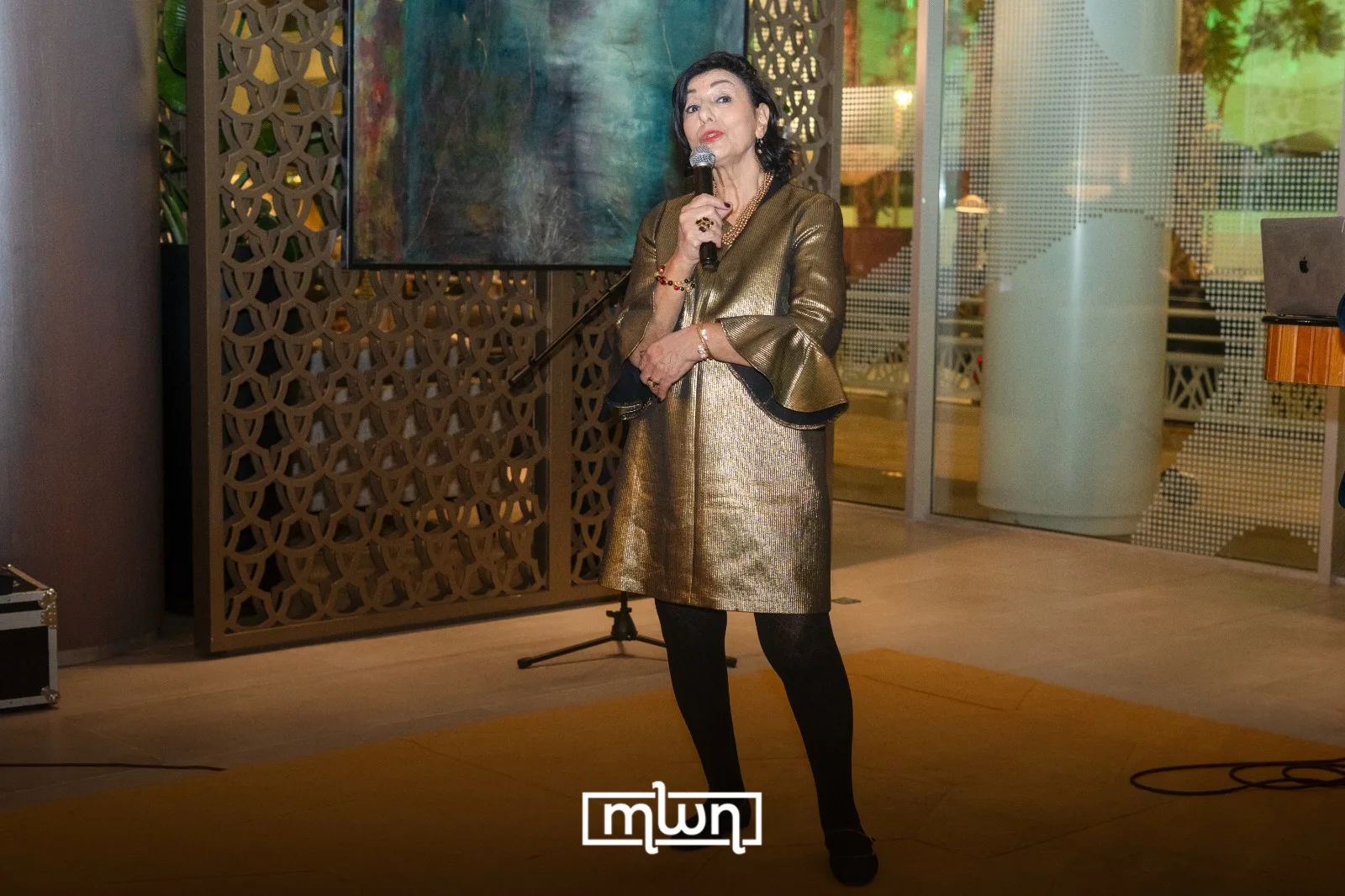
For Mezouar, showing “Mémoire de la matière” at the Marriott Rabat is also part of a larger movement to bring contemporary Moroccan art into everyday spaces. She told MWN she was honored to exhibit in what she called a beautiful hotel with a strong setting, and took time to thank the general manager, the directors, her friends, and her family for their support and presence.
With this exhibition, she returns once more to the elements that have defined her career: earth, dust, pigment, and now metal as a mirror of light. Through them, she keeps asking the same quiet question: what does matter remember, and how can an artist let that memory speak on the surface of a canvas?