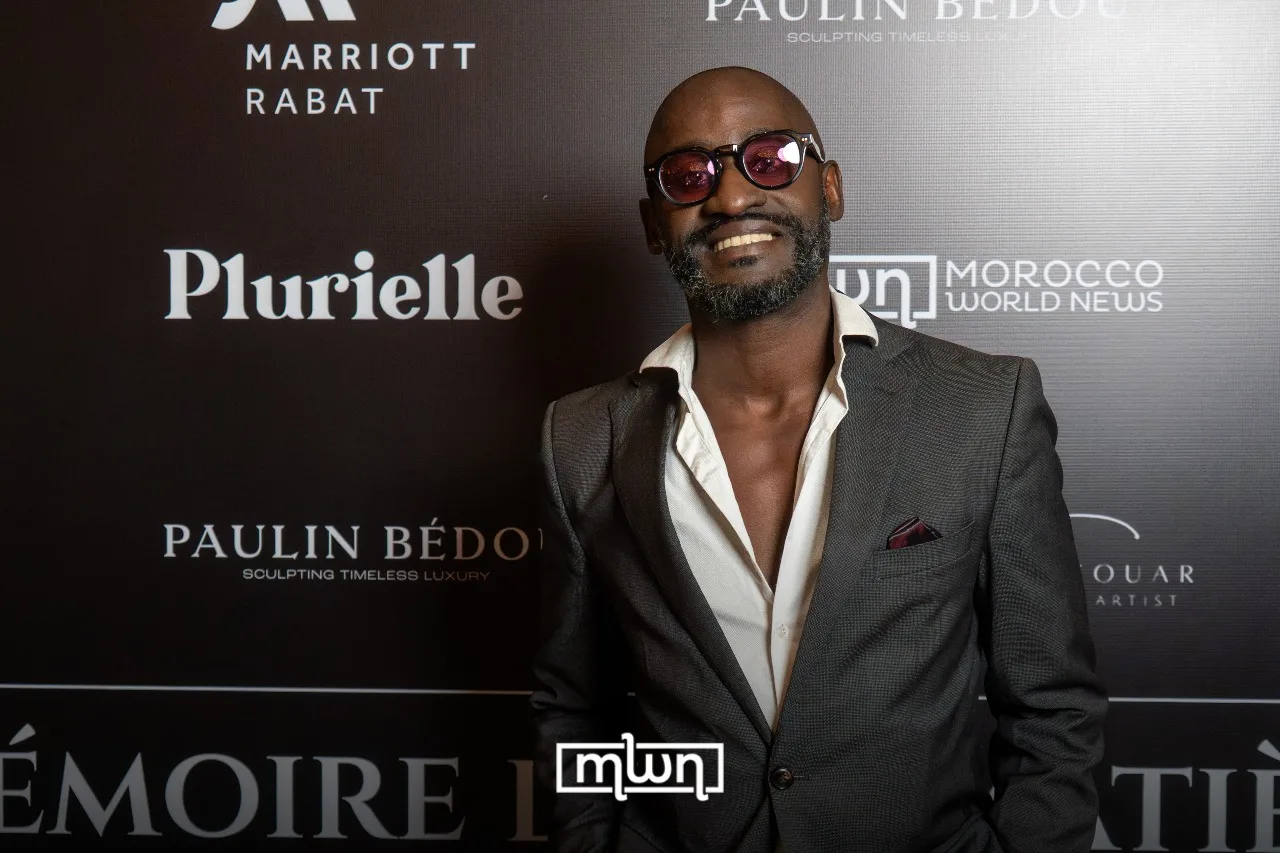
Rabat – French-Beninese artist Paulin Bédou brings his sculptural vision to life in “Mémoire de la Matière”, a new exhibition at Marriott Rabat created in collaboration with Moroccan painter Wafaa Mezouar.
The show transformed the space into a dialogue between materials and artistic approaches, where Bédou’s metallic structures and sculptural forms meet Mezouar’s mineral-inspired pigments.
Together, they explore the organic, the living, and the traces that matter carries, inviting visitors to experience art as a conversation between texture, form, and light.
Speaking to Morocco World News (MWN) on the sidelines of the event, Bédou described the exhibition as “a dialogue between what the eye sees and what the hand remembers.”
He explained that each piece reflects a belief he has carried since the beginning of his practice.
For him, the partnership with Wafaa is built on complementarity. Bédou approaches form through metal, sculpture, and structural detail, while Mezouar works with pigments and colors drawn from the mineral world. “Wafaa’s art is very mineral, focused on pigments and colors, evoking the essence of life, almost like the universe itself,” he said.
A dialogue between pigment, metal, and movement
The exhibition mixes their mediums across paintings, sculptural pieces, and even fashion.
Bédou explained that the process developed as a mutual exchange: “I have incorporated metallic elements and sculptures that complement her work. Just as I have adorned her paintings with my elements, she has embellished some of my leather dresses with pigments, crystals, and other materials, creating a coherent dialogue between our arts.”
This back-and-forth defines the exhibition’s visual language, where textures and tones shift from soft pigments to solid metals, and from sculptural relief to fluid shapes. The organic theme appears in each piece as an exploration of what lives, moves, or grows within matter.
“We created a collection around art, the organic, the living. We articulated all of this between artworks and paintings that I dressed with my sculptural work, and she, on her side, painted the leather dresses I created with her very organic touch, a very living aspect that really makes you dream about the stars and the universe.”
From Parisian workshops to a Moroccan turning point
Born in Paris in 1977 to a family of Beninese origin, Bédou grew up labeled as clumsy, an impression that later became the foundation of his creative impulse to fix, transform, and reshape.
After studying literature and philosophy, he discovered jewelry design by chance while working in a Paris shop. Fragile Murano-glass pieces broke often, and repairing them taught him technique, patience, and the value of touch.
A decisive moment came in 2003 when designer Mariza Laurens challenged him to produce ten pieces in a week. The collection sold out immediately.
His style, baroque, layered, and intensely detailed, was already unmistakable. He worked with fine stones such as rose quartz, jade, smoky quartz, obsidian, turquoise, and bamboo coral, assembling them by hand with spiraled links and hammered metallic elements.
His rise continued when lingerie designer Elisa Suissa Cohen entrusted him with her brand’s first flagship boutique on Rue Montmartre.
The evolution from jeweler to multidisciplinary artist
In Morocco, Bédou expanded his practice beyond jewelry, creating his first sculptures, furniture pieces, and interior objects. His work is now displayed in several spaces, including the Sahrai Hotel in Fez.
Across these mediums, his method remains the same: working primarily with his hands, guided by materials rather than imposing form on them.
Whether wood, textile, metal, or stone, each material opens a new field of experimentation. Borders between disciplines blur, and the result is an artistic language defined by structure, weight, and the quiet history embedded in surfaces.
Looking ahead with an open horizon
At the “Mémoire de la Matière” exhibition, Bédou and Mezouar build on contrast and balance. Soft pigments sit beside oxidized metal; polished sections meet raw relief. Visitors are encouraged to move close to read scratches, marks, and the layering of gestures that give each piece its depth.
For Bédou, the exhibition is anchored in continuity rather than a closed chapter. “We continue to move forward in that direction,” he said, thanking the audience and the team behind the event.
The result is a body of work rooted in shared vision, one where matter is alive, pigments breathe, and metal becomes part of a wider story shaped by two artistic identities evolving side by side.
At Marriott Rabat, this philosophy unfolds across corridors and open areas, inviting visitors into a world where surfaces remember and forms transform. The exhibition places Bédou’s evolution at its center, an artist who continues to reimagine the possibilities of matter.