Safi – The Moroccan caftan, a ceremonial gown Moroccan families have passed down for centuries, joined UNESCO’s Representative List of the Intangible Cultural Heritage of Humanity in December.
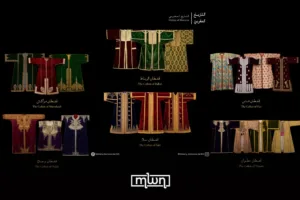
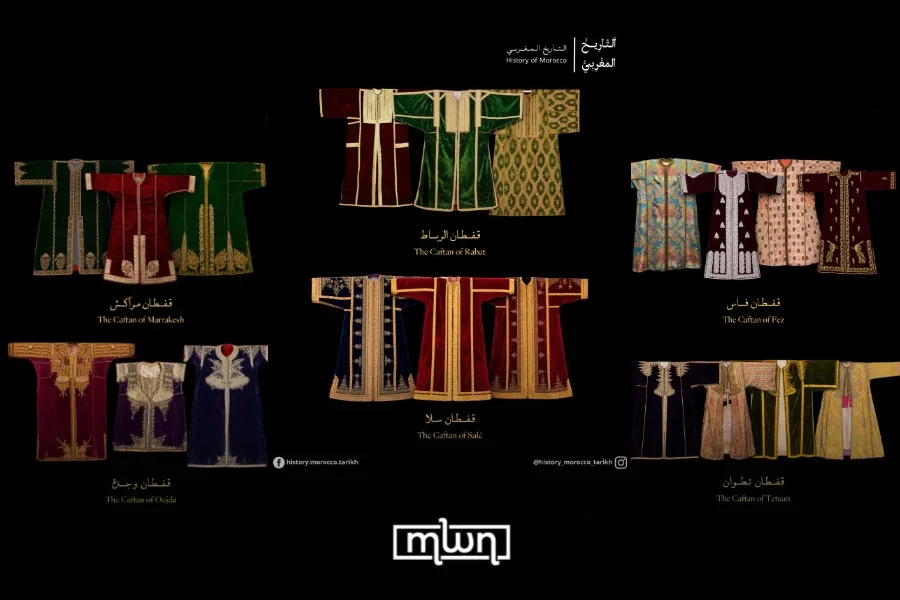
Behind the single inscription are six distinct traditions, each rooted in one of the cities that shaped the craft: Fez, Tetouan, Rabat, Sale, Marrakech, and Oujda.
The skills take every pair of hands in the chain: the weavers behind the brocade, velvet and silk, the tailors who cut them, and the artisans who supply buttons, braids and embroidery.
Those trades still pass from parent to child and from master to apprentice, and fashion schools have also joined in.
Six cities, six signatures
In Fez, the fabric does the talking. Fassi caftan is made of zardkhan, the figured brocade of a city that has woven silk since the Middle Ages. Its makers keep added decoration sparing, so nothing competes with the cloth.
Tetouan wears its caftan open. Sewn from brocade or velvet, it fronts a dense panel over the chest known as khanjar and was traditionally left unfastened to show the embroidered bad’iyya beneath.
On Rabat’s silk-velvet caftan, gold braid traces the collar, the front opening and the sleeves, then returns across the chest.
Sale, just across the river, goes finer still. Slaoui caftan mirrors Rabat’s design but takes on denser needlework, silk twisted, as the craft’s phrase goes, to the width of a hair.
In Marrakech, the ornament sinks toward the hem. Sfifa braid and aakad buttons run the full length of the front. The lower borders take the embroidery, which sometimes opens into a peacock stitched in sqalli, which is the local gold thread.
Oujda keeps it short. Narrow sleeves and a cut that ends higher than the rest set the Oujdi caftan apart, with decoration gathered on the chest, the sleeves and the back.
Braid, buttons, and gold
Underneath the differences, nearly every Moroccan caftan closes the same way. Sfifa, the narrow handwoven braid, edges the front opening, and aakad, the knotted silk buttons, fasten it in a pairing the trade calls the eye and the knot.
That sqalli comes in two grades. Sqalli el horr, gold or silver wire wound on a silk core, goes into most caftans, while sqalli mejbud uses the pure metal alone.
Come the henna night, the gold has a gown of its own. Many Moroccan brides still dress in the ntaâ, a velvet caftan born in Fez that spread across Morocco.
Before the brides, the scholars
Originally, the Moroccan caftan was a garment worn by men, dressing scholars, sharifs, and cavalrymen in cities across the kingdom long before it became the defining piece of women’s ceremonial attire.
UNESCO’s entry records a garment for all genders and ages, worn at weddings, baptisms and diverse rituals.
Across Morocco, the caftan still changes with every workshop, every family and every generation that picks up the needle.
The pattern may shift, the colors may follow new tastes, but each stitch keeps one question alive: where does this caftan come from?