Egypt Retains Title as North Africa’s Wealth Capital This Year
Currency swings haven’t toppled Egypt from its throne as North Africa’s richest nation. Fez – Egypt is holding tight to its crown as North Africa’s wealth capital, with 14,800 millionaires as of mid-2025, even as currency challenges have slightly reshaped the country’s ultra-rich landscape. The latest figures come from Henley & Partners, the global wealth advisory firm that tracks private capital trends. Egypt tops North Africa, second in Africa overall Despite a turbulent economic backdrop and a weakening pound, Egypt remains the undisputed hub for high-net-worth individuals in the region and ranks second on the African continent, behind South Africa. The total number of millionaires, defined as individuals holding at least USD 1 million in investable assets, slipped from 15,600 in late 2023 to 14,800 by June 2025. Those with USD 100 million or more dropped from 52 to 49, while Egypt’s billionaire count held steady at seven. Compared to 2015, the decade has not been easy: significant currency devaluations reduced the overall pool of wealthy residents by around 15%. Yet Egypt’s position remains resilient, bolstered by its concentration of financial activity, real estate development, and private capital inflows. Morocco on the rise Morocco has secured second place in North Africa with a solid increase in its wealthy population. The country now counts 7,500 millionaires, 35 centi-millionaires (individuals with USD 100 million or more), and four billionaires. This marks a sharp rise from 6,800 millionaires and 32 centi-millionaires last year, a 40% growth over the past decade. Driven by diversified industries, expanding infrastructure, and robust tourism investment, Morocco’s wealth profile continues to climb steadily, cementing its role as a rising regional powerhouse. Algeria facing decline Algeria ranks third in North Africa, with its wealthy population sliding from 2,800 millionaires in 2023 to 2,700 in 2024. The number of centi-millionaires also fell slightly, from eight to seven, while the country maintains a single billionaire. Compared to 2015, Algeria has experienced a 23% contraction in its millionaire population, following the challenges of an economy less diversified than its neighbors. What is a ‘centi-millionaire’? In wealth-tracking terms, a centi-millionaire is an individual holding at least USD 100 million in investable liquid assets, the category just below billionaire status. This small, elite group often plays an outsized role in regional investment flows, family offices, and major private equity ventures. Africa’s wealth map is shifting While Egypt continues to lead North Africa, the continent’s wealth distribution is changing. South Africa remains Africa’s overall wealth leader, but Morocco’s sharp upward trend signals a more competitive regional landscape. Meanwhile, currency volatility continues to be the single largest factor shaping millionaire statistics in countries like Egypt and Algeria. The report also indicates that capital migration, investment trends, and real estate development patterns, from Cairo and Casablanca to luxury markets in Marrakesh and Tangier, are redefining where wealth is built and retained. Experts suggest that Egypt’s ultra-wealthy will continue to concentrate in Cairo, which alone holds nearly half the nation’s private wealth. Morocco’s steady climb reflects strategic economic reforms and international investment ties, while Algeria’s numbers highlight the impact of limited diversification in resource-heavy economies. Henley & Partners notes that the coming decade could see greater competition among African wealth hubs as high-net-worth individuals seek stable currencies, investment security, and globally connected markets.
Angham Shuts Down Health Rumors With an Exclusive Concert at the Grand Egyptian Museum

Following health rumors, Angham makes a powerful return to the stage.
Is This Pyramid in Indonesia Older Than Egypt’s?
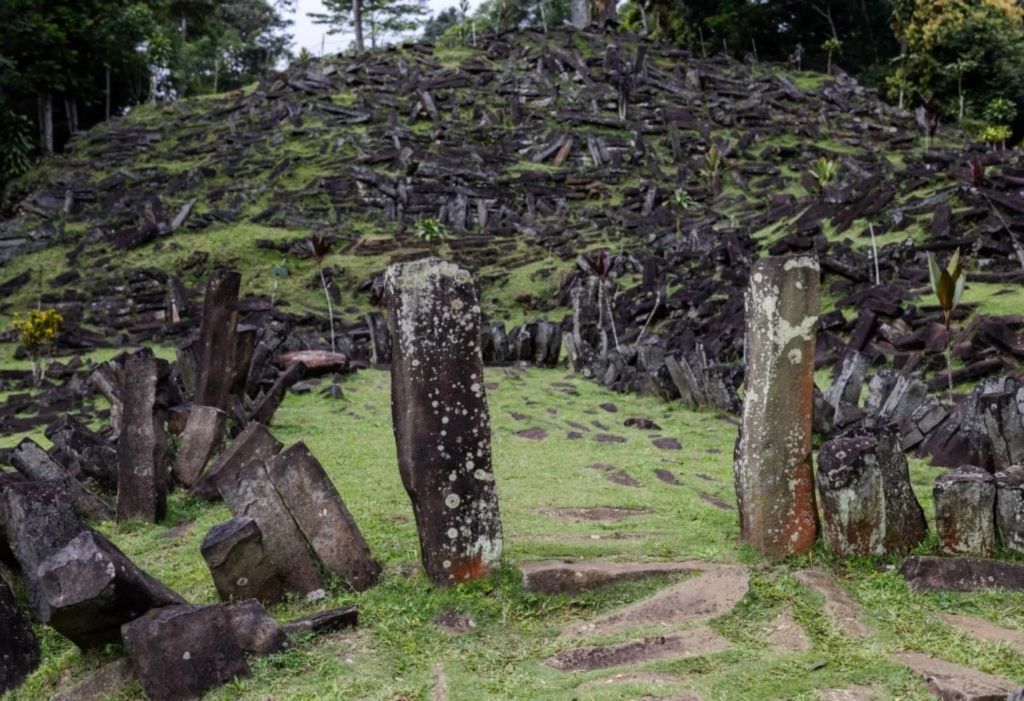
Indonesian researchers claim this to be true about the architectural marvel in Gunung Padang, but archaeologists disagree. Fez – A new scientific study out of Indonesia has stirred both curiosity and controversy. Researchers say the pyramid-like structure of Gunung Padang might be far older than Egypt’s pyramids, possibly dating back to 25,000 BCE. If confirmed, this would rewrite the timeline of human civilization as we know it. But not everyone’s convinced. The study, led by geologist Danny Hilman Natawidjaja from the Indonesian Institute of Sciences, was published in the journal “Archaeological Prospection”. According to the research team, the core of Gunung Padang isn’t just a natural hill, it’s made up of carefully carved andesite stones layered in complex formations. They argue that the oldest part of the structure was originally a volcanic mound that was later shaped and built upon by human hands. Here’s where it gets bold: the dating suggests that one of its lower layers is over 27,000 years old, nearly twice as old as what we’ve long accepted as the beginning of advanced human construction, which traditionally starts with the agricultural era around 11,000 years ago. To support this idea, the researchers point to other mysterious prehistoric sites like Göbekli Tepe in Turkiye, which also show signs of complex human activity before farming began. It all feeds into a growing global conversation: Did early humans master architecture and monument building long before we gave them credit? But many archaeologists are pushing back hard. According to Charq Al Awsat Flint Dibble, an archaeologist from Cardiff University, the evidence just doesn’t hold up. “When rocks tumble down a hill, they tend to align naturally,” he explained in “Nature”. “There’s no clear sign of tools or carving marks to prove that people actually shaped this site.” Others agree. Bill Farley from Southern Connecticut State University pointed out that the soil samples from Gunung Padang, some dating back over 27,000 years, don’t contain any tell-tale signs of human activity, such as charcoal from fires or broken bones. In response, Natawidjaja has kept the door open. He invited researchers from all over the world to visit the site, conduct their own studies, and examine the evidence firsthand. He insists he’s ready for full transparency and scientific collaboration. Meanwhile, the editorial board of “Archaeological Prospection” has announced it is reviewing the paper to assess its scientific validity and the accuracy of its claims. For now, Gunung Padang remains a mystery. Is it an overlooked wonder from a forgotten civilization, or just a hill with an imaginative backstory? The debate is far from over. Read also: Why No Human Remains Were Ever Found on the Titanic
Egypt’s $30 Million Project to Reimagine a 4,600-Year-Old Wonder
A multimillion-dollar upgrade is quietly reshaping one of the world’s most visited ancient wonders. Fez– After decades of disorganized access and complaints from tourists, Egypt is finally giving its most iconic heritage site the upgrade it deserves. A sweeping $30 million redevelopment of the Giza Plateau, home to the Pyramids of Giza and the Sphinx, is poised to reshape how the world experiences one of the oldest wonders still standing. Set to be inaugurated on July 3, 2025, the project is the result of a long-awaited partnership between Egypt’sgovernment and Orascom Pyramids Entertainment, a subsidiary of billionaire Naguib Sawiris’s conglomerate. Though initially signed in 2018, the initiative has only recently come to fruition after years of planning and logistical hurdles. The transformation is striking. The old chaotic entrance near the pyramids has been replaced with a new “Grand Gate” located 2.5 kilometers away, connected via a modern highway. Visitors now pass through an air-conditioned exhibition hall before boarding “hop-on, hop-off” buses that circulate along designated stops throughout the site, each equipped with clean public restrooms, licensed gift shops, and shaded cafés. What was once a raw, unregulated journey now feels like a curated museum experience. The overhaul hasn’t just focused on functionality. Luxury was also on the menu. Among the additions is “Khufu,” a high-end restaurant overlooking the Great Pyramid, which now ranks among the Middle East and North Africa’s best dining venues, according to “World’s 50 Best”. Despite the cosmetic and operational improvements, not all challenges have been resolved. One lingering issue is the regulation of horse and camel operators, many of whom were notorious for exploiting tourists. The government has relocated them to a separate area, yet some still attempt to return to the main entrances. Interestingly, while the Pyramids remain among the world’s most recognized landmarks, annual visitor numbers are modest: just 2.5 million in 2024, half of them local. That’s a far cry from Rome’s Colosseum, which welcomed 12 million the previous year. Still, officials are hopeful: tourism to Egypt surged 24% in April 2025 compared to the year before. Ultimately, this renovation isn’t just cosmetic, it’s strategic. Egypt is betting on heritage as a sustainable driver of tourism and economic growth. And with the nearby $1 billion Grand Egyptian Museum also nearing completion, the country is positioning its ancient treasures for a very modern kind of revival. Read also: Beyonce Turns Her Cowboy Carter Tour into a Fashion Spectacle
‘Salat Al-Qalaq’ Wins International Prize for Arabic Fiction

If history is written by victors, this Egyptian novel is a dispatch from the eternally defeated. Fez– In a year thick with noise, one novel whispered, and it was heard. “Salat Al-Qalaq” (Prayer of Anxiety), the third novel by Egyptian writer Mohamed Samir Nada, just clinched the 18th International Prize for Arabic Fiction. A surreal and unsettling tale that collides fantasy with historical trauma, the book reimagines the aftermath of the 1967 defeat, not as a past event, but as an ongoing fever dream. Set in 1977 in the fictional Upper Egyptian village of “Nag‘ al-Manasi”, Nada’s story kicks off with a mysterious explosion. The villagers, already trapped in an illusion that the war with Israel never ended, are pushed further into paranoia. Believing their village is surrounded by minefields, they live in self-imposed isolation, a potent metaphor for mental siege. This is not a war novel. It’s a story about memory hijacking, and how entire communities can be programmed to live in a reality sculpted by fear and fantasy. Nada’s writing is daring. The novel weaves together eight distinct narrative voices, a structural feat that demands literary precision. Instead of simply varying dialects or styles, he differentiated them through ideology and perception, creating a mosaic of conflicting truths. “It was a gamble,” he admits, “but the reader I imagined is patient, someone ready for complexity.” The book doesn’t just reference historical loss, it interrogates it. Nada challenges the idea that the 1967 defeat was merely a rupture. He sees it as the ultimate confirmation of the 1948 catastrophe (Nakba), an endless wound that never had a chance to scar. “The Nakba didn’t get re-opened. It never closed,” he says. “And the Naksa only hammered it in.” Stylistically, “Salat Al-Qalaq” is infused with the spirit of Orwell, but also flirts with the surrealism of Kafka and Saramago. The novel opens with a line that instantly sets the tone: “Sheikh Ayyoub al-Mansi woke up that morning and could not find his head between his shoulders.” The absurd is never far from the real, and in this universe, that’s the point. Even Abdel Halim Hafez shows up, not as a cameo, but as a symbol. His voice, says Nada, embodied the Nasserist dream, and his death marked the fading of that dream’s illusion. Described by jury chair Mona Baker as a “poetic and multi-layered narrative that transcends geography,” “Salat Al-Qalaq” was unanimously selected for the top prize. Nada walks away with $50,000, and a novel that will likely outlast the moment. Read also: Morocco Embraces Bakery Tourism as a Strategic Cultural and Economic Asset
Ancient Egyptian Pyramids Were Burial Sites for Laborers Also, Study Finds
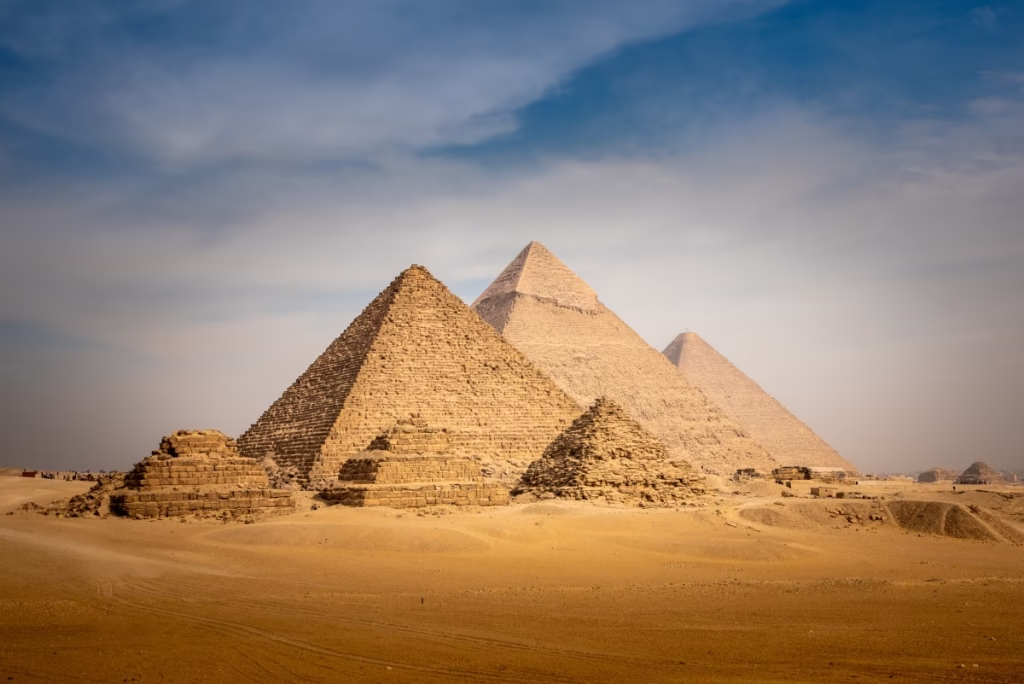
Turns out that ancient Egyptian pyramids weren’t just VIP lounges for the afterlife; some hard working laborers crashed the party too. Fez – For centuries, historians assumed that pyramids were the final resting places of Egypt’s elite, powerful rulers, influential scribes, and the ultra-wealthy. But fresh research from Sudan’s Tombos site suggests we may have been picturing the wrong guest list. According to a study in the Journal of Anthropological Archaeology, it turns out that ancient pyramid burials weren’t just for VIPs; hardworking laborers may have secured a spot alongside them. Tombos: The colonial outpost that kept on giving Located on the Nile’s third cataract in modern Sudan, Tombos was originally an Egyptian colony. Established around 1400 B.C. after Egypt’s conquest of Nubia, it functioned as an administrative hub, one where both elites and workers left their mark. And, as it turns out, their bones. When archaeologists examined 110 skeletons from the site, they weren’t just looking at burial styles. They focused on entheseal changes: tiny bone modifications that reveal how much physical labor a person endured in life. Essentially, the more grueling your day job, the more pronounced these skeletal markers become. The muscle mystery: who’s who in the pyramid? What did the bones tell us? Some individuals had smooth, unmarked attachment points, suggesting a life of bureaucratic comfort, scribes, officials, or maybe an ancient version of a desk job. Others, however, displayed significant wear and tear, evidence of years of back-breaking labor. Both groups were buried under pyramid tombs. Pyramids weren’t exclusively for the rich. Some of the hardest-working members of society were laid to rest in grand monuments once thought to be off-limits to commoners. Why were laborers buried like the elites? Theories abound. Some researchers suggest that wealthy individuals allowed lower-status workers to be buried nearby to reinforce the social hierarchy, even in death. Others believe the laborers may have chosen to rest near their employers, hoping for some posthumous status boost, kind of like an eternal networking strategy. Stuart Tyson Smith, an anthropology professor at UC Santa Barbara, suggests that elites surrounded themselves with the very workers who had served them in life. This wasn’t just about proximity; it was about power, prestige, and possibly even religious beliefs about the afterlife. The debate isn’t over Not everyone is sold on this groundbreaking revelation. Some scholars argue that physical labor wasn’t exclusive to lower classes; elites may have been physically active too, meaning their skeletal wear doesn’t necessarily indicate a working-class background. Still, the study has sparked major conversations in Egyptology. If further research supports these findings, our understanding of social divisions in ancient burial practices could change dramatically. And who knows, maybe history’s been underestimating the ambitions of ancient laborers all along. Read also: Vast Underground Structures Beneath Giza Pyramids