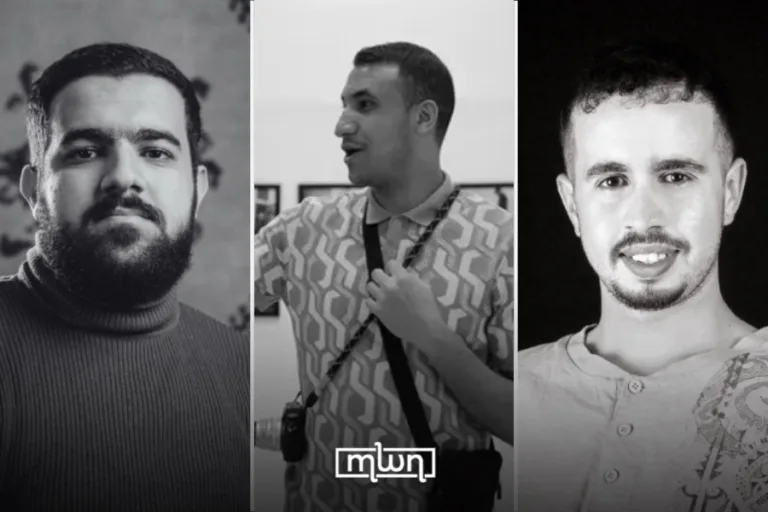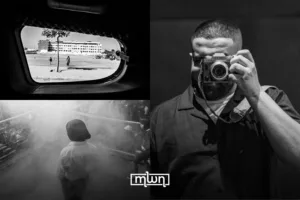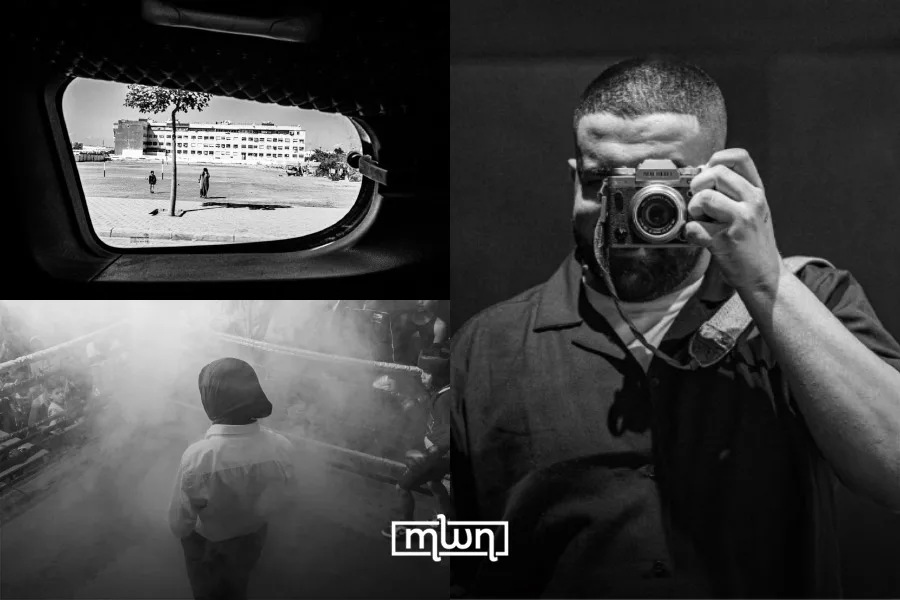
Rabat – From photographing the streets of Larache with a phone to exhibiting internationally and receiving recognition at major photography competitions,Moroccan documentary photographer Issam Chorrib has built his practice around people, society, and stories that often exist away from the spotlight.
Based in Casablanca, Chorrib works primarily in black and white, combining a documentary and journalistic approach with a cinematic visual language.
His work explores social realities, collective memory and resilience, often through long-term projects.
In 2026, he also received third place in the CDG Foundation Award for Young Moroccan Photography for “L’Écho des Arènes Hautes”, (Echoes of the High Arenas) and was selected for the Tasweer Project Award for his ongoing project “A Pair of Gloves.”
In an exclusive interview with MWN Lifestyle magazine, Chorib explained how behind those recognitions is a journey that started much more simply with a phone camera.
From a phone camera to international exhibitions
Chorrib traces his relationship with photography back to childhood, when he first experimented with cameras during school trips and family events. But his serious photographic journey began in Larache in 2018.
At the time, he was primarily photographing with his phone, walking through the city and practicing street photography.
“I would go out, have tea and do street photography,” he recalled. “At that time, what I really enjoyed was the flow of being behind the camera. And my camera was my phone.”
One of the early turning points came when one of his photographs was selected for an exhibition at the International Center of Photography in New York.
He later participated in an exhibition in Dubai connected to National Geographic and Gulf Photo Plus.
Those experiences helped him understand that photography could become more than a personal interest.
“That was when we became convinced that photography could really become something for us, and that we could tell stories through photography, perhaps more than through text,” he said.
His move to Casablanca opened another chapter. Through a photography course, he began learning how to develop photographic projects rather than simply individual images.
That process eventually pushed him toward documentary photography and longer-term storytelling.
Photographing people who are often overlooked
Much of Chorrib’s work is centered on people.His interest is not necessarily in photographing the most famous or visible figures, but in observing the people and communities around him.
“Why do I focus more on people? Because for me, it’s about giving them a spotlight,” he explained.
Living in Sidi Moumen has also influenced his perspective.“I live in Sidi Moumen, in a completely communal environment in Casablanca ,” he explained. “Even if I’m not necessarily part of that life and don’t have friends everywhere, I feel connected to the people. I observe them.”
For Chorrib, photography began as a way of seeing even before he had the equipment to formally document what he saw.
“Even before I had a camera, I was photographing with my eyes,”
That perspective extends to his approach to boxing and football, where the sport itself is only one part of the story. The people, communities and social environments surrounding it are equally important.
Why black and white?
Chorrib’s visual identity is strongly connected to black-and-white photography. For him, removing color is not simply an aesthetic choice. It is a way of controlling what the viewer sees.
“I don’t want the viewer to focus on the beauty of the colors in the photograph,” he explained.
Instead, he wants attention to remain on the composition, the strength of the image and its message.
“I want people to focus on the composition of the image, its strength, the black-and-white contrast, and the message coming from the image.”
Chorrib believes black and white can create a sense of equality between the people he photographs.
“In a color photograph, someone might appear well dressed while another person might not. When you make the image black and white, that difference disappears” he explains.
Football beyond the game
His project “L’Écho des Arènes Hautes,” developed between 2022 and 2024, approaches football as more than a sport.
The series looks at the people, celebrations, communities and environments surrounding the game, exploring ideas of belonging and resilience.
Interestingly, Chorrib said the project was not originally planned.
“There was a national CDG competition, and the theme was football. So I went back through the photographs I already had,” he said.
He had already spent years photographing football, but not necessarily football itself.
As he explained, “I wasn’t really photographing football as football. I was photographing what surrounds football, the people, the public and society.”
The approach earned him third place in the second edition of the CDG Foundation Award for Young Moroccan Photography.
The award recognized “L’Écho des Arènes Hautes” among six selected photographers, with Chorrib receiving third prize.
Finding another story inside the boxing ring
Issam’s current project, “A Pair of Gloves,” takes him into the world of boxing. The project was selected for the 2026 Tasweer Project Award, which supports photographers developing longer-term projects.
The project focuses on boxing communities in Sidi Moumen and Lahraouyine, looking beyond the ring to questions of identity, resilience, family and social life.
He had initially been photographed in a boxing gym but later returned and found that the coach he had been working with was no longer there.
While taking part in a documentary photography and journalism workshop with the VII Foundation, he continued researching boxing communities in Casablanca.
Eventually, a coach told him about a tournament taking place during Ramadan.
“I had to choose between continuing the boxing project and working on a project about my father,” he described . “I chose boxing because I wasn’t photographing anything at that period, and I felt that this tournament could give me the opportunity to continue the project.”
The tournament became an important part of the series.
“When I went to the tournament during Ramadan, I became comfortable with the people. It started to feel like a family.”
His inspirations also extend beyond Morocco. Chorrib mentioned Muhammad Ali and his fascination with the way boxing has been photographed.
“I wanted to understand the project, but also to try to photograph things that hadn’t been photographed before,” he explained. “I was looking for images that could stay in the story.”
Photography as something personal
Behind his documentary approach, Chorrib also describes photography as something deeply personal.
Looking toward the next five years, he admits that he does not have a precise answer about where the journey will take him.
“Honestly, I don’t know,” he said. “What I do know is that I want to make the effort to become better than the Issam I am today.”
For him, photography has become more than a profession or artistic practice.
“Photography has given me something that feels almost like psychological medicine,” he believed. “It gives me something that makes me feel like myself. When I have my camera, I feel happy.”
Stories that can make a difference
Rather than focusing solely on recognition, Chorrib hopes his future work will have a wider social purpose.
“In five years I want to have worked on stories about issues in society and in the world,” he envisioned .
His ambition is to develop photojournalistic projects that can contribute to conversations around social issues and potentially help create change.
“I want to work on photojournalism projects that can have an impact on society — projects that can contribute to changing something, improving something or simply helping people.”
That ambition is also connected to the photographers who have influenced him, particularly Hamza Zidan and Ali Arkadi.
The photographer describes Arkadi as someone who had a major impact on his vision during a transitional period in his career.
“He completely changed the way I looked at photography,” Chorrib admitted.
“God willing, I want to become someone who can teach other people as well, so that the message continues,” he said,“For me, it’s important to become someone who is recognized not simply for being famous, but for working according to his principles.”