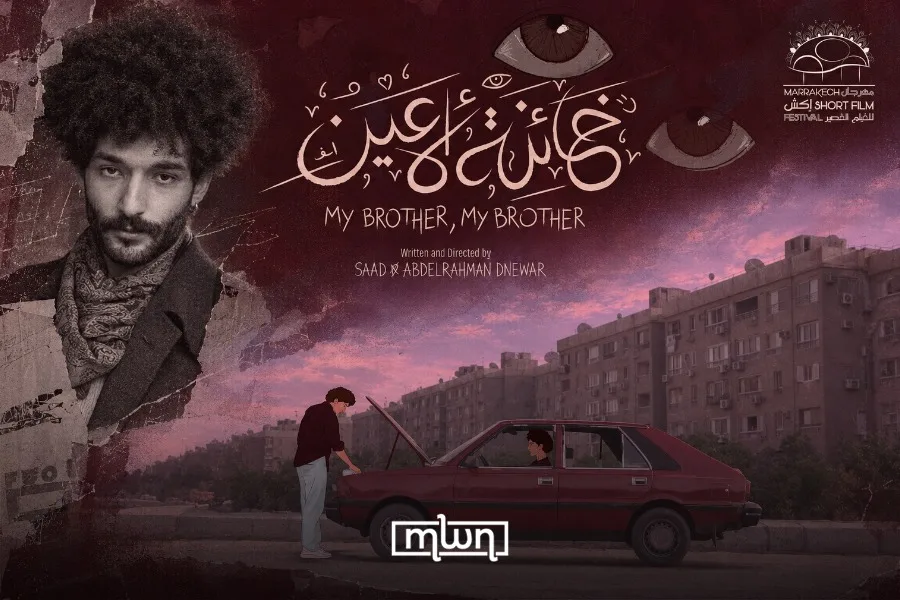
Rabat – What began as two brothers’ attempt to revisit their childhood and say goodbye to their mother eventually became a film about memory, loss, and the enduring connection between siblings.
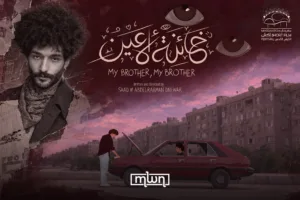
“My Brother, My Brother,” an animated short co-directed by twin brothers Saad and Abdelrahman Dnewar, is heading to the sixth Marrakech Short Film Festival (MARRAKECHsFF), scheduled for September 25 to 30.
In an interview with MWN Lifestyle magazine, Egyptian filmmaker and producer Abdallah Dnewar discusses the deeply personal story behind “My Brother, My Brother,” an animated short film exploring memory, identity, and the bond between twin brothers.
For Dnewar, the film represents years of creative work, a deeply personal family history, and the artistic legacy of his late brother, Saad.
Based in Cairo, Dnewar is a filmmaker, producer, screenwriter, and script consultant. He began his career as a literature reviewer for Ahram Online before publishing a short-story collection titled “Before You Commit Suicide.”
Since 2016, he has worked in film production and development, focusing on independent and emerging cinema. His producing credits include “My Brother, My Brother” and “Khufu,” which won the Pardino d’Argento – Arts3 Foundation Award at the 79th Locarno Film Festival in August.
Now, as “My Brother, My Brother” prepares to meet audiences in Marrakech, Dnewar looks back on the family experiences that shaped the story and the difficult decision to complete the film following Saad’s death.
The film is part of the festival’s international competition, joining a selection of works from countries including Italy, Iraq, China, France, and Japan. The festival has received more than 400 submissions from over 90 countries across five continents.
Two brothers, two versions of the same childhood
The idea for “My Brother, My Brother” emerged about seven years ago, when Saad began developing a film inspired by his childhood.
The project was also deeply connected to the family’s experience of losing their mother following a three-year illness.
“He wanted to make a film about his childhood, and through that story, he was also looking for a way to say goodbye to our mother,” Dnewar told MWN Lifestyle magazine.
Saad began writing alongside his twin brother, Abdelrahman, with the intention of directing the film together.
But as the brothers revisited their childhood memories, they discovered that they remembered certain events differently.
Their attempts to find tangible evidence for their respective memories gradually transformed the story into an exploration of how people reconstruct their past.
“We all store and revisit memories in different ways, and through this process, they began to uncover unexpected things about their childhood and our family,” Dnewar explained.
The brothers developed two parallel narratives, presenting the same events from different perspectives.
“What began as a way to explore their childhood became a story about the nature of memory, the way we construct our own versions of the past, and how two people can share the same experience yet remember it in entirely different ways,” he said.
The resulting film follows identical twins Omar and Wesam as they navigate their shared memories and struggle to distinguish their individual identities.
For Dnewar, their relationship reflects the difficulty of establishing a separate identity when two people have spent their lives being treated as one.
“Omar and Wesam have grown up being treated as one, whether in the way others perceive them or in the consequences they face,” he said.
“Yet, beneath that shared identity, each of them is a different person, with his own story, perspective, and voice.”
Their relationship takes on another meaning when a tragic loss occurs.
Despite their efforts to establish separate identities, the brothers remain connected by their shared history.
“The film explores that tension between individuality and togetherness, and how loss can reveal the bonds that exist beneath the differences we spend our lives trying to establish,” Dnewar explained.
From a farewell to their mother to Saad’s legacy
The film’s production took a devastating turn two years after the brothers began working on its writing, pre-production, and animation tests.
Saad died before the film could be completed.
For the family, continuing the project initially seemed impossible.
“Our immediate reaction was that we would not be able to make the film,” Dnewar recalled.
Revisiting the story was particularly painful for Abdelrahman, who had lost his twin brother.
But one day, Abdelrahman called Abdallah with a decision that would change the film’s future.
“It’s Saad’s legacy. We will make that film, even if we can’t.”
Dnewar described the decision as a profoundly personal moment for the family, made while they were still grieving.
“It was a brother’s decision before it was a director’s or screenwriter’s decision,” he said.
From that point forward, Abdelrahman dedicated himself to completing the project while preserving Saad’s artistic vision and visual language.
The brothers’ personal history also transformed the film’s meaning.
Out of respect for Saad and in recognition of the film’s original dedication to their mother, the family decided to change the ending.
What had initially been conceived as a farewell to their mother became a final goodbye to both her and Saad.
The project was no longer simply about exploring childhood memories. It had become a way of preserving the artistic work and voice of someone they had lost.
“In that sense, the film became more than the story we had set out to tell,” Dnewar said.
“It became a way of preserving Saad’s voice, continuing the work he had started, and carrying his artistic vision forward.”
Marrakech offers a return to familiar ground
“My Brother, My Brother” arrives in Marrakech following an extensive international festival journey.
According to Dnewar, the film has been selected for more than 92 international, regional, and local festivals across five continents, receiving 16 awards.
Its distinctions include the Golden Gate Award for Best Animated Short at the 2025 San Francisco International Film Festival and an International Jury Special Mention at Clermont-Ferrand the same year.
For Dnewar, however, the Marrakech selection is also a personal return.
His first short film, “Temporary,” which he wrote and directed in 2018, previously screened at the Marrakech Short Film Festival.
“Returning to the festival with My Brother, My Brother brings back beautiful memories of when I was just starting my film career,” he told MWN Lifestyle magazine.
The producer said preserving the film’s Egyptian identity was an important priority throughout production.
“We invested so much in making the film authentically Egyptian, and we fought to preserve that identity throughout the process,” he explained.
While the film has connected with audiences internationally, Dnewar believes screenings in the Arab region offer a different kind of experience.
“We speak the same language, understand the same jokes, and share the same cultural references,” he said.
“There is a different kind of connection when the audience recognizes something of their own lives in the film.”
That cultural familiarity makes the Marrakech selection particularly meaningful to the filmmaker and his family.
Dnewar will not attend this year’s edition, something he admitted leaves him with a little fear of missing out.
He nevertheless expressed enthusiasm about the festival’s growth and the international community of filmmakers it brings together.
“I hope the audience enjoys the film, and I hope we will be able to join you at the next edition,” he said.
More than another stop on the festival circuit, Marrakech offers the family an opportunity to share the work they completed in Saad’s memory with audiences who may recognize something of their own experiences in its story.
“We are very happy that the audience at the Marrakech Short Film Festival will get to see a part of our soul and Saad’s artistic legacy,” Dnewar said.