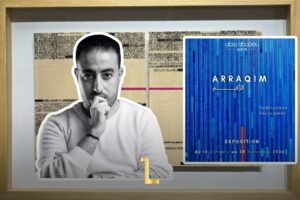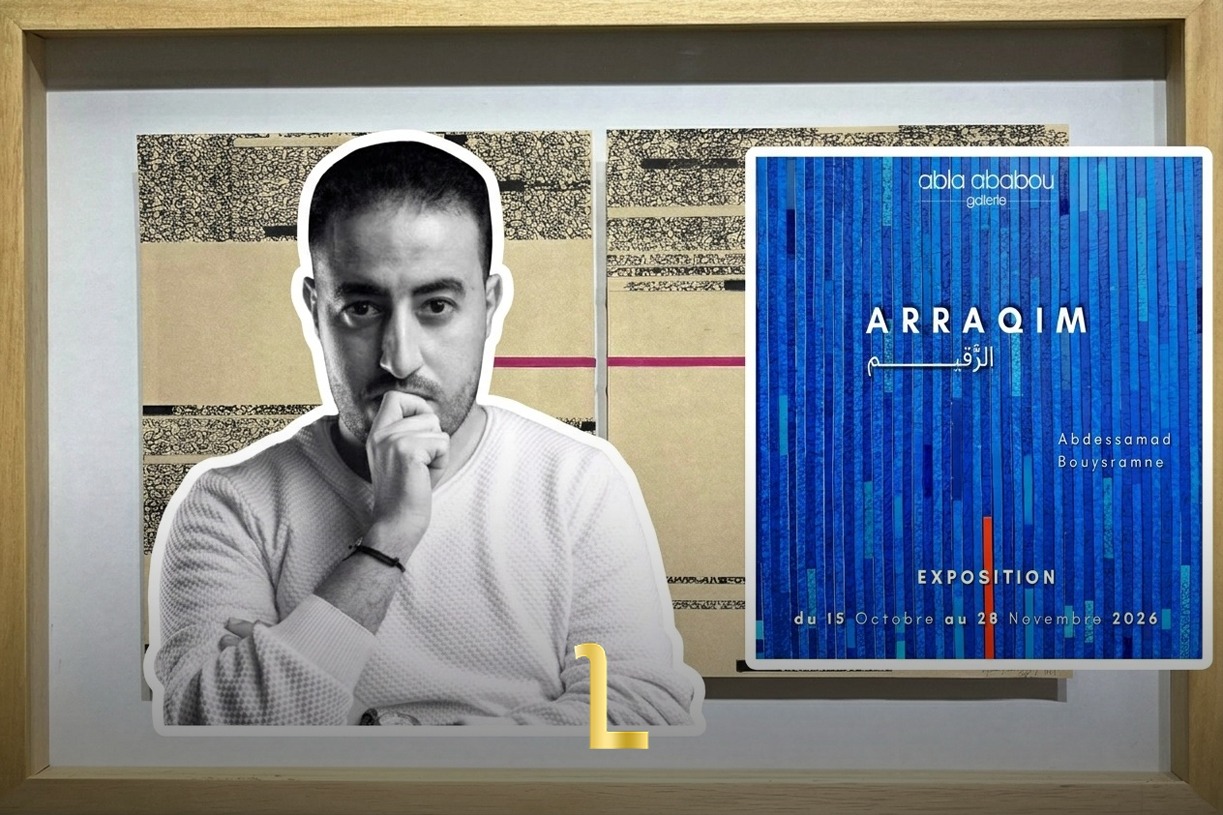
Fez — Moroccan artist Abdessamad Bouysramne will open “Arraqîm” at Abla Ababou Galerie in Rabat on October 15, exploring how ancient writing traditions continue to shape contemporary artistic expression.
The exhibition will run until November 28, with an opening reception on Thursday at 6:30 p.m. Through mixed-media compositions, embroidered surfaces, and installations, Bouysramne examines the relationship between writing, memory, and material.
The gallery presents the exhibition as an exploration of how written signs evolve across generations, connecting the manuscripts of Morocco’s past with the visual languages of the digital age.
From his father’s manuscripts to contemporary art
Bouysramne’s fascination with writing began during his childhood in Marrakech, where his father worked as a fqih, a religious scholar.
As a child, he discovered his father’s manuscripts and became fascinated by their pages, inscriptions, and intricate signs.
Those early encounters gradually shaped his artistic interests, eventually inspiring a practice that treats writing as more than a system of communication.
In Bouysramne’s work, letters and symbols move beyond the page. They become physical forms, impressions, textures, and fragments that carry traces of their origins.
The exhibition’s title, “Arraqîm” (الرَّقيم), refers to engraved writing and the material that preserves an inscription.
It also evokes raqm, the Arabic word for numeral, establishing a connection with the numerical language that underpins digital technologies.
An artistic journey around a symbolic center
The exhibition also transforms the gallery itself into part of the artistic experience.
A black structure occupies the center of the exhibition space, encouraging visitors to move around it rather than simply observe artworks from a fixed position.
According to the gallery, this arrangement symbolically evokes the Kaaba and the circular movement of pilgrimage without attempting a literal representation of the sacred site.
Movement, observation, and physical presence consequently become important elements of the visitor’s experience.
The exhibition explores how writing can disappear, reappear, and transform into new visual configurations while retaining traces of its earlier meanings.
Among the works, “Arraqim #3” (2026) uses collage and cut-paper techniques on paper, while “Masfoufa #1” explores mixed media across panels and cotton-paper surfaces.
In “Sitar 1” (2026), Bouysramne combines embroidery and charcoal on black twill fabric, extending his investigation of writing into textile materials.
“Tawaf #1” (2026), a mixed-media work on canvas, also forms part of the exhibition. Its title recalls the ritual of circumambulation, echoing the spatial symbolism that guides the gallery’s layout.
A practice between archaeology and abstraction
Born in Marrakech in 1995, Bouysramne graduated from the Casablanca Higher School of Fine Arts in 2017.
His multidisciplinary practice encompasses painting, photography, installation, performance, and sculpture.
The artist describes his artistic approach through the relationship between human influence and time, creating visual spaces that resemble archaeological investigations into cultural memory.
His work draws on the visual power of writing to explore connections between civilizations and the material and intangible heritage they transmit.
Bouysramne previously held solo exhibitions including “Tumulte” at Artem Gallery in Casablanca in 2021 and “Whispers of Silence” at Kalimat Gallery in Dubai in 2022.
He has also participated in exhibitions and artistic projects in Morocco and abroad, developing a visual language that connects contemporary abstraction with historical forms of expression.
With “Arraqîm,” Bouysramne returns to the manuscripts that first captured his imagination, transforming a childhood encounter with written heritage into an exploration of how societies preserve knowledge.
The exhibition invites visitors to consider what remains when writing loses its original form, and how a simple mark can continue carrying memory long after its meaning changes.
“Arraqîm” will run from October 15 to November 28 at Abla Ababou Galerie, located at 57 Avenue Mehdi Ben Barka in Rabat’s Souissi neighborhood.