Robots in Ghutrah Perform Ayyalah at Abu Dhabi Autonomous Week

Humanoid robots wearing traditional Emirati headgear performed the Ayyalah men’s dance at Abu Dhabi Autonomous Week, drawing crowds at the six-day forum that runs November 10 to 15.
21 Robots Join Beijing Half-Marathon
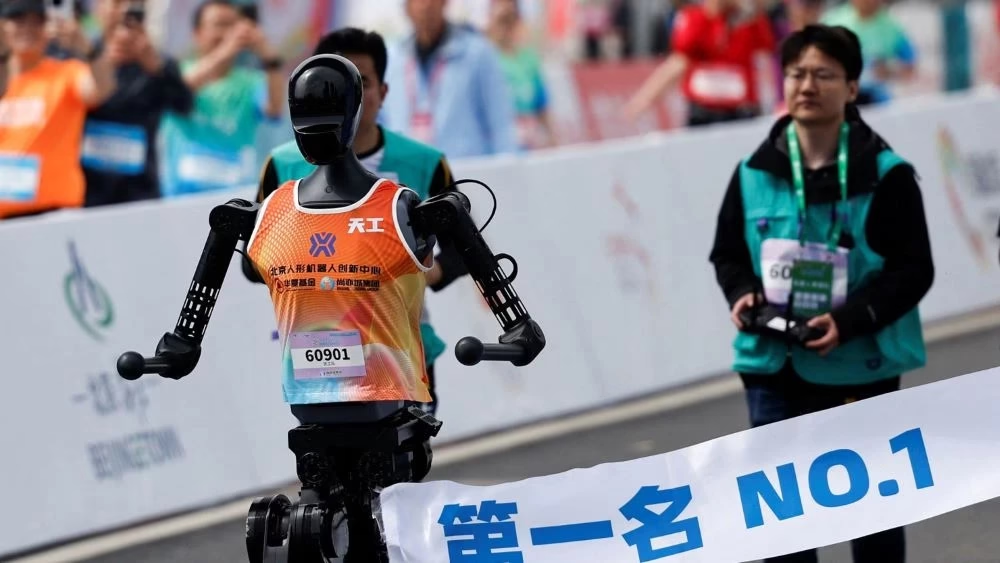
The robots have officially entered the race, literally. Fez – Beijing’s Yizhuang Half-Marathon just made history in what looked more like a scene straight out of a sci-fi movie (but with less CGI and more sneakers). On Saturday, April 20, 21 humanoid robots laced up and joined thousands of human runners on the 21-kilometer route. Machines and people ran side-by-side in a real marathon event for the first time ever, and yes, it was as wonderfully bizarre as it sounds. According to Reuters, the robots came in all shapes and sizes, from under 1.2 meters tall to a full 1.8 meters. Some were designed to look like actual humans, one even boasted a feminine face, capable of winking and smiling. The robot squad wasn’t there just for show. They’d spent weeks in rigorous training, supported by full-on engineering and navigation teams. Beijing officials even likened the event to a Formula 1 race, only with more awkward running and fewer crashes (well, mostly). These robots were developed by companies like DroidUP and Noetix Robotics, with trainers literally running behind them, sometimes holding them up when their circuits had a little too much excitement. One robot sported boxing gloves, another wore a headband with the phrase “Committed to Win” in Chinese. Honestly? Iconic. After 2 hours and 40 minutes of this robo-race, the star of the show was “Tiangong Ultra,” a humanoid marvel from the Beijing Humanoid Robot Innovation Center. Read also: Protoclone: The Creepy-Cool Future of Muscle Robots Is Here Tiangong was powered by long legs, a smart running algorithm, and just three battery swaps, because even robots need pit stops. Meanwhile, the human winner clocked in at 1 hour and 2 minutes. Not bad for someone who doesn’t run on lithium. Beijing’s robot center is partially owned by government-backed firms, but also includes heavyweights like Xiaomi and UBTECH. Their CTO, Tang Jian, didn’t hold back. “I don’t want to brag, but Western robot companies haven’t done this.” Consider the mic dropped. Of course, not all robots crushed it. One collapsed at the starting line and just… lay there for a bit like a robotic damsel in distress. Another sprinted straight into a wall, taking its trainer down with it. Still, after a few hiccups and some dramatic recoveries, most of them managed to finish the course. While some analysts question whether marathon running is really a benchmark of industrial potential, China’s bet is clearly to make humanoid robots a part of the country’s economic future. That said, experts like Oregon State’s Alan Fern think these flashy demos are more entertaining than practical. Still, if the future of robotics includes headbands, sneakers, and sass, we’re here for it.
Protoclone: The Creepy-Cool Future of Muscle Robots Is Here
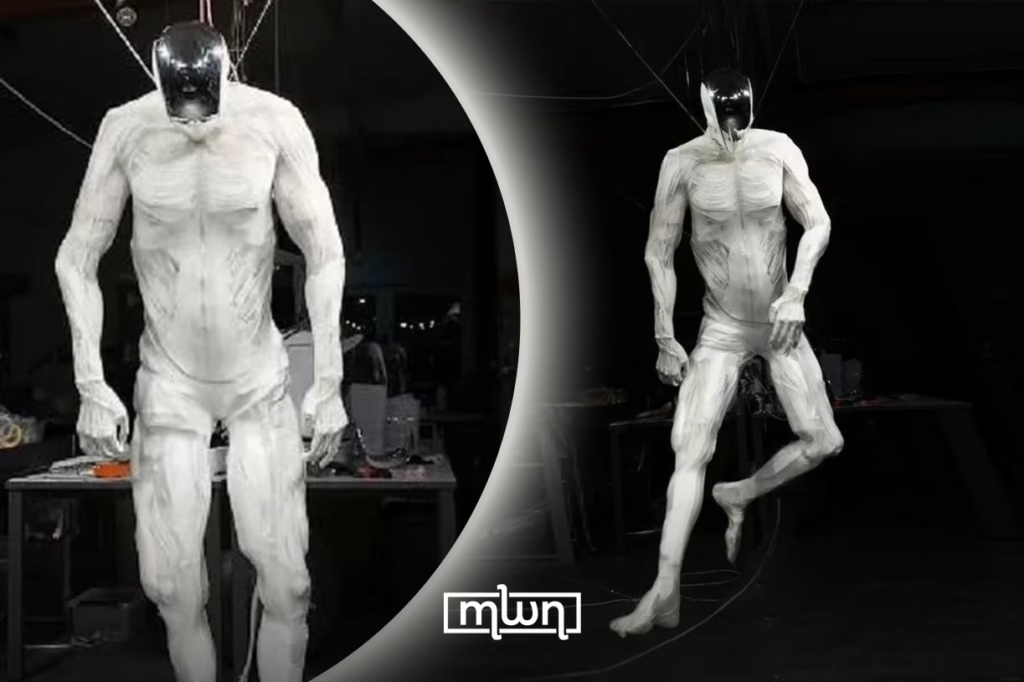
A new robot technology is here, and it’s moving like it knows it’s being watched. Fez– Clone Robotics just dropped a video that feels straight out of a sci-fi fever dream, and yes, it’s as impressive as it is unsettling. Meet Protoclone, the humanoid robot that doesn’t just look vaguely human but moves like one. Think twitching fingers, twisting neck, flexing limbs, all powered by synthetic muscles and tendons. No gears, no metal clunks, just eerie, organic motion. In the video, Protoclone dangles in mid-air like some futuristic puppet, connected to what looks like a tangle of biomechanical nerves. Then, it starts testing out its joints: stretching, rotating, flexing. At one point, it even stares at its own hand like it’s having an existential moment. (Don’t worry, it doesn’t cry. Yet.) Clone Robotics, a startup based between Poland and the US, is calling this the world’s “first muscular-skeletal robot” essentially, a machine that mimics the structure and movement of the human body, without the creepy skin. The body is anatomically accurate, loaded with over 1,000 artificial muscles and 500 sensors, giving it the ability to perform nearly 200 unique movements. That’s more than most of us manage before coffee. The company wants Protoclone to eventually wander around your house, helping with chores and becoming the world’s most high-tech roommate. A faceless one, for now. But you just know a version with a hyper-realistic face is cooking in the lab somewhere. Clone Robotics didn’t shy away from stirring the pot. After Elon Musk flexed about Tesla’s Optimus robot being delicate enough to handle a Fabergé egg, Clone fired back with a bold claim: Protoclone’s hand is just as dexterous, faster, stronger, lighter, and soft enough for massages. Sure, the Japanese Kengoro robot from 2017 technically beat Protoclone to the muscular game, but that was a research prototype. Clone’s going commercial, and fast. They’re aiming to dominate the domestic robotics scene before Optimus even leaves the showroom floor in 2026. Co-founder Danush Radhakrishna even declared on X that Protoclone marks the “beginning of the new era of robotics.” Bold words, but with tech like this, maybe not so far-fetched. 2025 might just be the year your next housemate is a faceless, muscle-bound robot who can flex better than you, and possibly hug better too. Read also: What Is Easter and Why Do Bunnies Lay Eggs?