Fez — There is a Moroccan song that tells you to visit a place, greet its people, and then keep your mouth shut.
Known as “L’Aloua,” the centuries-old folk composition has echoed through Moroccan weddings, celebrations, and traditional musical gatherings for generations.
Its famous warning, “Fi L’Aloua La Tatakallam,” literally tells visitors not to speak when they arrive.
But why would an entire place demand silence? And what makes a seemingly ordinary folk song so closely associated with spirituality, sacred figures, and even stories of people entering mysterious trances?
The answer takes us into the rural heartland of Morocco’s Chaouia region, where music has long served as a way to preserve collective memory, honor spiritual figures, and express belonging to the land.
L’Aloua is a real place, not an imaginary kingdom
Despite its mysterious reputation, L’Aloua is not a mythical location hidden somewhere in Morocco.
The name refers to a geographical and cultural area associated with Ben Ahmed and its surroundings in the Chaouia region, within Settat Province.
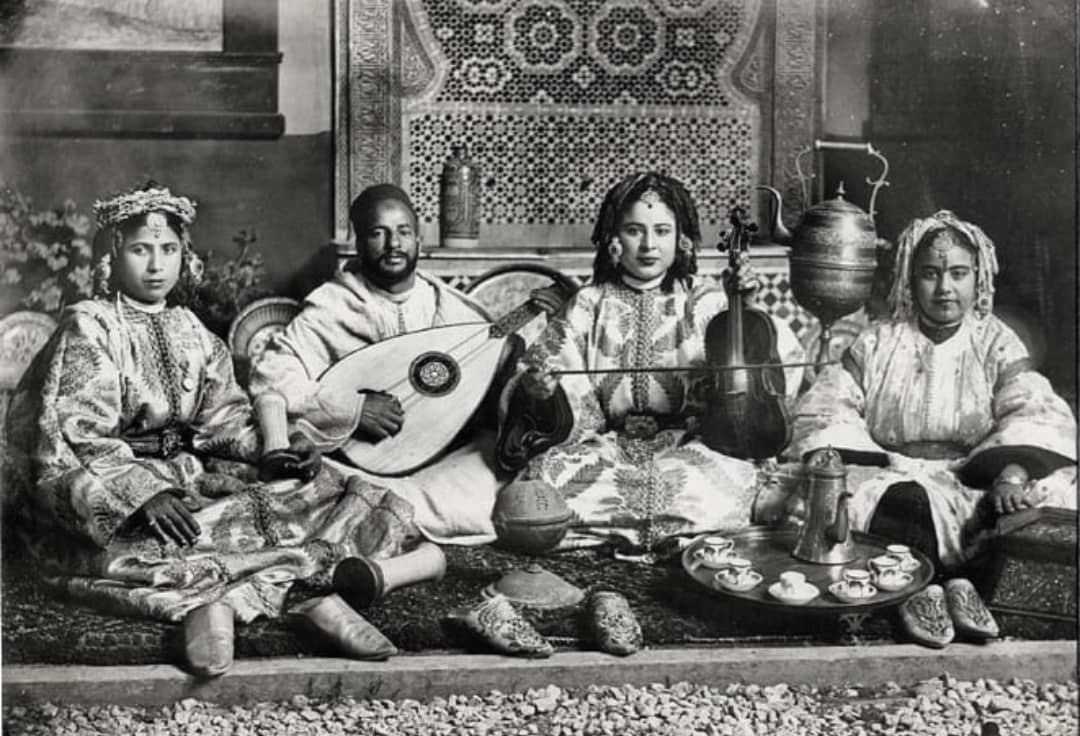
In Moroccan Arabic, “aloua” can refer to elevated ground or a hill. Within the song, however, it takes on additional meanings connected to homeland, ancestry, and identity.
The area’s spiritual reputation comes partly from its association with religious figures whose shrines became important landmarks in local memory.
Among them are Sidi M’hamed El Bahloul and Sidi Hajjaj, figures whose names appear in discussions of the region’s oral traditions.
The song celebrates these spiritual personalities alongside the land, its inhabitants, and their history.
Its words preserve a relationship between geography and spirituality that remains important in Moroccan folk culture.
Why are visitors told not to speak?
The song’s warning sounds particularly strange when separated from its original cultural setting.
Yet the prohibition is not necessarily a literal demand for complete silence.
One interpretation connects it to the etiquette of approaching spiritually significant places.
Visitors are encouraged to enter respectfully, avoid harmful speech, and recognize the dignity of the people and religious figures associated with the area.
Other verses refer to purification and proper conduct, reinforcing the idea that reaching L’Aloua involves more than simply arriving at a geographical destination.
Silence, in this reading, represents humility rather than fear.
Another interpretation connects the warning to the historical reputation of the region and the need for outsiders to approach its inhabitants respectfully.
The poetry also celebrates the courage of local horsemen and the protection of the land.
These explanations are not mutually exclusive. Folk traditions often preserve several meanings at once, particularly when songs travel between communities over generations.
What sounds like an ominous warning today may originally have been a lesson about respect, restraint, and knowing how to behave in unfamiliar territory.
The Sufi mystery behind the song
L’Aloua’s deeper history remains a subject of debate.
Researcher Abdelrahim Cherrad has argued that the composition may have originated as a Sufi poem connected to Sidi M’hamed El Bahloul, a spiritual figure he associates with the 17th century.
According to his interpretation, the original text underwent substantial changes as singers and communities adapted it over time.
He also questions whether L’Aloua should originally be classified as aita, a traditional Moroccan form of sung poetry, or understood primarily as a spiritual composition.
That distinction matters because the song now exists in several overlapping traditions.
Its spiritual vocabulary connects it to religious devotion, while its musical performance places it within the broader world of Moroccan rural folk music.
The exact authorship and original wording remain disputed, making it difficult to establish a definitive version of the composition.
What survives is an oral tradition shaped by generations of performers rather than a single, unchanged historical document.
Why do some people enter a trance when L’Aloua plays?
Perhaps the strangest aspect of L’Aloua’s reputation concerns what happens when musicians perform it.
Accounts from Moroccan celebrations describe listeners becoming intensely emotional, dancing uncontrollably, or appearing to enter trance-like states.
Some traditional interpretations connect these experiences with spirits or jinn.
Others associate them with “l’hal,” a term used in Moroccan musical and spiritual contexts to describe an altered emotional or trance-like state.
Similar experiences are associated with certain forms of Gnawa music and other Moroccan ritual performance traditions.
However, these accounts do not establish that the song possesses supernatural powers or that listening to it necessarily produces a trance.
Music, repetition, rhythmic intensity, emotional expectations, and the atmosphere of collective performance can all influence how people experience a musical gathering.
The supernatural explanations belong to the realm of cultural belief rather than scientifically established fact.
Still, the association with trance has contributed to the song’s reputation as something more mysterious than ordinary entertainment.
A song that refuses to disappear
Over time, L’Aloua became closely associated with traditional performers such as the late Ahmed Ould Kaddour, whose interpretations helped preserve its place in Moroccan musical culture.
The song has also continued to evolve through contemporary arrangements and performances.
Modern interpretations have introduced its melodies and lyrics to younger audiences, sometimes removing them from the rural and spiritual settings in which earlier generations encountered them.
Yet the central warning survives.
For some listeners, it evokes childhood memories of weddings and family celebrations. For others, it carries religious significance or recalls the landscape and communities of Chaouia.
And for those unfamiliar with its history, it remains an intriguing piece of Moroccan folklore with a seemingly unsettling message.
Perhaps the most interesting thing about L’Aloua is that its warning has become more mysterious as the context surrounding it has faded.
The song does not offer a single, universally accepted explanation for its demand for silence.
Instead, it preserves several centuries of cultural memory, where respect for sacred places, regional pride, spirituality, and music meet.
What first sounds like a prohibition against speaking may ultimately be an invitation to understand where you are before opening your mouth.