Award-Winning AI Projects Take the Spotlight in Dakhla

Through this competition, AI innovative solutions would be better developed in Morocco.
Digital Sovereignty: Rabat Charts Course Toward ‘AI Made in Morocco’

Morocco has reaffirmed its ambition to place artificial intelligence at the core of digital transformation, public-sector performance, and South–South cooperation.
Certidox Launches in Morocco to Reinforce Digital Trust

A new partnership is betting on trust as the next pillar of Morocco’s digital shift.
Moroccan Digital Agency Rhillane Marketing Digital Expands to Dubai

Rhillane Marketing Digital (RMD), a Morocco-born agency specializing in data-driven performance marketing, has opened a new office in Dubai, adding a third hub to its footprint after Tangier and California.
The first Artist to recreate Mona Lisa with 100 iPhone replicas

This British artist has done something unexpected with our famous Mona Lisa
Free Fire Celebrates 8th Anniversary, Teams Up With Netflix’s Squid Game

This year, Free Fire just blew out eight candles — and who strutted into the room, decked out in a red jumpsuit and holding a creepy doll?
Inside the 15 Biggest Announcements from Google I/O 2025
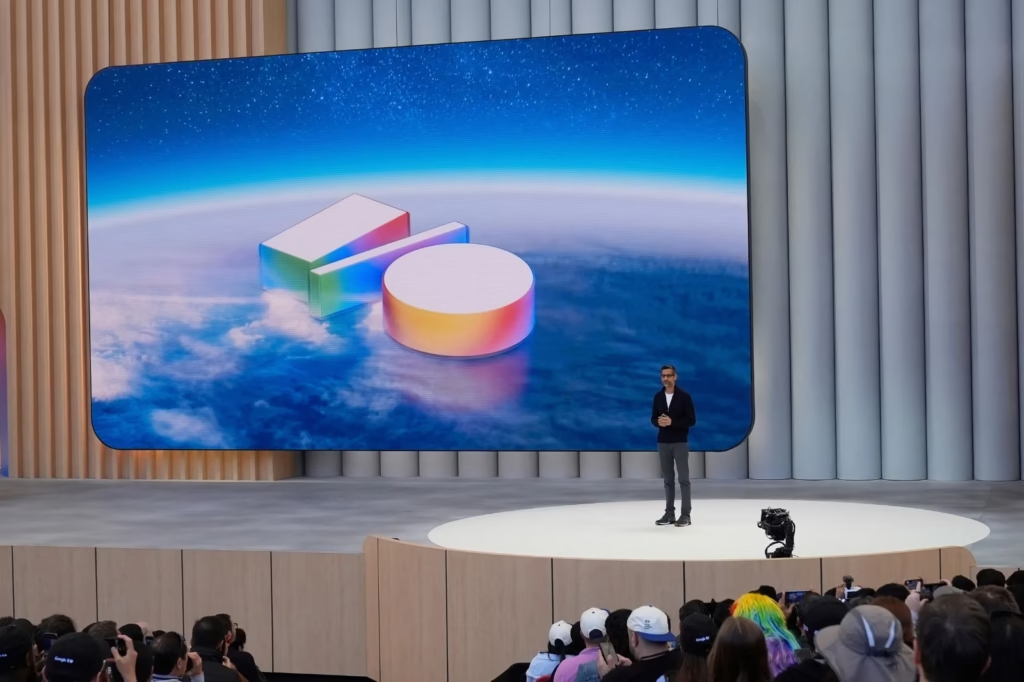
If you blinked during Google I/O 2025, you probably missed something big. Fez – This year’s keynote in the Google announcements was, unsurprisingly, a full-on AI extravaganza. But it wasn’t just more of the same, Google dropped major updates across Search, Chrome, Gmail, and even revealed new tools that flirt with the future of filmmaking, 3D video calls, and smart glasses. Here’s your smart, streamlined roundup of what actually matters. AI Mode is going mainstream Google’s AI Mode, powered by Gemini, is finally rolling out to all users in the U.S. You’ll now be able to search the web through the chatbot interface, and starting this summer, you’ll get deep search options, data-driven charts for finance and sports, and shopping tools built directly into the experience. Project Starline evolves into Google Beam Remember that futuristic 3D video chat booth? It’s now called Google Beam and is being built into HP-branded hardware. Think light field display, six cameras, and a 3D version of whoever you’re talking to. Deloitte and Duolingo are already lining up to bring it into their offices. Imagen 4 and Veo 3 are here Imagen 4 is better at generating images with text and now offers new format options. Veo 3, Google’s video model, takes it up a notch by producing video with sound. Meanwhile, Veo 2 adds object removal and camera control, yes, like a director’s toolkit for AI. Flow, Google’s AI filmmaking app Google introduced Flow, a tool that uses Imagen, Veo, and Gemini to create 8-second video clips from a simple text prompt. You can then piece together your own AI mini-movie. Gemini 2.5 gets a brain boost With Deep Think mode, Gemini now handles complex logic: math, coding, and more, by considering multiple solutions before answering. Think of it as your overachieving study buddy. Chrome is getting Gemini baked in Starting May 21, Chrome users with Gemini Pro or Ultra subscriptions can use the Gemini button to summarize pages, answer questions, and even work across tabs. Multi-tab navigation is coming soon. New Gemini subscription tier: AI Ultra The Ultra tier unlocks access to Google’s top-tier AI models, plus perks like early access to Flow, NotebookLM, and even Project Mariner, which can complete up to 10 tasks for you, simultaneously. Project Astra just got more powerful Google’s AI assistant can now observe through your camera and talk to you in real time. Search Live builds on this, letting you literally show Google something and chat about it as it sees it. Xreal and Google’s Project Aura smart glasses Smart glasses are back. Google is partnering with Xreal, Samsung, Warby Parker, and more on Android XR-based specs with Gemini integration and voice interaction. Gmail’s smart replies are getting personal AI will soon craft email replies using information from your inbox and Drive, and match the tone of whoever you’re writing to. Formal for your boss, casual for your friend. Real-time translation in Google Meet Starting with English and Spanish, Google Meet can now translate your speech into someone else’s language in near real-time. It’s still in beta but seriously impressive. AI-powered shopping is coming Upload a full-length pic of yourself and see how clothes would look on you. Coming soon: agentic checkout, where AI can buy things for you. Stitch: AI-generated app interfaces Stitch lets you describe an app layout, upload sketches, and boom, you’ve got a working UI prototype, all generated by AI. Currently in Google Labs. Chrome will auto-fix weak passwords If your password is compromised, Chrome will soon offer to create and apply a strong one automatically, with your permission, of course. Gemini Flash goes public Google’s lighter, faster Gemini Flash model is now available to everyone, bringing a speedier AI experience to both casual users and developers. This year’s Google I/O wasn’t just another AI flex, it’s clear the company is actively rebuilding the way we search, create, work, and communicate. Ready or not, the AI future is arriving… and it’s coming to your browser, your camera, your inbox, and maybe even your face. Read also: Hailey Bieber’s Rhode Is Joining the e.l.f. Beauty Family in a $1B Deal
Apple’s New CarPlay Ultra Is Here and Aston Martin Is First in Line
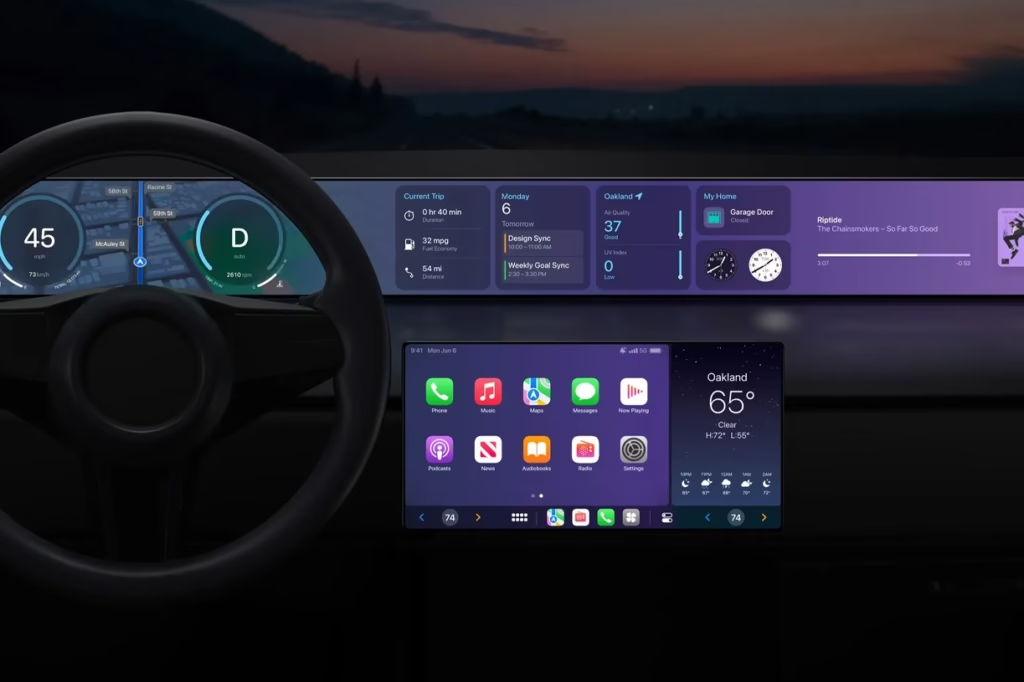
Your car’s dashboard just got a serious Apple upgrade. Fez– Apple has officially unveiled “CarPlay Ultra”, the long-promised upgrade to its in-car experience, and it’s not just a facelift. First announced in 2022, this sleek new system is finally hitting the roads, starting with Aston Martin’s new lineup. Yep, the same folks who make James Bond’s favorite wheels. And they’re not alone; Hyundai, Kia, and Genesis have all signed up for the next-gen CarPlay revolution. So, what’s actually new here? CarPlay Ultra isn’t just your usual Apple-on-wheels situation. It goes way beyond mirroring your phone. Instead of staying politely tucked away in the infotainment screen like its predecessor, this version takes over the entire car’s digital universe. Think: your speedometer, fuel gauge, climate control, radio, performance settings, all wrapped in that clean, buttery Apple aesthetic. That means everything you see on-screen (yes, even the tachometer) now speaks fluent iOS. It’s like Apple moved into your car and redecorated everything. The look is streamlined, stylish, and instantly familiar if you’ve ever used an iPhone or Mac. But this isn’t a one-size-fits-all situation. Apple’s giving carmakers a toolkit to co-design the look and feel of the interface. The result? Bespoke CarPlay themes that blend Apple’s design DNA with each automaker’s own vibe. Aston Martin’s version, for example, won’t look like a Kia’s. And you, the driver, get even more say; you can tweak the wallpaper and color schemes to match your mood or your outfit (no judgment). Here’s the real kicker: CarPlay Ultra doesn’t just display things. It runs things. You can adjust your seat heaters, blast your playlist, fiddle with your suspension settings, or ask Siri to cool the cabin, all without exiting the Apple experience. Physical buttons, touchscreen, voice, it’s all fair game. Widgets also get a glow-up. They’re now designed to fit seamlessly into any part of the car’s display, so you can glance at maps, music, or messages while keeping your eyes on the road. It’s Apple’s world now; your car’s just living in it. To jump aboard, you’ll need an iPhone 12 or newer running iOS 18.5 or higher. The rollout starts with Aston Martin’s new DB12, DBX, Vantage, and Vanquish models in the U.S. and Canada. If you already own one of those equipped with the next-gen infotainment that launched in 2023, a software update is headed your way soon. And yes, this is just the beginning. CarPlay Ultra is set to go global within the next year. Read also: Vanessa Bruno’s Summer 2025 Collection Draws Inspiration from the Soul of Marrakech
Bitcoin Reclaims Its $100K Throne

One minute, you’re questioning every financial decision you’ve ever made. The next, Bitcoin is back on top, and suddenly your crypto wallet feels like it’s wearing couture. Marrakech – Yes, Bitcoin is back — and not just “back,” but strutting above the $100,000 mark in full confidence, like it never dropped to $74K just a few weeks ago. On Thursday, it hit its highest level since February, clocking in at $101,679.85, according to Coin Metrics. The comeback was so quick, it practically needed a wind machine and a runway. So, what triggered this fabulous glow-up? It all started when former President Donald Trump, ever the showman, teased a trade announcement between the US .S. and the UK. .K. Like any good cliffhanger, Bitcoin took the bait — and then took off. As Trump laid out the outline of the agreement Thursday morning, the crypto world responded like it had just been handed the final rose. “Bitcoin has not only reclaimed $100,000 for the first time in three months but it’s also reaffirmed its status as the ultimate bouncebackability asset as the prospects for US U.S. trade deals brighten,” said Antoni Trenchev, co-founder of crypto exchange Nexo. Translation? Bitcoin is the ex that always comes back hotter — and richer. Investors, apparently, are growing weary of relying on traditional “safe havens” like the US.S. dollar. Between geopolitical tensions and a Federal Reserve that’s in no rush to cut rates, Bitcoin suddenly feels like the friend who always keeps their cool in a crisis — and has the receipts to prove it. “Bitcoin remains buttressed by a pro-crypto Trump administration along with hungry buying from spot-ETF investors … while its outperformance versus US equity benchmarks in 2025 highlights its resilience and safe haven status,” Trenchev added. And resilience really is the key word here. Because while Wall Street’s been dealing with mixed signals and emotional whiplash, Bitcoin has just been doing what it does best — bouncing back. “Expect bitcoin’s resilience to be tested further in an uncertain and volatile global macro and geopolitical environment,” Trenchev said. “Look no further than rising tensions between India and Pakistan, which risk escalating into a full blown conflict. Meanwhile we have a Federal Reserve in no rush to cut rates and equally concerned about unemployment and inflation.” Of course, Bitcoin isn’t dancing in the moonlight just yet. It’s still shy of its January high of around $109,350, and according to Trenchev, it could linger in its post-election trading range of $70K to $109K for a while longer. Think of it as a highly promising situationship — full of sparks, but still figuring things out. Still, as Trenchev puts it, “the retaking of $100,000 must go down as one of bitcoin’s more formidable feats and is a reminder that buying peak fear — just last month bitcoin was languishing around $74,000 — can be exceptionally lucrative.” So, if Bitcoin were a person, right now it would be sipping champagne, wearing vintage Prada, and winking at everyone who doubted it. And we? We’re just along for the ride — hopefully with a little crypto in our bags and a whole lot of curiosity about what’s next.
Microsoft Is Officially Retiring Skype on May 5
Skype is officially logging off, for good. Fez – After more than two decades of video calls, voice chats, and those iconic “ping” sounds, Microsoft is saying goodbye to Skype, yes, for real this time. The company has officially announced that it will shut down the service on May 5, 2025, marking the end of an era that started in the early 2000s and really took off when Microsoft acquired Skype in 2011 for a cool $8.5 billion. So, why is Skype being sunsetted now? According to Microsoft, it’s all about “simplifying our consumer communication offerings to better adapt to customer needs.” In plain English: they’re streamlining things, and Skype didn’t make the cut. It’s a bittersweet move for many. Skype was the original Zoom – the app for connecting across continents, used for everything from international job interviews to awkward long-distance dates. With its free voice and HD video calls, chat features, and pretty decent reliability (at least most of the time), Skype carved out a special place in internet history. So naturally, users, past and present, are feeling the nostalgia kick in. But don’t panic: your chats, contacts, and call credits aren’t disappearing into the void. Microsoft is folding Skype’s key features into its newer darling, Microsoft Teams. Think of it as Skype’s grown-up cousin who wears a blazer and actually reads the meeting agenda. Here’s how the transition will work: If you log into the free version of Teams using your Skype credentials, all your contacts and conversations will be waiting for you, no need to start from scratch. Even better, if you still have Skype credit or an active subscription, you can keep using it through Teams’ dial pad or via Skype on the web. The decision makes sense from a tech evolution perspective. Teams has matured far beyond its business-only roots and now offers nearly everything Skype did, with a few extra bells and whistles. Microsoft is clearly betting on one unified platform to carry its communications ecosystem into the future, and it’s not looking back. So yes, it’s the end of Skype as we know it, but in true tech fashion, it’s also a rebrand, a merger, and a gentle nudge toward something new. If nothing else, it’s a good excuse to finally clear those dusty old Skype contacts you haven’t messaged since 2013. RIP Skype, you were weird, glitchy, and oddly comforting. And now, you’re Teams. Read also: Meta Launches New AI App to Join Its Expanding Tech Empire