China Launches World’s First 10G Internet Network and It’s Insanely Fast
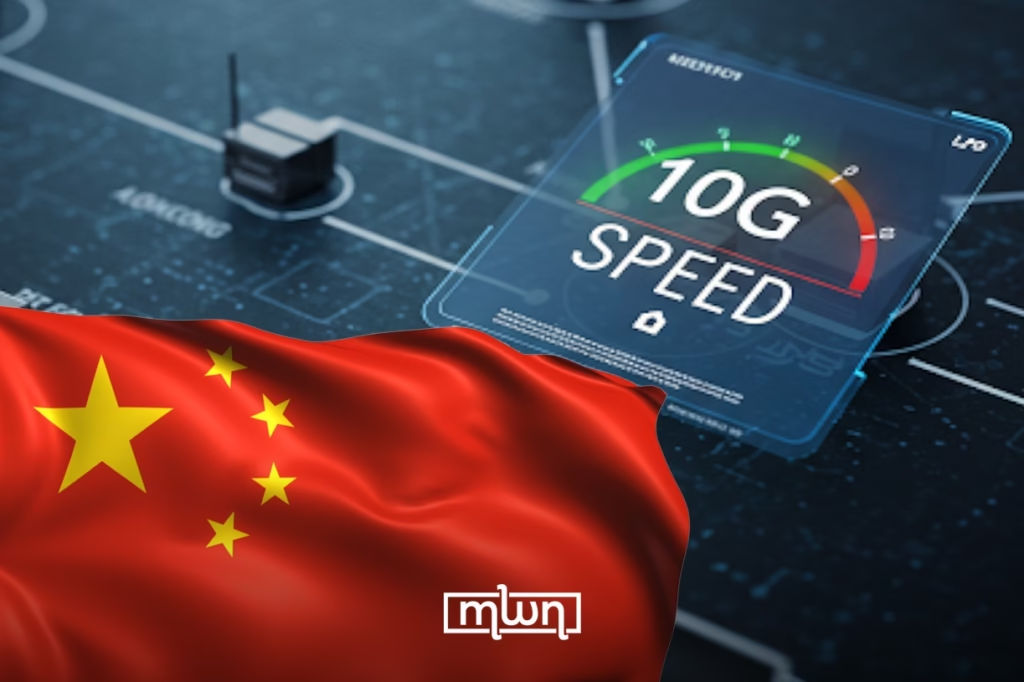
While the world blinked, a new digital era was born in a small corner of Hebei. Fez – While most of the world is still fumbling around with 5G and celebrating the occasional four-bar miracle, China has gone full speed ahead literally. In a history-making move, the country has launched the world’s first commercial 10G internet network, and the numbers are almost too good to be true. We’re talking about download speeds nearing 9,834 Mbps, uploads hitting over 1,000 Mbps, and latency so low it practically doesn’t exist (just 3 milliseconds). Yes, you read that right. This is no lab test fantasy; it’s a real-world rollout that just set a brand-new world record. The network is live in Sunan County, nestled in China’s Hebei Province, thanks to a power duo: tech titan Huawei and state-owned telecom operator China Unicom. Together, they’ve taken what’s usually reserved for experimental labs and turned it into a tangible, working infrastructure that makes even today’s best Wi-Fi feel like dial-up. Now, let’s geek out for a second (but in a cool way). This isn’t just fast-for-the-sake-of-fast internet. It’s powered by 50G Passive Optical Network (PON) technology, a fancy term for a very clever system that supercharges existing fiber-optic cables without ripping up streets and starting from scratch. Read also: Poland Launches ‘Chopin Season in Morocco’ with a Concert in Rabat This May Think of it as putting a Formula 1 engine in your everyday sedan. Same car, wildly different experience. The implications? Massive. With speeds like this, we’re talking about instant HD movie downloads (plural), ultra-smooth VR and AR experiences, next-level remote learning, and real-time telemedicine that actually feels real-time. And for industries relying on cloud computing, big data, or smart city tech, this could be a game changer. Interestingly, this lightning-fast network isn’t just about bragging rights (though let’s be honest, they’ve earned them). It’s also part of a broader national strategy. China is investing heavily in “smart” infrastructure, and this 10G leap is a foundational piece of that vision. The network also now live in Xiong’an, a model smart city about 70 miles southwest of Beijing, which suggests this isn’t a one-off stunt, it’s a scalable blueprint for the future. While the rest of us are still rebooting our routers, China’s already living in 2030. The 10G era has officially begun, and the bar for global connectivity just got dramatically higher.
Are Transformers Just Robots in Disguise… or Is it Deeper than Action-Packed Mayhem?

There I was, two hours deep into Transformers, and it got me wondering is this really about us?
UAE Integrates AI into Lawmaking to Shape the Future of Governance
In a global first, the UAE is using AI not just to support laws, but to predict them. Fez – The United Arab Emirates is taking a groundbreaking step by officially integrating artificial intelligence into its lawmaking process. In a move that sets a new benchmark for innovation in governance, the UAE plans to use AI not only as a supportive tool but as an active player in predicting future legislative needs. This ambitious initiative aims to revolutionize how laws are created, moving beyond traditional reactive policymaking. Instead of waiting for societal changes or emerging challenges to force updates, the UAE’s AI systems are being developed to forecast legal requirements ahead of time, allowing for a more agile, forward-thinking legal framework. While governments around the world have been gradually incorporating AI into administrative tasks, from document drafting to regulatory analysis, the UAE’s strategy stands out for its scope and vision. It is among the first to position AI as a proactive engine for legislative development, not merely a backend assistant. Although the specific technologies and platforms the UAE will deploy have not yet been fully disclosed, it is expected that a combination of AI models will be used. These systems will likely analyze large datasets, detect evolving trends, and recommend potential updates to existing laws or the creation of new ones. The goal is to make the legislative process smarter, faster, and more responsive to the dynamic realities of modern society. Importantly, the UAE focuses on ensuring that human oversight will remain central to this process. Artificial intelligence will provide recommendations and predictions, but final decisions will stay firmly in human hands. By designing the system with this balance in mind, the UAE ensures that technological innovation enhances governance without replacing the critical human judgment that lawmaking demands. This move aligns with the UAE’s broader vision to be a leader in digital transformation and artificial intelligence across all sectors. It follows several major initiatives launched over the past few years to integrate AI into education, healthcare, infrastructure, and now, governance itself. By adopting AI at the legislative level, the UAE signals a future where governments can become more predictive, efficient, and adaptable, qualities increasingly necessary in a fast-changing world. It is a bold statement about the country’s commitment to staying ahead of the curve and using technology not just to serve society’s current needs, but to anticipate its future ones. As the project unfolds, the UAE will be closely watched by other nations eager to understand how artificial intelligence might transform the fundamental processes of governance in the years ahead. Read also: ElGrandeToto Makes History as First Moroccan Artist to Headline Souissi Stage at Mawazine Festival
NASA’s SPHEREx Telescope Just Snapped Its First Images
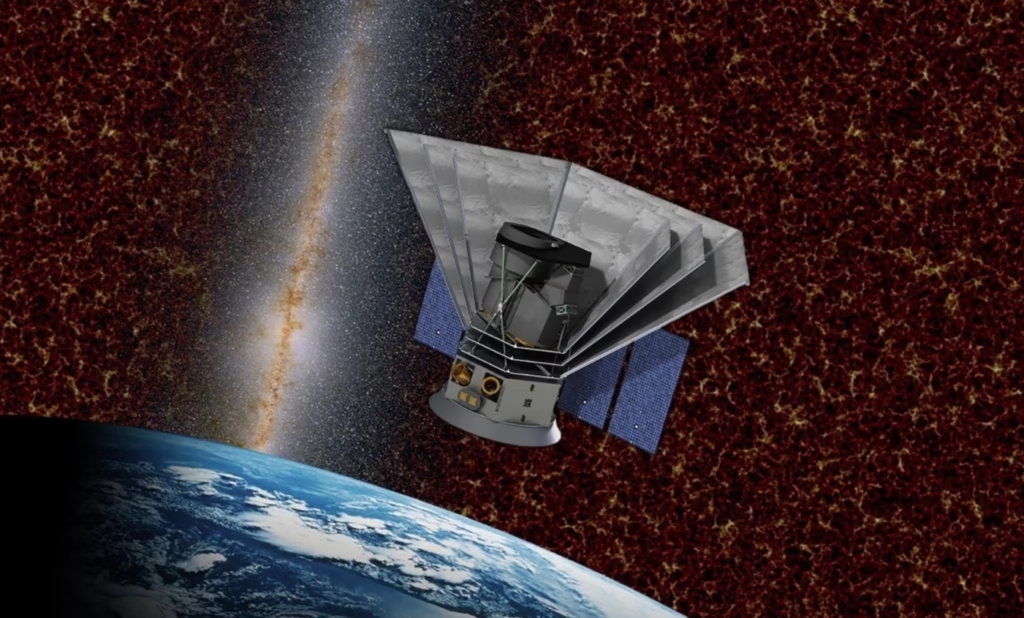
SPHEREx has opened its eyes to the universe, delivering its first images like never before Fez– The universe just got a little less mysterious, and a lot more photogenic. NASA’s brand-new SPHEREx space telescope has officially opened its eyes and shared its first-ever infrared images of deep space, marking the start of what’s shaping up to be a groundbreaking mission in cosmic cartography. Now, SPHEREx isn’t your typical stargazing telescope. It’s not just here to take pretty pictures of galaxies, it’s here to map the entire sky in spectral detail. Think of it as a cosmic historian-meets-chemist, aiming to uncover the secrets behind how galaxies form, where water begins its interstellar journey, and what’s hiding inside the dense clouds where stars and planets are born. What makes SPHEREx so special? The telescope can detect wavelengths between 0.75 and 5.0 microns, right in the sweet spot of the infrared spectrum. That’s a big deal because infrared light can sneak through cosmic dust clouds that usually block visible light. Imagine an X-ray, but for space: just like a broken arm gets revealed behind your skin, SPHEREx reveals the bones of the universe: galaxies, icy molecules, and star-forming nurseries hidden behind veils of dust. Over the next two years, SPHEREx will scan the sky four full times, gathering data from hundreds of millions of celestial objects. It’s basically doing the most detailed all-sky spectral survey in human history. Not bad for a new kid on the galactic block. SPHEREx is zooming in on some pretty big cosmic questions. One of its main goals? To trace the origin and journey of water. Yes, water. As in the stuff that makes up 60% of your body and 71% of Earth’s surface. Turns out, it might have been hitchhiking across galaxies long before Earth even existed. Scientists believe that icy dust grains in the spaces between stars (what they call “interstellar medium”) could be the very building blocks of water delivery systems. SPHEREx is going to analyze the chemistry of these cold clouds to figure out where water forms, how it travels, and whether it’s baked into planets from the start, or added later via crashing comets and asteroids. Basically, we’re talking about tracing the cosmic water cycle, and unlocking one of the biggest mysteries about life in the universe. After its launch, SPHEREx underwent a meticulous technical checkup at NASA’s Jet Propulsion Laboratory. One key milestone? Reaching a chilling -210°C, the precise operating temperature it needs to detect faint infrared signals. If it ran any warmer, the whole mission would risk failure. But good news: the first images show the optics are on point. The telescope’s lenses, installed before launch and now unchangeable, are working flawlessly. That’s a huge relief for the engineers who spent years designing and building this high-stakes instrument. What’s next? A 3D map of the entire universe By late April, SPHEREx will go fully operational, and the astronomical world is buzzing. The mission is expected to deliver the most accurate and expansive 3D map of the universe ever created. And it’s not just pretty, this map could completely reshape what we know about galaxy evolution, water’s interstellar journey, and the potential for life beyond Earth. In other words, space just got a whole lot more interesting. And this is only the beginning. Read also: 14th Edition of Les Théâtrales Brings Laughter and Thrills
These 3 Jobs Are Safe from AI – At Least for Now

Not all jobs are doomed, some are still out of AI’s league. Fez– Worried that AI is coming for your job? You’re not alone. With machines getting smarter by the minute, it’s easy to feel like no profession is safe. But according to Bill Gates, there are still a few careers where humans aren’t going anywhere, because robots, for all their processing power, just don’t have what it takes. Not yet, anyway. As artificial intelligence barrels into every industry from finance to filmmaking, people are right to ask: what’s left for us? While automation will likely reshape the way we work, Gates points to three specific fields that are still heavily reliant on human talent, intuition, and decision-making. So if you’re in one of these, take a deep breath — you might just be future-proof. Software developers Sure, AI can write lines of code. It can even debug basic problems. But it can’t dream up entire systems or creatively solve complex issues on its own. Skilled developers are still the ones steering the AI ship, designing, refining, and making judgment calls machines can’t. Gates sees AI as a tool for developers, not a replacement. It can assist, but it still needs its human overlords to function properly. Energy experts The energy sector is too nuanced, too strategic, and way too risky for AI to run alone. Whether it’s renewables, fossil fuels, or nuclear, energy decisions involve technical knowledge, regulatory navigation, and long-term planning, none of which can be fully automated. AI might help crunch numbers or forecast demand, but it’s not about to take over the control room. At least not without a human watching closely. Life science researchers In labs and research centers, AI is a powerful assistant, but it still can’t think outside the box. Discovering a new treatment or unlocking a scientific mystery requires leaps of logic, intuition, and a level of creative thinking no algorithm has mastered. Data analysis? Great. Radical breakthroughs? Still very much a human game. Gates believes that medical and biological innovation will remain driven by people, not programs. AI may be smart, but it’s not imaginative, strategic, or emotionally intelligent. Not yet, anyway. So if your job demands original thought, big-picture thinking, or human connection, you’ve still got the upper hand. For now. Read also: Where to Get a Luxury Wellness Experience Without the White Lotus Price Tag
The Future of Sound: Your Own Private Audio Bubble
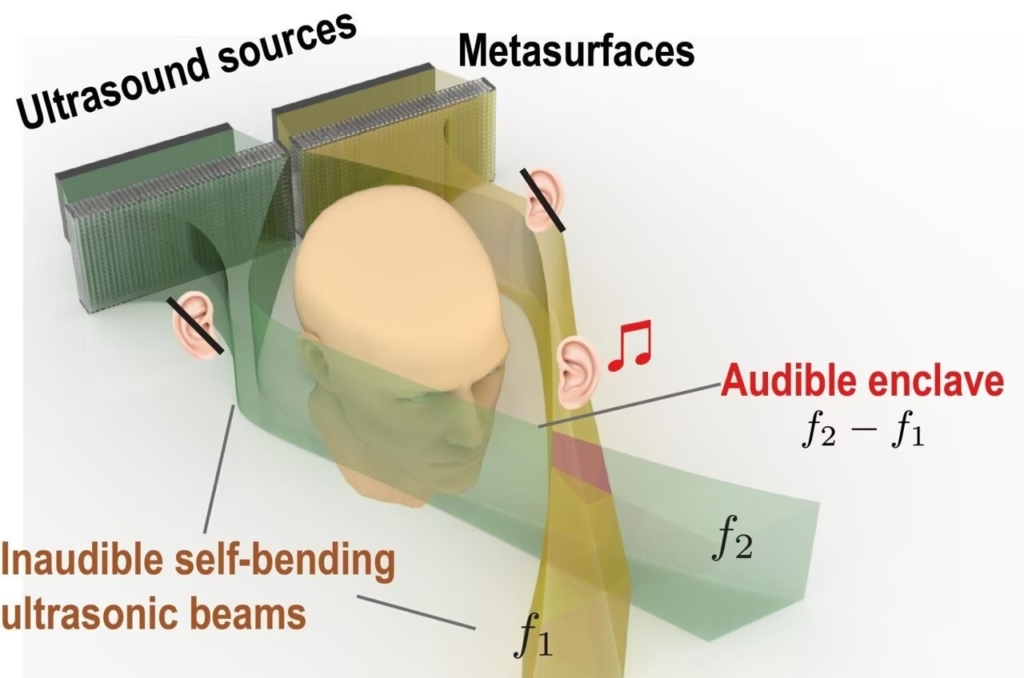
Goodbye, noise-canceling headphones; hello, personal sound bubbles. Fez– Imagine blasting your favorite playlist, tuning into an audiobook, or taking a confidential call, all in a public space, without disturbing a soul. Sounds like sci-fi, right? Well, the future of sound control is shaping up to make this a reality through something called audio enclaves, personalized sound zones that deliver audio directly to specific locations or individuals, leaving everyone else in blissful silence. Forget clunky headphones or awkwardly cupping your ear to hear better in noisy places. With audio enclaves, sound is delivered only where it’s needed, unlocking all kinds of possibilities: Museums could provide different audio guides to visitors simultaneously without a tangled mess of rented earpieces. Libraries could let students absorb audio lessons without shushing wars. Cars could ensure passengers jam out while the driver hears crisp, distraction-free navigation. Offices could host private meetings without the whole floor eavesdropping. City planners could create oases of quiet, reducing urban noise pollution. The road to making it happen Of course, we’re not quite there yet. Turning this dream into reality comes with a few speed bumps, like sound distortion and the fact that generating targeted audio takes a serious amount of energy. Scientists are still figuring out how to fine-tune the tech without draining the power grid. But make no mistake: this will be a game-changer. The way we experience sound is evolving, and one day soon, silence and sound will coexist in ways we never imagined. Audio enclaves are turning up the volume without turning up the noise. Read also: Vast Underground Structures Beneath Giza Pyramids